
Close Menu
    Facebook X (Twitter) Instagram
    SciTechDaily
    • Biology
    • Chemistry
    • Earth
    • Health
    • Physics
    • Science
    • Space
    • Technology
    Facebook X (Twitter) Pinterest YouTube RSS
    SciTechDaily
    Home»Space»Cause of Jupiter’s X-Ray Aurora Revealed – Mystery Has Puzzled Scientists for 40 Years
    Space

    Cause of Jupiter’s X-Ray Aurora Revealed – Mystery Has Puzzled Scientists for 40 Years

    By Chinese Academy of SciencesJuly 21, 2021No Comments3 Mins Read
    Facebook Twitter Pinterest Telegram LinkedIn WhatsApp Email Reddit
    Share
    Facebook Twitter LinkedIn Pinterest Telegram Email Reddit
    Jupiter’s Mysterious X-ray Auroras
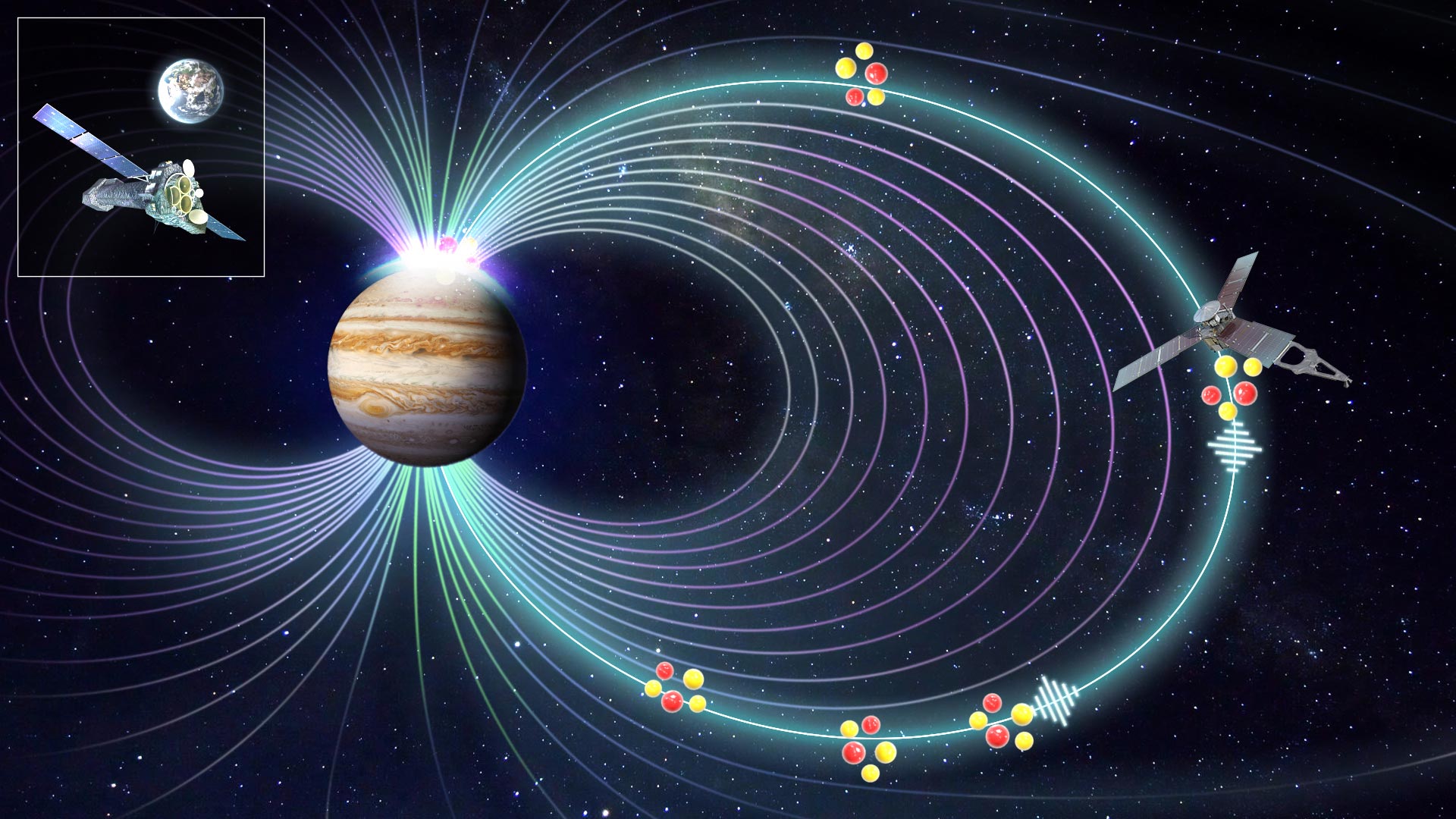
    NASA’s Juno Mission observed pulsating electromagnetic ion cyclotron waves in Jupiter’s dawn magnetosphere that periodically expel energetic heavy ions into the atmosphere, producing stunning X-ray pulsations as captured by ESA XMM-Newton. Credit: ESA/NASA/Yao/Dunn

    Researchers have traced Jupiter’s X-ray aurorae to volcanic ions from its moon Io that are energized in the planet’s magnetosphere and guided into the atmosphere by magnetic field lines.

    An international research team led by YAO Zhonghua from the Institute of Geology and Geophysics of the Chinese Academy of Sciences (IGGCAS) has explained the cause of Jupiter’s X-ray aurorae, a mystery that has puzzled scientists for 40 years.

    The findings were published in Science Advances on July 9, 2021.

    It is the first time planetary researchers have described the entire causality chain for Jupiter’s X-ray auroral flares. The mechanism in producing X-ray auroral flares at Jupiter may have potential applications in X-ray astronomy.

    The X-ray auroral spectra tell us these aurorae are produced by heavy ions with energies in the mega electron volt range. But how they are formed and why these ions enter Jupiter’s atmosphere was previously unknown.

    To understand the energetic processes associated with Jupiter’s polar emissions, researchers organized, over the last four years, a series of paradigm-shifting observation campaigns from Earth in tandem with in situ measurements by ESA’s flagship X-ray observatory, XMM-Newton, and NASA’s Juno spacecraft. These efforts included the most extensive X-ray campaign and the most extensive Hubble Space Telescope campaign ever conducted for Jupiter.

    Using these tools, the researchers were able to probe the physics behind the phenomenon and reveal the processes that lead planets to produce X-ray aurorae.

    Magnetosphere Chain Reaction

    “These are strikingly similar to the processes of producing ion aurorae on Earth, suggesting that ion aurorae share common mechanisms across planetary systems, despite temporal, spatial, and energetic scales varying by orders of magnitude,” said YAO Zhonghua, first author of the study.

    “What we see in the Juno data is this beautiful chain of events. We knew that the auroral ions are stored in the magnetosphere, originated from the volcanic activities of Jupiter’s moon Io. In the magnetosphere, now we see the magnetic compression happen, the electromagnetic ion cyclotron wave triggered, the ions, and then a pulse of ions traveling along the field line. A few minutes later, XMM sees a burst of X-rays,” said William Dunn from University College London, who co-led the study.

    It is noteworthy that Jupiter’s X-ray auroral flares are often correlated with ultraviolet auroral flares, which are the most common auroral form. Indeed, the study of the latter may benefit from the wealth of Hubble Space Telescope data acquired through this research. “The discovery of Jupiter’s X-ray processes may have implications for our understanding of stunning ultraviolet auroral flares,” said Denis Grodent from the University of Liege, a co-author of the study.

    For more on this discovery:

    • Scientists Solve 40-Year Mystery Over Jupiter’s Spectacularly Powerful X-ray Aurora
    • 40-Year Mystery Solved: Source of Jupiter’s Strange X-Ray Flares Uncovered

    Reference: “Revealing the source of Jupiter’s x-ray auroral flares” by Zhonghua Yao, William R. Dunn, Emma E. Woodfield, George Clark, Barry H. Mauk, Robert W. Ebert, Denis Grodent, Bertrand Bonfond, Dongxiao Pan, I. Jonathan Rae, Binbin Ni, Ruilong Guo, Graziella Branduardi-Raymont, Affelia D. Wibisono, Pedro Rodriguez, Stavros Kotsiaros, Jan-Uwe Ness, Frederic Allegrini, William S. Kurth, G. Randall Gladstone, Ralph Kraft, Ali H. Sulaiman, Harry Manners, Ravindra T. Desai and Scott J. Bolton, 9 July 2021, Science Advances.
    DOI: 10.1126/sciadv.abf0851

    Never miss a breakthrough: Join the SciTechDaily newsletter.
    Follow us on Google and Google News.

    Astronomy Astrophysics Aurora Chinese Academy of Sciences Juno Spacecraft Jupiter NASA Planets XMM-Newton
    Share. Facebook Twitter Pinterest LinkedIn Email Reddit

    Related Articles

    Incredible Webb Space Telescope Images of Jupiter Showcase Auroras, Hazes, Moons & Rings

    Ganymede Casts a Massive Shadow Across Jupiter in Spectacular New Image From NASA’s Juno Spacecraft

    40-Year Mystery Solved: Source of Jupiter’s Strange X-Ray Flares Uncovered

    Scientists Solve 40-Year Mystery Over Jupiter’s Spectacularly Powerful X-ray Aurora

    Strange New Auroral Feature Discovered on Jupiter

    NASA’s Juno Mission Expands Into the Future – To Explore Jupiter and Its Rings and Moons

    Cyclones at Jupiter’s North Pole Appear As Swirls of Striking Colors

    A Billion or More Jupiter-Like Worlds Could Be Orbiting Stars in the Milky Way

    Chandra Observations Show Solar Storms Trigger Jupiter’s ‘Northern Lights’

    Leave A Reply Cancel Reply

    • Facebook
    • Twitter
    • Pinterest
    • YouTube

    Don't Miss a Discovery

    Subscribe for the Latest in Science & Tech!

    Trending News

    Mezcal “Worm” in a Bottle Mystery: DNA Testing Reveals a Surprise

    New Research Reveals That Your Morning Coffee Activates an Ancient Longevity Switch

    This Is What Makes You Irresistible to Mosquitoes

    Shockingly Powerful Giant Octopuses Ruled the Seas 100 Million Years Ago

    Scientists Stunned by New Organic Molecules Found on Mars

    Rewriting Dinosaur Evolution: Scientists Unearth Remarkable 150-Million-Year-Old Stegosaur Skull

    Omega-3 Supplements Linked to Cognitive Decline in Surprising New Study

    First-of-Its-Kind Discovery: Homer’s Iliad Found Embedded in a 1,600-Year-Old Egyptian Mummy

    Follow SciTechDaily
    • Facebook
    • Twitter
    • YouTube
    • Pinterest
    • Newsletter
    • RSS
    SciTech News
    • Biology News
    • Chemistry News
    • Earth News
    • Health News
    • Physics News
    • Science News
    • Space News
    • Technology News
    Recent Posts
    • This New Chip Could Make GPUs Far More Efficient
    • This Tiny World in the Outer Solar System Should Be Airless, but It Has an Atmosphere
    • NASA’s Webb Space Telescope Reveals a Dark Airless Super-Earth That Looks Like Mercury
    • These Simple Daily Habits Can Quickly Improve Blood Pressure and Heart Risk Factors
    • A Common Nutrient May Play a Surprising Role in Anxiety
    Copyright © 1998 - 2026 SciTechDaily. All Rights Reserved.
    • Science News
    • About
    • Contact
    • Editorial Board
    • Privacy Policy
    • Terms of Use

    Type above and press Enter to search. Press Esc to cancel.