
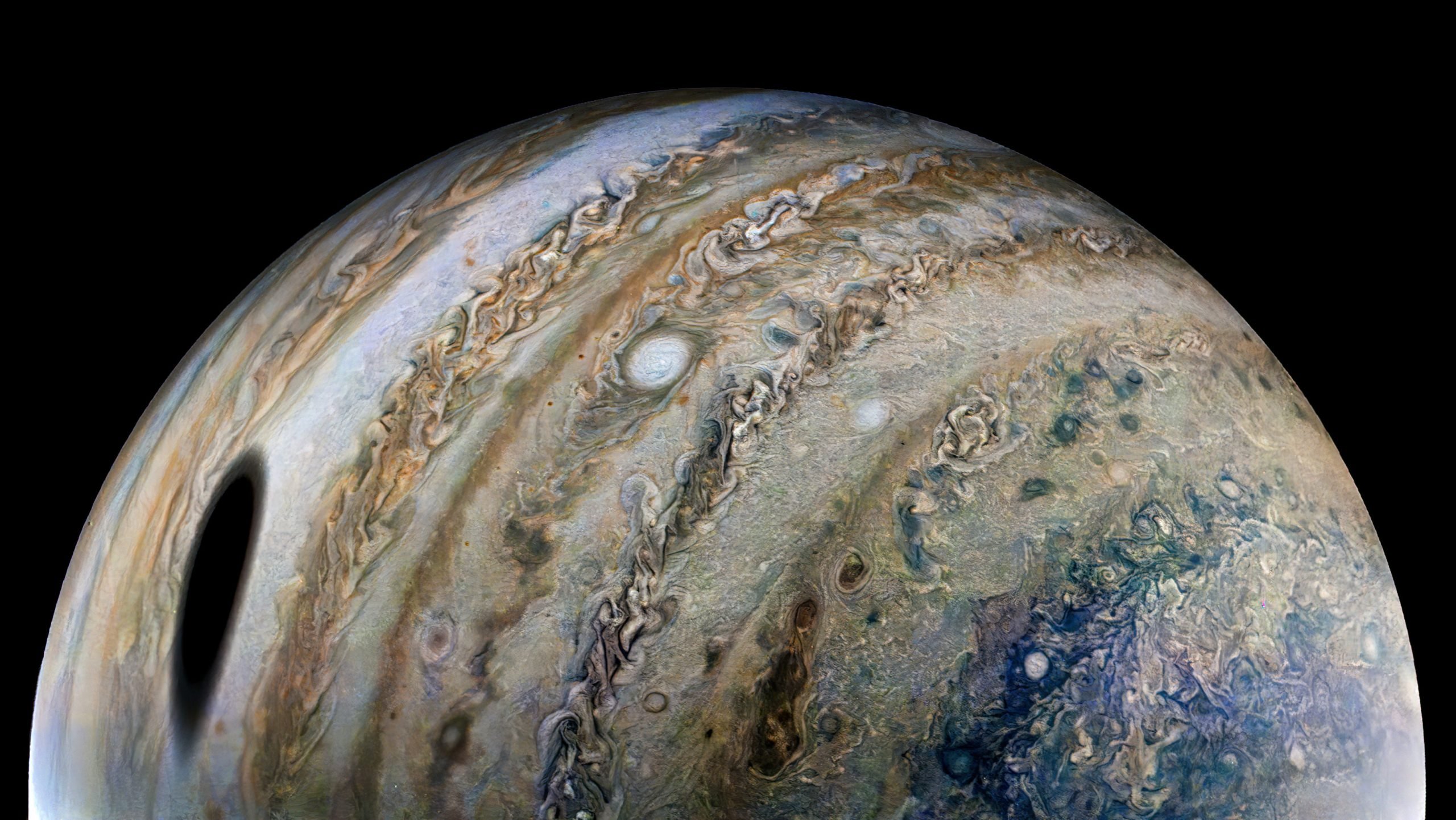
NASA’s Juno spacecraft captured this magnificent view of Jupiter during the mission’s 40th close pass by the giant planet on February 25, 2022. The large, dark shadow on the left side of the image was cast by Jupiter’s moon Ganymede.
Citizen scientist Thomas Thomopoulos created this enhanced-color image using raw data from the JunoCam instrument (Figure 1). At the time the raw image was taken, the Juno spacecraft was about 44,000 miles (71,000 kilometers) above Jupiter’s cloud tops, at a latitude of about 55 degrees south, and 15 times closer than Ganymede, which orbits about 666,000 miles (1.1 million kilometers) away from Jupiter.
An observer at Jupiter’s cloud tops within the oval shadow would experience a total eclipse of the Sun. Total eclipses are more common on Jupiter than Earth for several reasons. Jupiter has four major moons (Galilean satellites) that often pass between Jupiter and the Sun: in seven days, Ganymede transits once; Europa, twice; and Io, four times. And since Jupiter’s moons orbit in a plane close to Jupiter’s orbital plane, the moon shadows are often cast upon the planet.
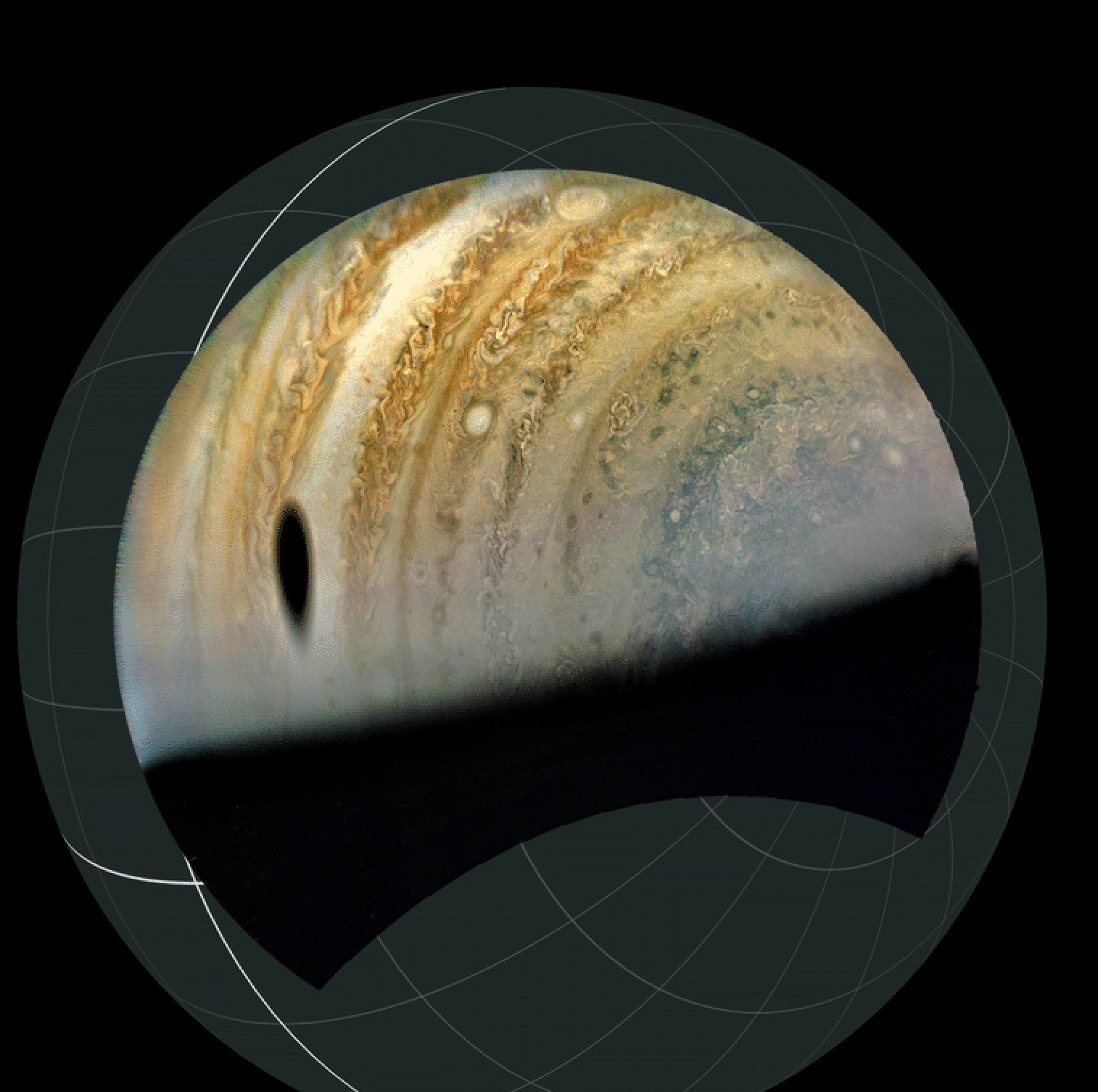
Credit: NASA/JPL-Caltech/SwRI/MSSS, Image processing by Brian Swift © CC BY
JunoCam captured this image from very close to Jupiter, making Ganymede’s shadow appear especially large. Figure 2, created by citizen scientist Brian Swift using JunoCam data, illustrates the approximate geometry of the visible area, projected onto a globe of Jupiter.
JunoCam’s raw images are available for the public to peruse and process into image products at https://missionjuno.swri.edu/junocam/processing.
Jupiter is the largest planet in the Solar System and the fifth planet from the Sun. It is a gas giant with a mass that is more than two and a half times that of all the other planets in the Solar System combined, but is only about one-thousandth the mass of the Sun. Jupiter, behind the Moon and Venus, is the third brightest natural object in the Earth’s night sky, and it has been noticed since prehistoric times. It was named after Jupiter, the Roman god and king of the gods.
Ganymede, a satellite of the planet Jupiter, is the largest and most massive of the Solar System’s moons. It is the ninth-biggest object in the Solar System (including the Sun) and the largest without a significant atmosphere. It has a diameter of 5,268 kilometers (3,273 miles), making it 26 percent larger by volume than Mercury, but it is only 45 percent as massive.
Never miss a breakthrough: Join the SciTechDaily newsletter.
Follow us on Google and Google News.
11 Comments
Interesting.
As far as I know Jupiter is a Gaseous Giant Planet. Sunlight falling on it directly probably passes right through like Neutrinos.
So the Satellites become important. The many satellites of Jupiter server multiple Purpose. It casts a Shadow on the Gaseous Giant (Shadow = Reflected Darkness ) so that the visibility of the Giant Gaseous Planet is enhanced. Darkness plus Brightness along with contrast enhances visibility.
Would be interesting to see the opposite effect on Saturn and its rings and its many moons. Much more complexity involved.
Ever wondered why Satellites revolve around the Planets ? Are they designed to protect the planets from stray , runaway asteroids and such?
Gravity probably place a role. The Forces of Gravity probably vary depending on the reaction to the approaching body. I suspect gravitational forces can be used to attract as well as repel other bodies just like Magnetic Forces with North and South Poles.
Like repels and unlike attracts. Probably the secret to creating Tractor Beams!
Views expressed are personal and not binding on anyone.
Were you high when you wrote this?
If so, I want some of his stuff, it seems GROOVY
High on cockroach spray, The cores of Jupiter and Saturn comprise chiefly metallic hydrogen.
Congratulations on “least self-explanatory illustration” award for Figure 2. What is this supposed to be telling us?
Dude, what part of “This is a section of Jupiter we photographed laid over a Jupiter-sized globe and the photo includes a shadow Ganymede was casting” don’t you get? You did read the article, right? You can read, right?
Juno’s orbit brought it close enough to Jupiter that it couldn’t see an entire hemisphere of the planet (similar to the view of Earth from the ISS). So, they mapped the portion of the hemisphere it could see onto a Jupiter-sized globe to give you a sense of how much of the planet it was seeing at once when the photo was taken. It’s easy to see how someone might misinterpret the original photo as showing an entire hemisphere, in which case Ganymede’s shadow would appear much larger relative to the planet than it really is.
Uh..since when did shadows become “Massive”? It’s a shadow..
So, when someone says they have a “massive headache,” do you also interpret that literally?
In response to Sekar… Jupiter’s clouds are thought to be about 30 miles (50 km) thick. Below this there is a 13,000 mile (21,000 km) thick layer of hydrogen and helium which changes from gas to liquid as the depth and pressure increase. Beneath the liquid hydrogen layer is a 25,000 mile (40,000 km) deep sea of liquid metallic hydrogen. the Big Red Spot extends over 500 miles above the main visible cloud layers surrounding it, and extends below the cloud layer as much as 200 miles. There is a not chance for sunlight to penetrate to any depth through the that make up of thick atmosphere.
Nerds!!!