
Close Menu
    Facebook X (Twitter) Instagram
    SciTechDaily
    • Biology
    • Chemistry
    • Earth
    • Health
    • Physics
    • Science
    • Space
    • Technology
    Facebook X (Twitter) Pinterest YouTube RSS
    SciTechDaily
    Home»Space»Incredible Jupiter Images from Juno, Shadow Jumping, and a New Cyclone Discovery
    Space

    Incredible Jupiter Images from Juno, Shadow Jumping, and a New Cyclone Discovery

    By NASA's Jet Propulsion LaboratoryDecember 18, 20192 Comments10 Mins Read
    Facebook Twitter Pinterest Telegram LinkedIn WhatsApp Email Reddit
    Share
    Facebook Twitter LinkedIn Pinterest Telegram Email Reddit
    Jupiter South Pole Infrared Image
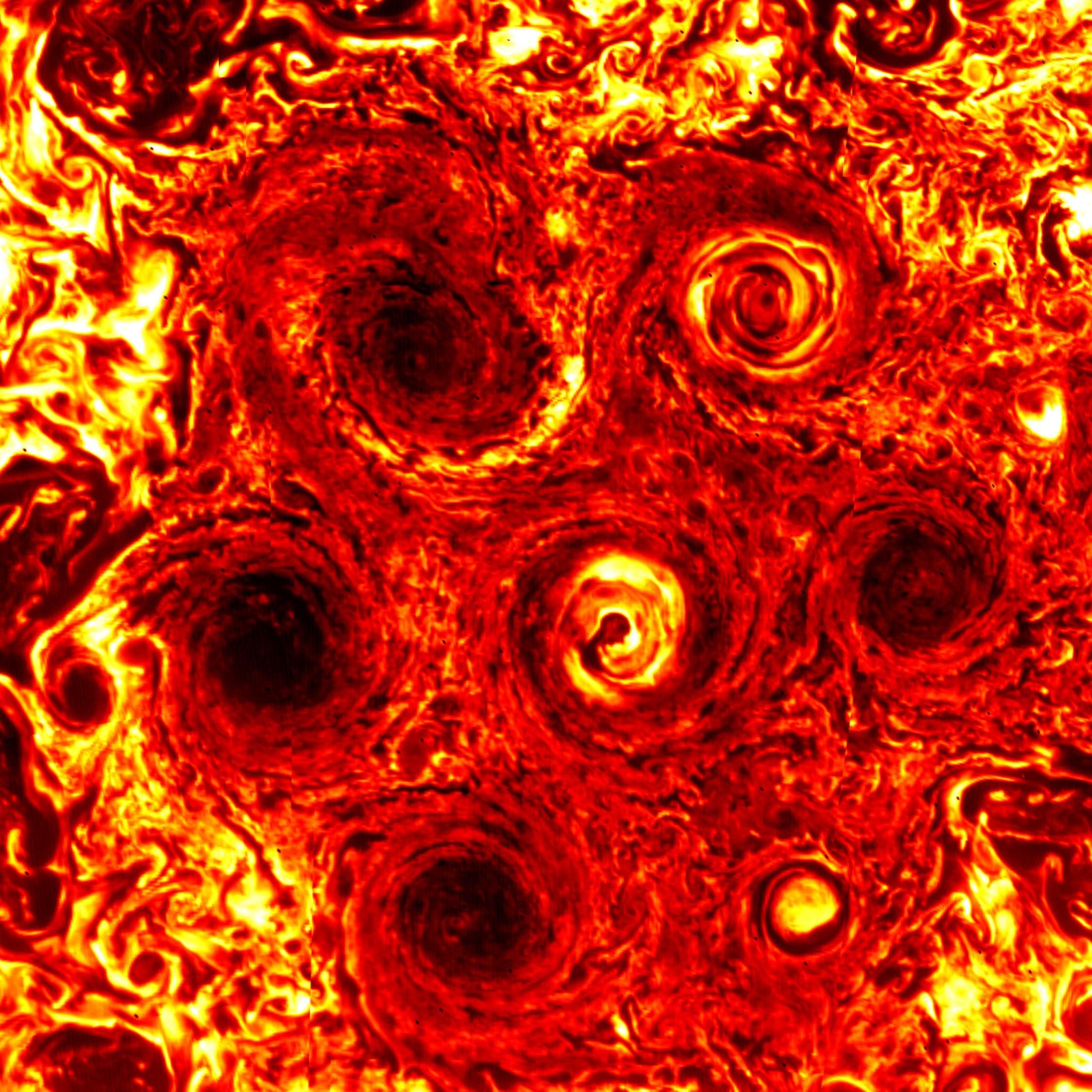
    A new, smaller cyclone can be seen at the lower right of this infrared image of Jupiter’s south pole taken on November 4, 2019, during the 23rd science pass of the planet by NASA’s Juno spacecraft. Credit: NASA/JPL-Caltech/SwRI/ASI/INAF/JIRAM

    Jupiter’s south pole has a new cyclone. The discovery of the massive Jovian tempest occurred on November 3, 2019, during the most recent data-gathering flyby of Jupiter by NASA’s Juno spacecraft. It was the 22nd flyby during which the solar-powered spacecraft collected science data on the gas giant, soaring only 2,175 miles (3,500 kilometers) above its cloud tops. The flyby also marked a victory for the mission team, whose innovative measures kept the solar-powered spacecraft clear of what could have been a mission-ending eclipse.
    Jupiter South Pole Infrared Image Annotated
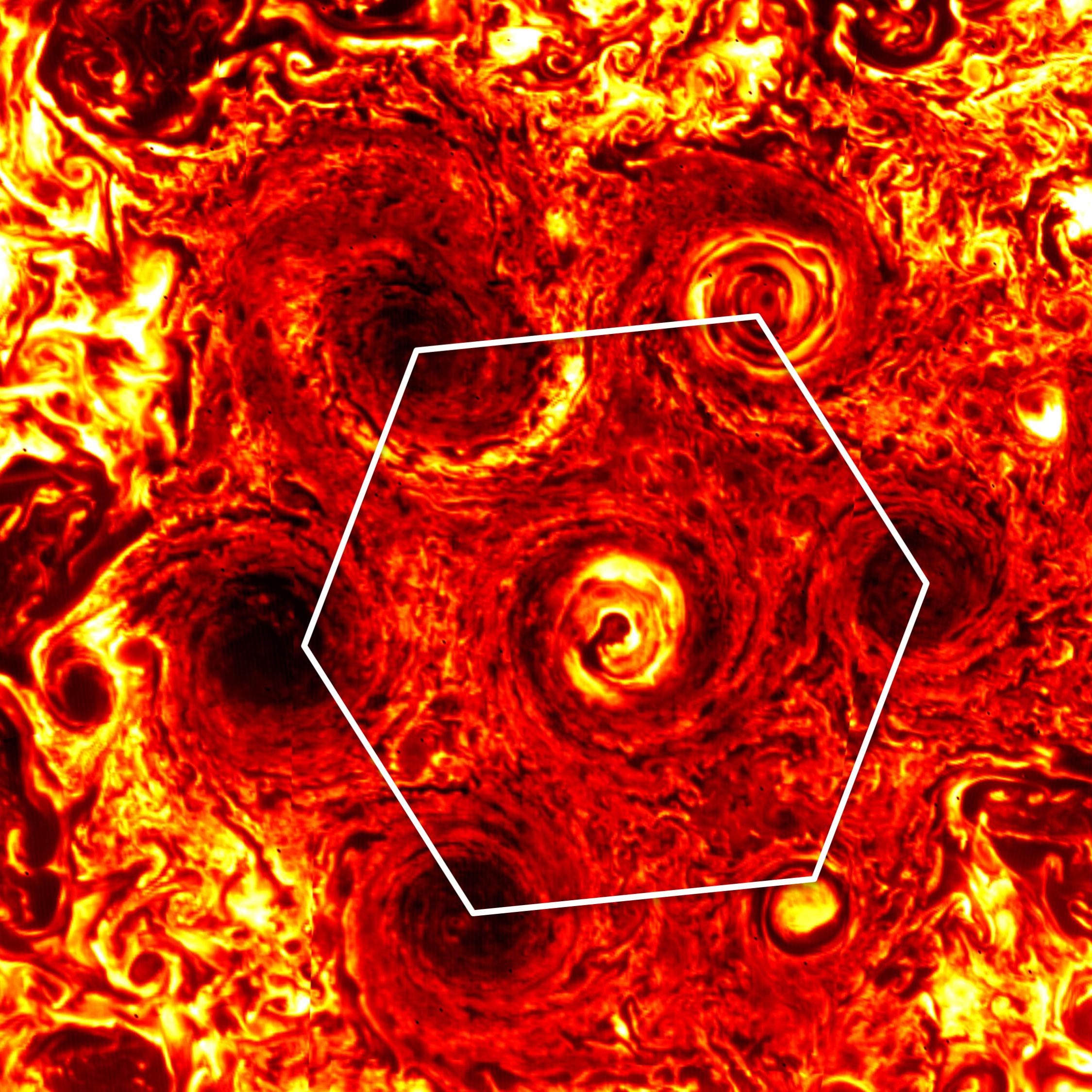
    In this annotated infrared image, six cyclones form a hexagonal pattern around a central cyclone at Jupiter’s south pole. The image was generated from data collected by NJASA’s Juno spacecraft on November 4, 2019. Credit: NASA/JPL-Caltech/SwRI/ASI/INAF/JIRAM

    “The combination of creativity and analytical thinking has once again paid off big time for NASA,” said Scott Bolton, Juno principal investigator from the Southwest Research Institute in San Antonio. “We realized that the orbit was going to carry Juno into Jupiter’s shadow, which could have grave consequences because we’re solar-powered. No sunlight means no power, so there was a real risk we might freeze to death. While the team was trying to figure out how to conserve energy and keep our core heated, the engineers came up with a completely new way out of the problem: Jump Jupiter’s shadow. It was nothing less than a navigation stroke of genius. Lo and behold, the first thing out of the gate on the other side, we make another fundamental discovery.”
    Six Cyclones on Jupiter
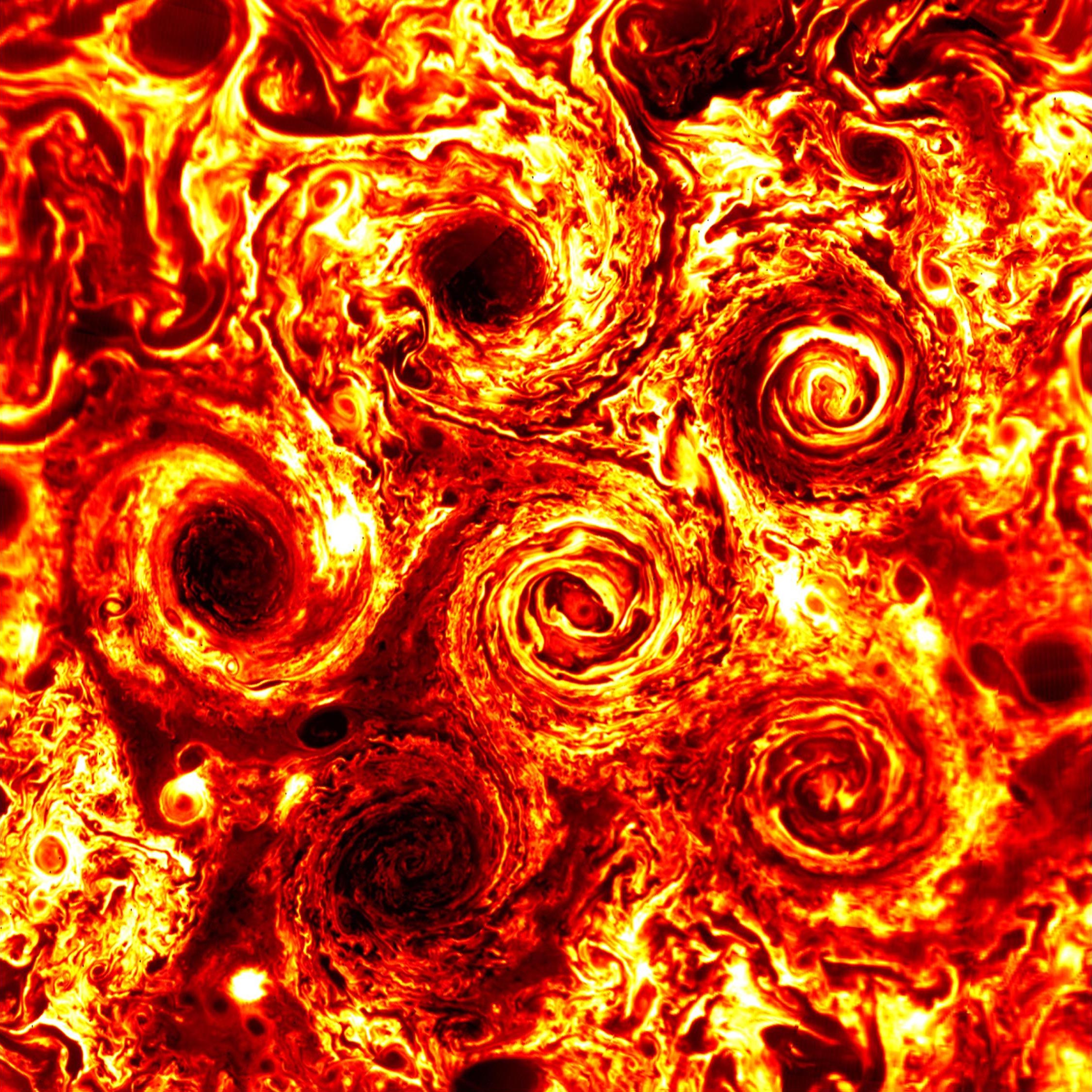
    Six cyclones can be seen at Jupiter’s south pole in this infrared image taken on February 2, 2017, during the 3rd science pass of NASA’s Juno spacecraft. Juno’s Jovian Infrared Auroral Mapper (JIRAM) instrument measures heat radiated from the planet at an infrared wavelength of around 5 microns. Credit: NASA/JPL-Caltech/SwRI/ASI/INAF/JIRAM

    When Juno first arrived at Jupiter in July 2016, its infrared and visible-light cameras discovered giant cyclones encircling the planet’s poles — nine in the north and six in the south. Were they, like their Earthly siblings, a transient phenomenon, taking only weeks to develop and then ebb? Or could these cyclones, each nearly as wide as the continental U.S., be more permanent fixtures?
    Six Cyclones on Jupiter Annotated
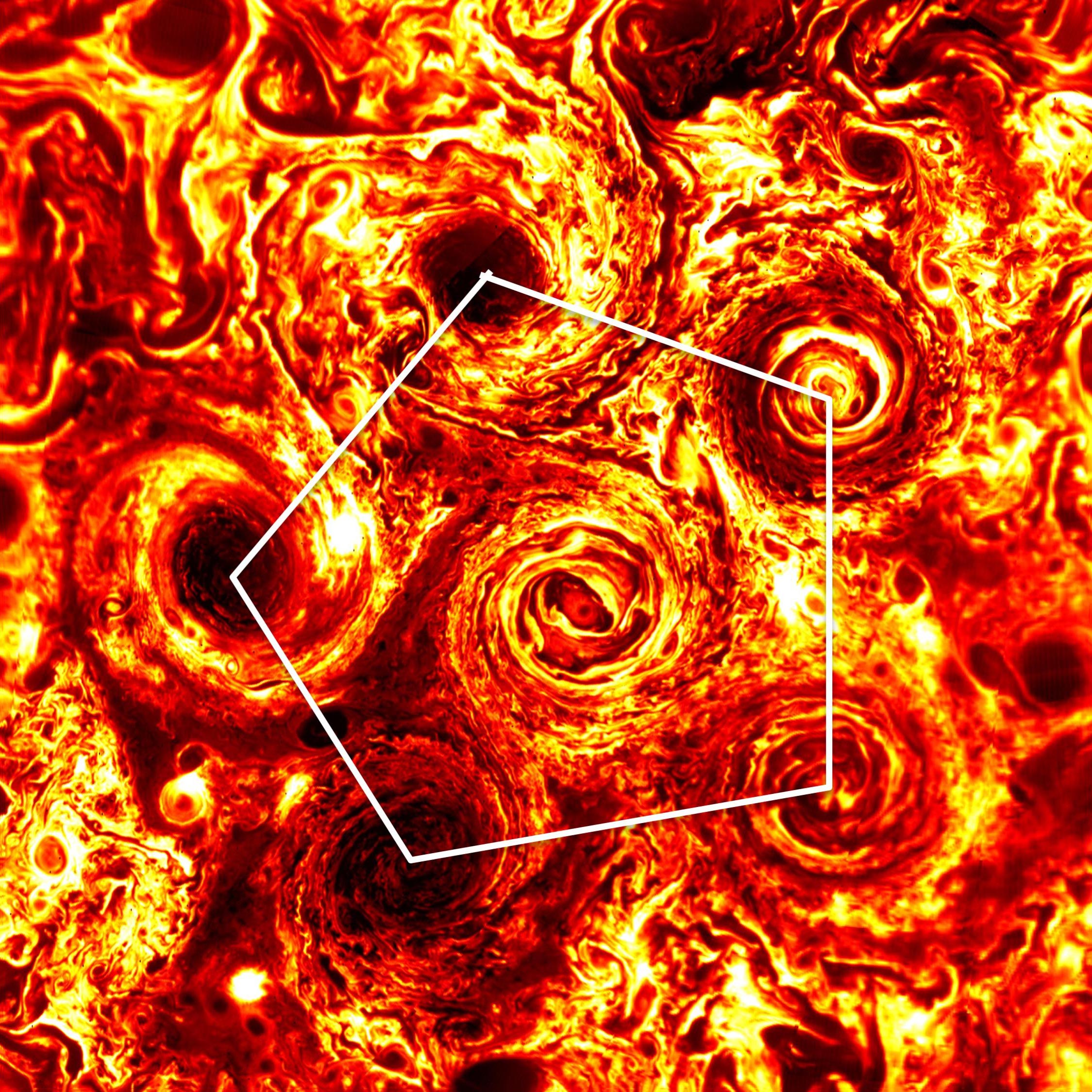
    In this annotated infrared image, the five cyclones surrounding a sixth directly over Jupiter’s south pole form a pentagonal pattern. The image was taken on February 2, 2017, by the Jovian Infrared Auroral Mapper (JIRAM) instrument aboard NASA’s Juno spacecraft. Credit: NASA/JPL-Caltech/SwRI/ASI/INAF/JIRAM

    With each flyby, the data reinforced the idea that five windstorms were swirling in a pentagonal pattern around a central storm at the south pole and that the system seemed stable. None of the six storms showed signs of yielding to allow other cyclones to join in.

    Jupiter Cyclones Scale
    An outline of the continental United States superimposed over the central cyclone and an outline of Texas is superimposed over the newest cyclone at Jupiter’s south pole give a sense of their immense scale. The hexagonal arrangement of the cyclones is large enough to dwarf the Earth. Credit: NASA/JPL-Caltech/SwRI/ASI/INAF/JIRAM

    “It almost appeared like the polar cyclones were part of a private club that seemed to resist new members,” said Bolton.

    Then, during Juno’s 22nd science pass, a new, smaller cyclone churned to life and joined the fray.
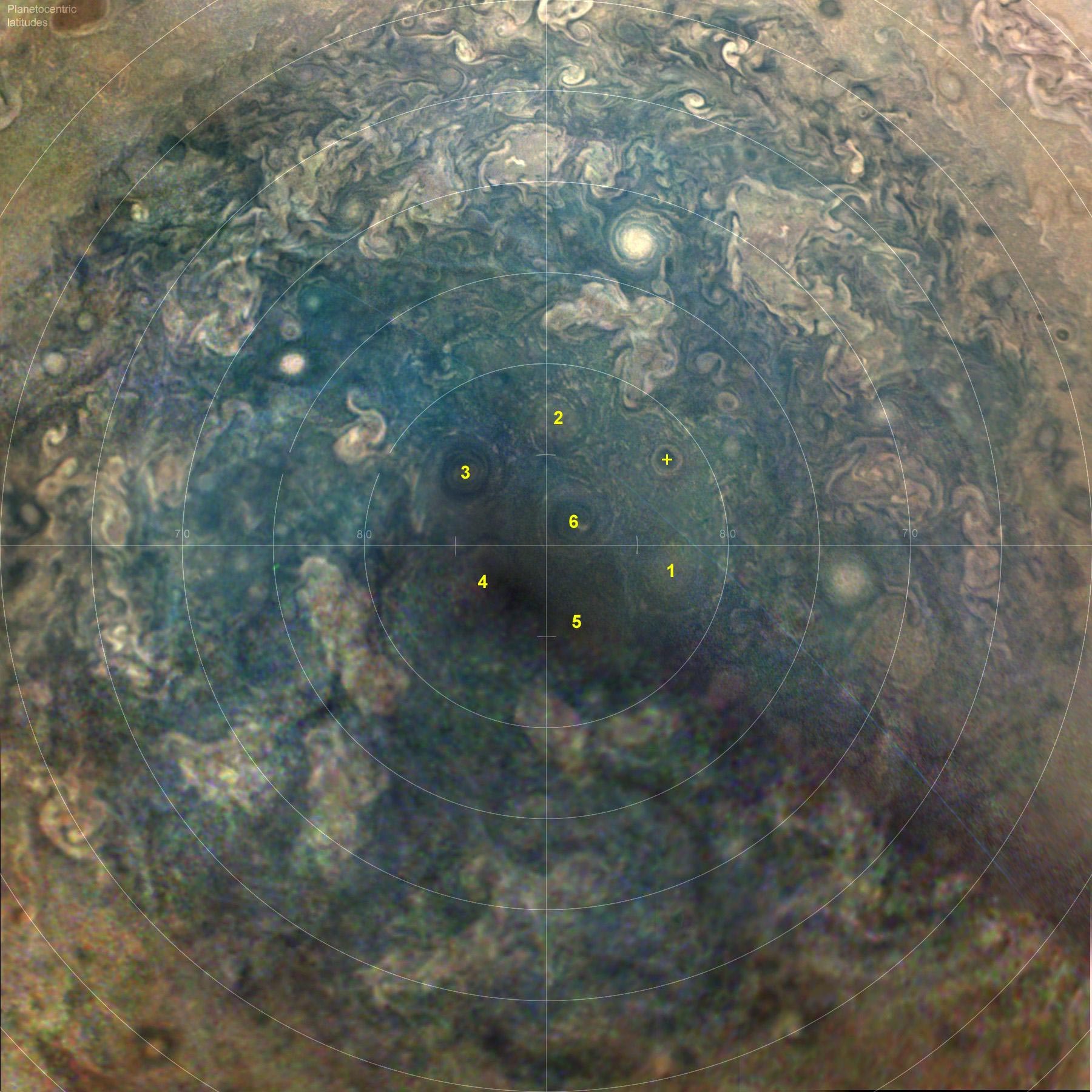
    New Cyclone Jupiter South Pole
    This composite visible-light image taken by the JunoCam imager aboard NASA’s Juno spacecraft on November 3, 2019, shows a new cyclone at Jupiter’s south pole has joined five other cyclones to create a hexagonal shape around a large single cyclone. Credit: NASA/JPL-Caltech/SwRI/MSSS/JunoCam

    The Life of a Young Cyclone

    “Data from Juno’s Jovian Infrared Auroral Mapper [JIRAM] instrument indicates we went from a pentagon of cyclones surrounding one at the center to a hexagonal arrangement,” said Alessandro Mura, a Juno co-investigator at the National Institute for Astrophysics in Rome. “This new addition is smaller in stature than its six more established cyclonic brothers: It’s about the size of Texas. Maybe JIRAM data from future flybys will show the cyclone growing to the same size as its neighbors.”
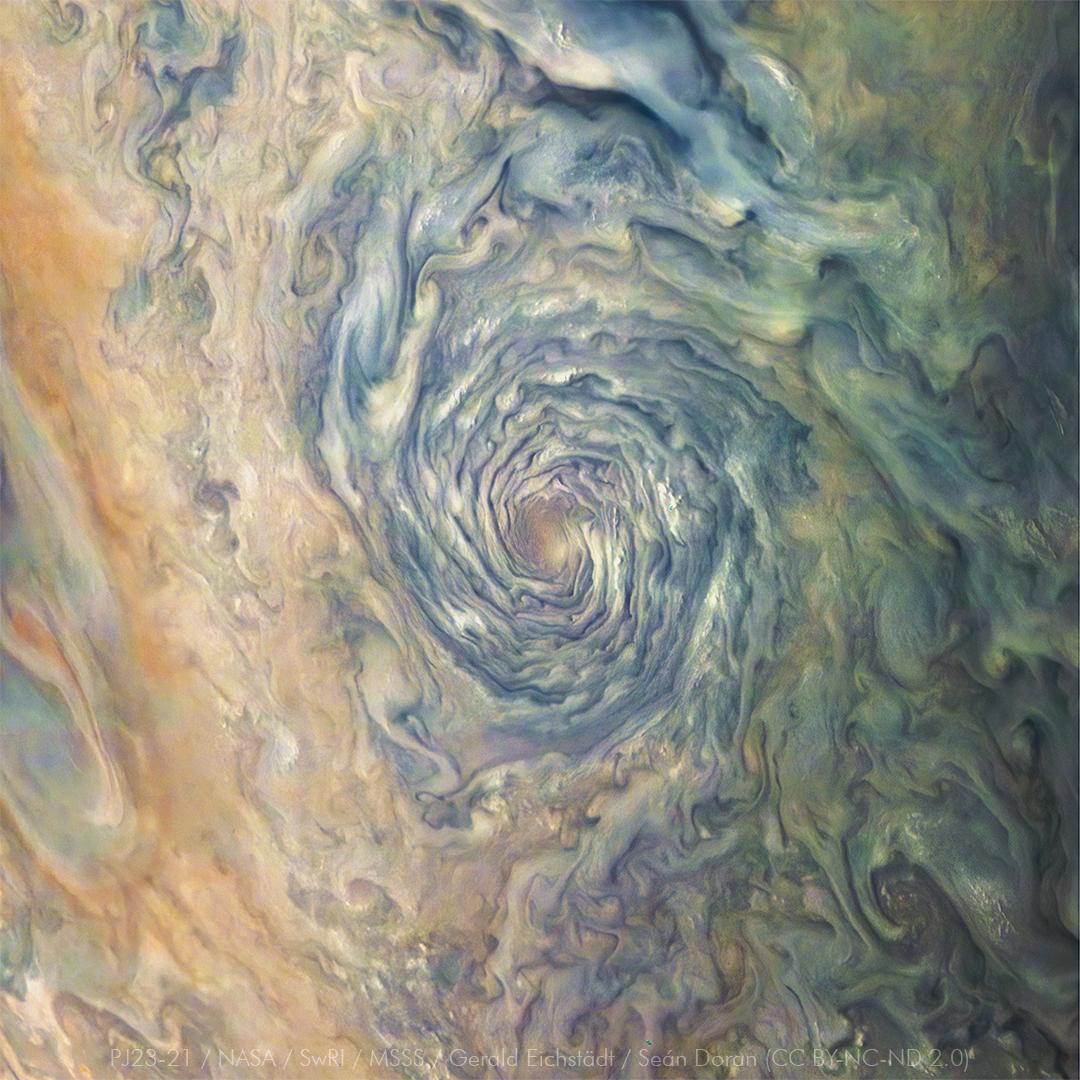
    Vortex Jupiter Clouds
    Soft pastels enhance the rich colors of the swirls and storms in Jupiter’s clouds. This image of a vortex on Jupiter, taken by the Juno mission camera, JunoCam, captures the amazing internal structure of the giant storm. Credit: Image data: NASA/JPL-Caltech/SwRI/MSSSImage processing by Gerald Eichstadt/Sean Doran, CC BY

    Probing the weather layer down to 30 to 45 miles (50 to 70 kilometers) below Jupiter’s cloud tops, JIRAM captures infrared light emerging from deep inside Jupiter. Its data indicate wind speeds of the new cyclone average 225 mph (362 kph) — comparable to the velocity found in its six more established polar colleagues.
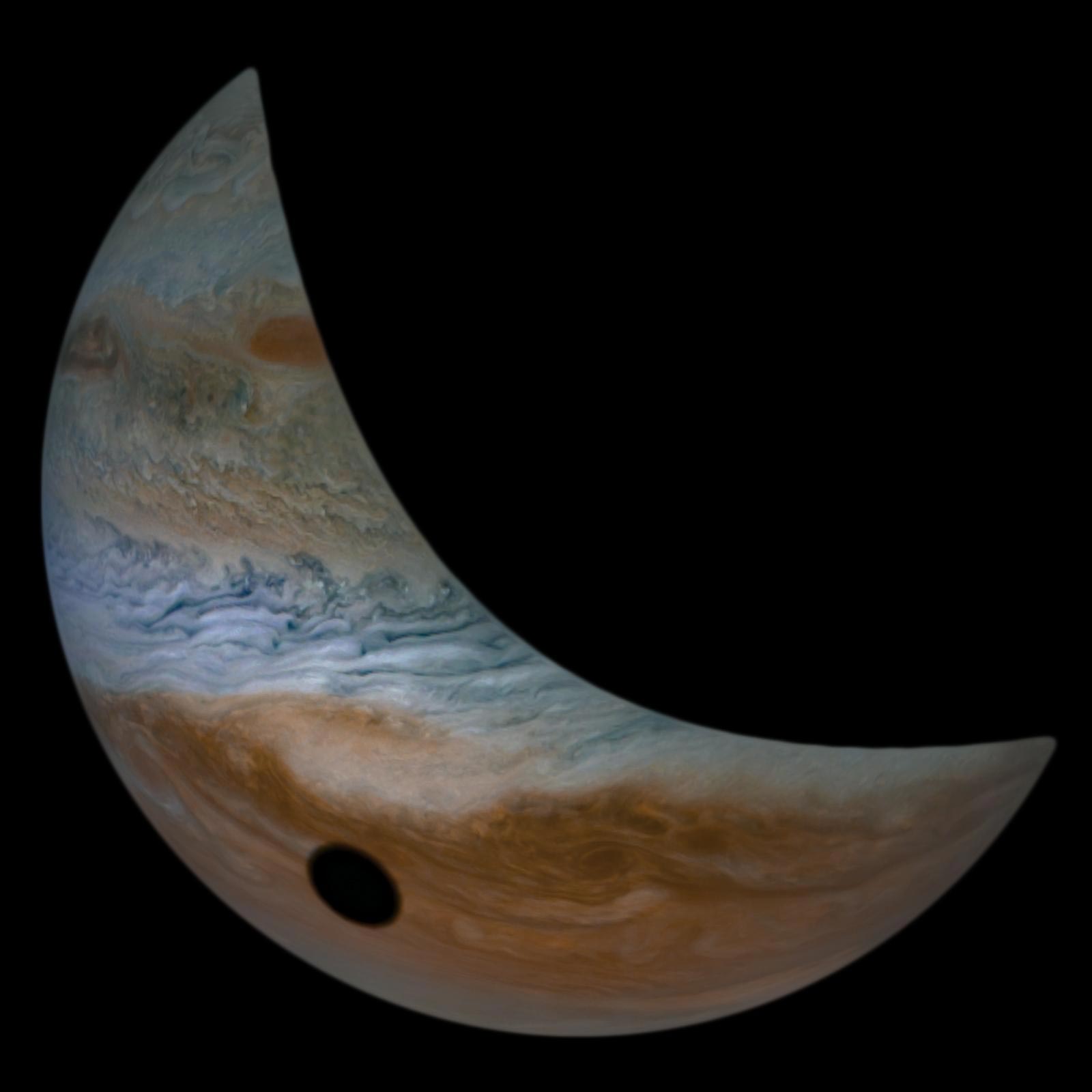
    Jupiter IO Shadow
    Jupiter’s moon Io casts its shadow on Jupiter whenever it passes in front of the Sun as seen from Jupiter. Credit: Image data: NASA/JPL-Caltech/SwRI/MSSS, Image processing by Tanya Oleksuik, CC BY

    The spacecraft’s JunoCam also obtained visible-light imagery of the new cyclone. The two datasets shed light on atmospheric processes of not just Jupiter but also fellow gas giants Saturn, Uranus, and Neptune as well as those of giant exoplanets now being discovered; they even shed light on atmospheric processes of Earth’s cyclones.
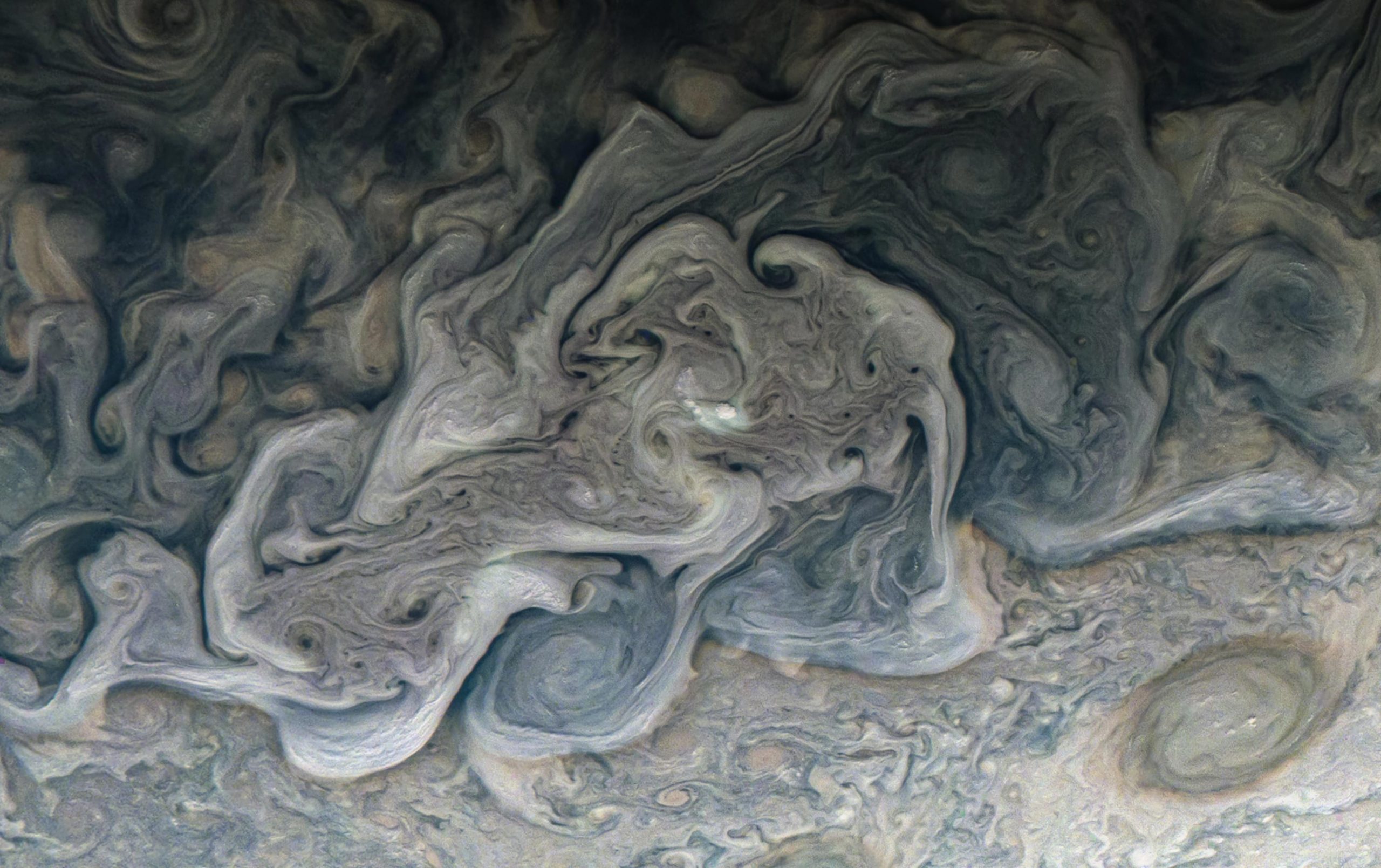
    Jupiter's Atmosphere
    Layers of clouds swirl in Jupiter’s atmosphere, captured in this image from Juno’s JunoCam imager. Sharp boundaries of storms cast thin shadows on the clouds beneath the storms at about 50 degrees north. Credit: Image data: NASA/JPL-Caltech/SwRI/MSSS, Image processing by Kevin M. Gill, CC BY

    “These cyclones are new weather phenomena that have not been seen or predicted before,” said Cheng Li, a Juno scientist from the University of California, Berkeley. “Nature is revealing new physics regarding fluid motions and how giant planet atmospheres work. We are beginning to grasp it through observations and computer simulations. Future Juno flybys will help us further refine our understanding by revealing how the cyclones evolve over time.”

    Shadow Jumping

    Of course, the new cyclone would never have been discovered if Juno had frozen to death during the eclipse when Jupiter got between the spacecraft and the Sun’s heat and light rays.

    Jupiter Luminous Clouds
    Jupiter’s clouds have a luminous beauty in this image taken by Juno’s JunoCam camera on its 20th close pass by Jupiter. Enhanced colors give a vertical dimension to the clouds. Credit: Image data: NASA/JPL-Caltech/SwRI/MSSSImage processing by Kevin M. Gill, CC BY

    Juno has been navigating in deep space since 2011. It entered an initial 53-day orbit around Jupiter on July 4, 2016. Originally, the mission planned to reduce the size of its orbit a few months later to shorten the period between science flybys of the gas giant to every 14 days. But the project team recommended to NASA to forgo the main engine burn due to concerns about the spacecraft’s fuel delivery system. Juno’s 53-day orbit provides all the science as originally planned; it just takes longer to do so. Juno’s longer life at Jupiter is what led to the need to avoid Jupiter’s shadow.

    “Ever since the day we entered orbit around Jupiter, we made sure it remained bathed in sunlight 24/7,” said Steve Levin, Juno project scientist at NASA’s Jet Propulsion Laboratory in Pasadena, California. “Our navigators and engineers told us a day of reckoning was coming, when we would go into Jupiter’s shadow for about 12 hours. We knew that for such an extended period without power, our spacecraft would suffer a similar fate as the Opportunity rover, when the skies of Mars filled with dust and blocked the Sun’s rays from reaching its solar panels.”
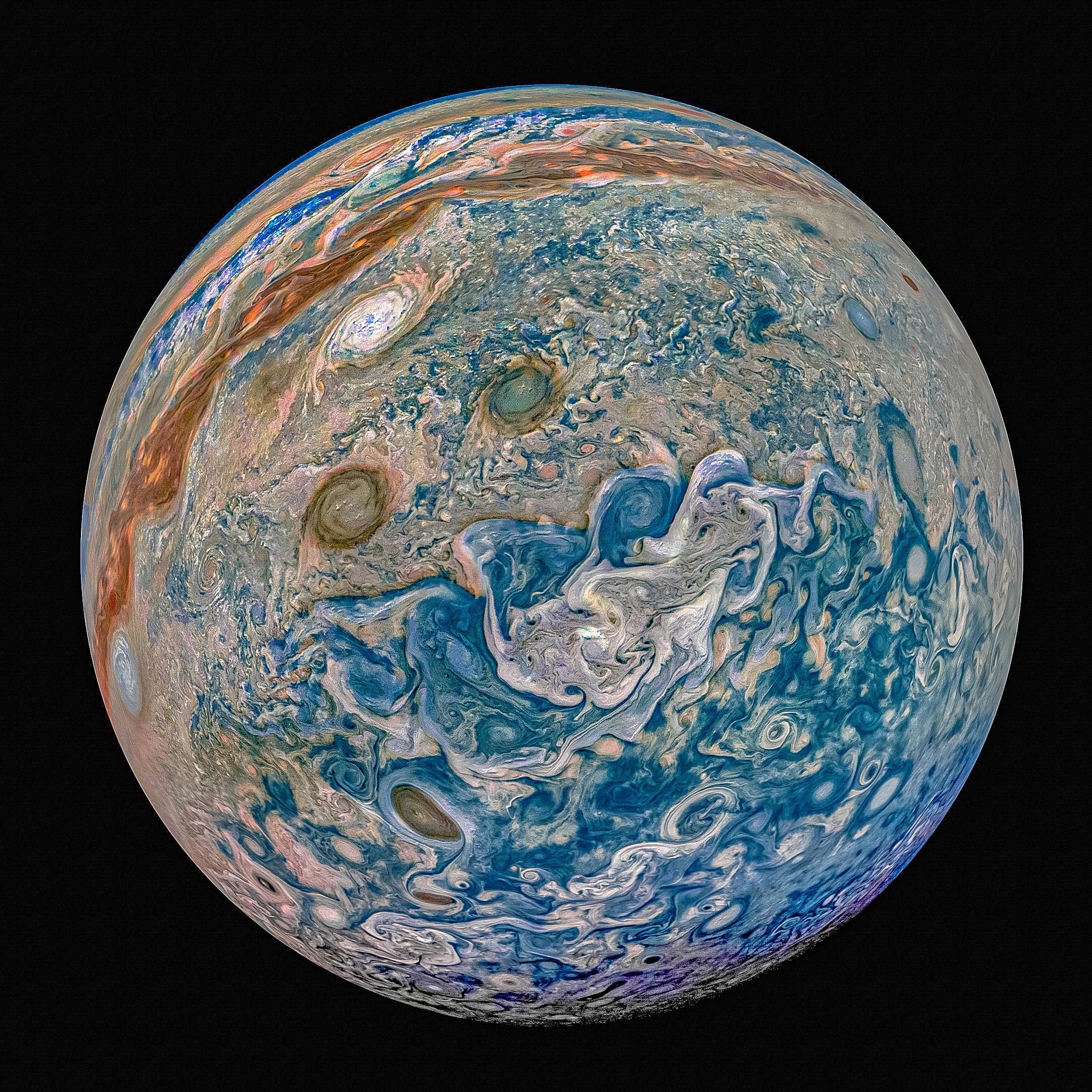
    Jupiter A Mind of Limits
    “A mind of limits, a camera of thoughts” is the name of this contribution from citizen scientist Prateek Sarpal. Jupiter inspires artists and scientists with its beauty. In this image, south is up, and the enhanced color evokes an exotic marble and childhood joy. Credit: Image data: NASA/JPL-Caltech/SwRI/MSSS, Image processing by Prateek Sarpal, CC BY

    Without the Sun’s rays providing power, Juno would be chilled below tested levels, eventually draining its battery cells beyond recovery. So the navigation team set devised a plan to “jump the shadow,” maneuvering the spacecraft just enough so its trajectory would miss the eclipse.

    “In deep space, you are either in sunlight or you are out of sunlight; there really is no in-between,” said Levin.
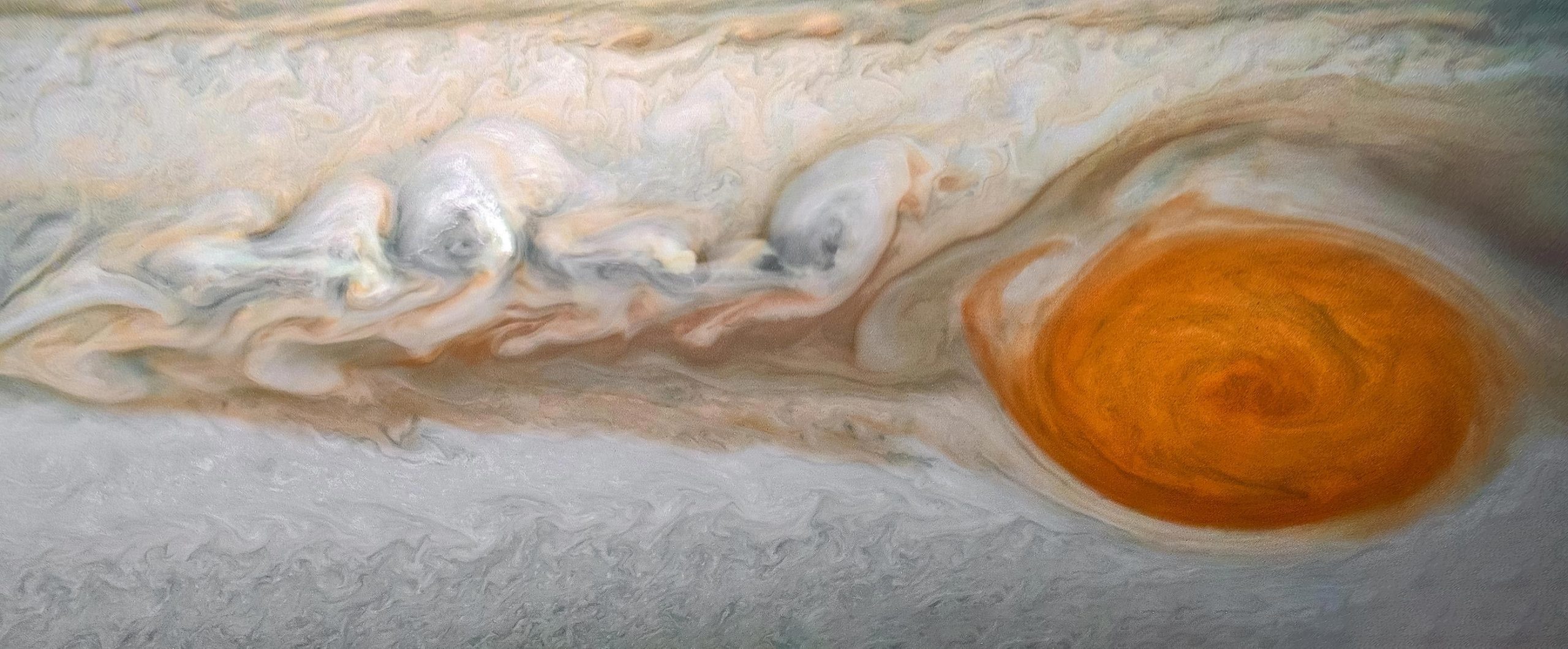
    Jupiter's Great Red Spot
    Swirling in Jupiter’s atmosphere for hundreds of years, the Great Red Spot is captured in this pair of close-up images from Juno’s JunoCam camera. The giant storm churns through Jupiter’s atmosphere, creating the turbulent flows to its west. Credit: Image data: NASA/JPL-Caltech/SwRI/MSSSImage processing by Kevin M. Gill, CC BY

    The navigators calculated that if Juno performed a rocket burn weeks in advance of November 3, while the spacecraft was as far in its orbit from Jupiter as it gets, they could modify its trajectory enough to give the eclipse the slip. The maneuver would utilize the spacecraft’s reaction control system, which wasn’t initially intended to be used for a maneuver of this size and duration.

    On September 30, at 7:46 p.m. EDT (4:46 p.m. PDT), the reaction control system burn began. It ended 10 ½ hours later. The propulsive maneuver — five times longer than any previous use of that system — changed Juno’s orbital velocity by 126 mph (203 kph) and consumed about 160 pounds (73 kilograms) of fuel. Thirty-four days later, the spacecraft’s solar arrays continued to convert sunlight into electrons unabated as Juno prepared to scream once again over Jupiter’s cloud tops.
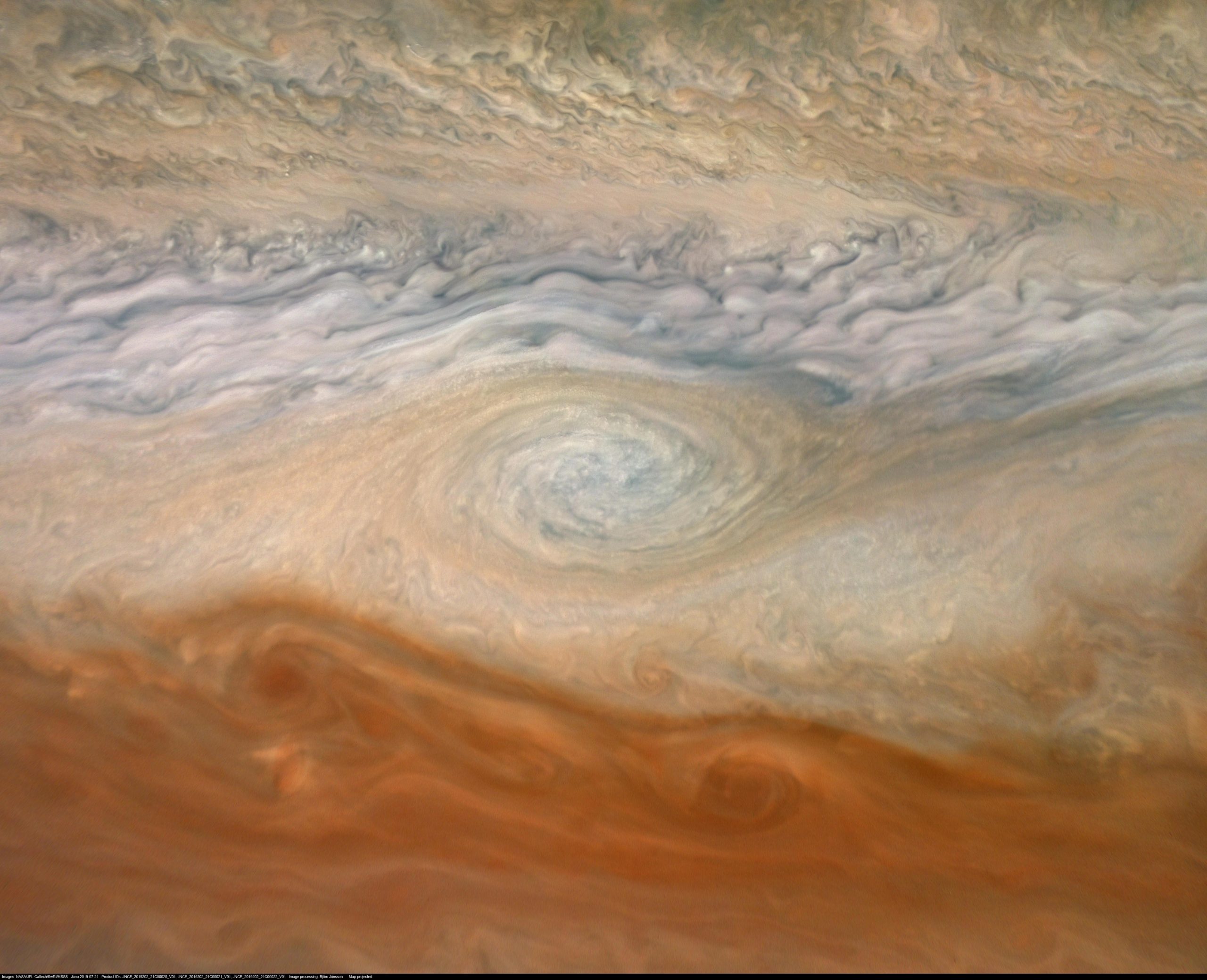
    Jupiter's White Spot Z
    “White Spot Z” is one of the long-lived storms in Jupiter’s atmosphere. Three JunoCam images from Juno’s 21st close pass by Jupiter have been mosaicked together, showing the setting of this oval-shaped storm perched just above the reddish-brown North Equatorial Belt. Credit: Image data: NASA/JPL-Caltech/SwRI/MSSS, Image processing by Bjorn Jonsson, CC BY

    “Thanks to our navigators and engineers, we still have a mission,” said Bolton. “What they did is more than just make our cyclone discovery possible; they made possible the new insights and revelations about Jupiter that lie ahead of us.”

    NASA’s JPL manages the Juno mission for the principal investigator, Scott Bolton, of the Southwest Research Institute in San Antonio. Juno is part of NASA’s New Frontiers Program, which is managed at NASA’s Marshall Space Flight Center in Huntsville, Alabama, for NASA’s Science Mission Directorate in Washington. The Italian Space Agency (ASI) contributed to the Jovian Infrared Auroral Mapper. Lockheed Martin Space in Denver built and operates the spacecraft.

    Never miss a breakthrough: Join the SciTechDaily newsletter.
    Follow us on Google and Google News.

    Astronomy Astrophysics JPL Jupiter NASA Popular
    Share. Facebook Twitter Pinterest LinkedIn Email Reddit

    Related Articles

    40-Year Mystery Solved: Source of Jupiter’s Strange X-Ray Flares Uncovered

    The 7 Rocky Earth-Size TRAPPIST-1 Planets Have Remarkably Similar Densities

    NASA’s Juno Mission Expands Into the Future – To Explore Jupiter and Its Rings and Moons

    Gravitational Wave Search Finds Tantalizing New Clue: Unexplained Fluctuations in Space-Time

    Jupiter’s Icy Moon Europa Glows in the Dark

    Mysterious, Repeating Radio Burst Identified in Our Own Galaxy for the First Time

    NASA’s Spitzer Spies a Massive Star Factory – 2 Quadrillion Miles Across

    Astronomers Believe They Have Spotted the First Known Light Flare From a Pair of Colliding Black Holes

    Enticing Clues to Formation of Exotic Worlds From Young Giant Planet

    2 Comments

    1. plp on December 12, 2020 10:00 am

      ,

      Reply
    2. dom on May 26, 2021 1:46 pm

      Lets see real images deep inside each layer of Jupiter!!!!!!!

      Reply
    Leave A Reply Cancel Reply

    • Facebook
    • Twitter
    • Pinterest
    • YouTube

    Don't Miss a Discovery

    Subscribe for the Latest in Science & Tech!

    Trending News

    Breakthrough Bowel Cancer Trial Leaves Patients Cancer-Free for Nearly 3 Years

    Natural Compound Shows Powerful Potential Against Rheumatoid Arthritis

    100,000-Year-Old Neanderthal Fossils in Poland Reveal Unexpected Genetic Connections

    Simple “Gut Reset” May Prevent Weight Gain After Ozempic or Wegovy

    2.8 Days to Disaster: Scientists Warn Low Earth Orbit Could Suddenly Collapse

    Common Food Compound Shows Surprising Power Against Superbugs

    5 Simple Ways To Remember More and Forget Less

    The Atomic Gap That Could Cost the Semiconductor Industry Billions

    Follow SciTechDaily
    • Facebook
    • Twitter
    • YouTube
    • Pinterest
    • Newsletter
    • RSS
    SciTech News
    • Biology News
    • Chemistry News
    • Earth News
    • Health News
    • Physics News
    • Science News
    • Space News
    • Technology News
    Recent Posts
    • After 37 Years, the World’s Longest-Running Soil Warming Experiment Uncovers a Startling Climate Secret
    • NASA Satellite Captures First-Ever High-Res View of Massive Pacific Tsunami
    • ADHD Isn’t Just a Deficit: Study Reveals Powerful Hidden Strengths
    • Scientists Uncover “Astonishing” Hidden Property of Light
    • Scientists Discover Stem Cells That Could Regrow Teeth and Bone
    Copyright © 1998 - 2026 SciTechDaily. All Rights Reserved.
    • Science News
    • About
    • Contact
    • Editorial Board
    • Privacy Policy
    • Terms of Use

    Type above and press Enter to search. Press Esc to cancel.