
On December 21, at 8:49:48 a.m. PST (11:49:48 a.m. EST) NASA’s Juno spacecraft will be 3,140 miles (5,053 kilometers) above Jupiter’s cloud tops and hurtling by at a healthy clip of 128,802 mph (207,287 kilometers per hour). This will be the 16th science pass of the gas giant and will mark the solar-powered spacecraft’s halfway point in data collection during its prime mission.
Juno is in a highly-elliptical 53-day orbit around Jupiter. Each orbit includes a close passage over the planet’s cloud deck, where it flies a ground track that extends from Jupiter’s north pole to its south pole.
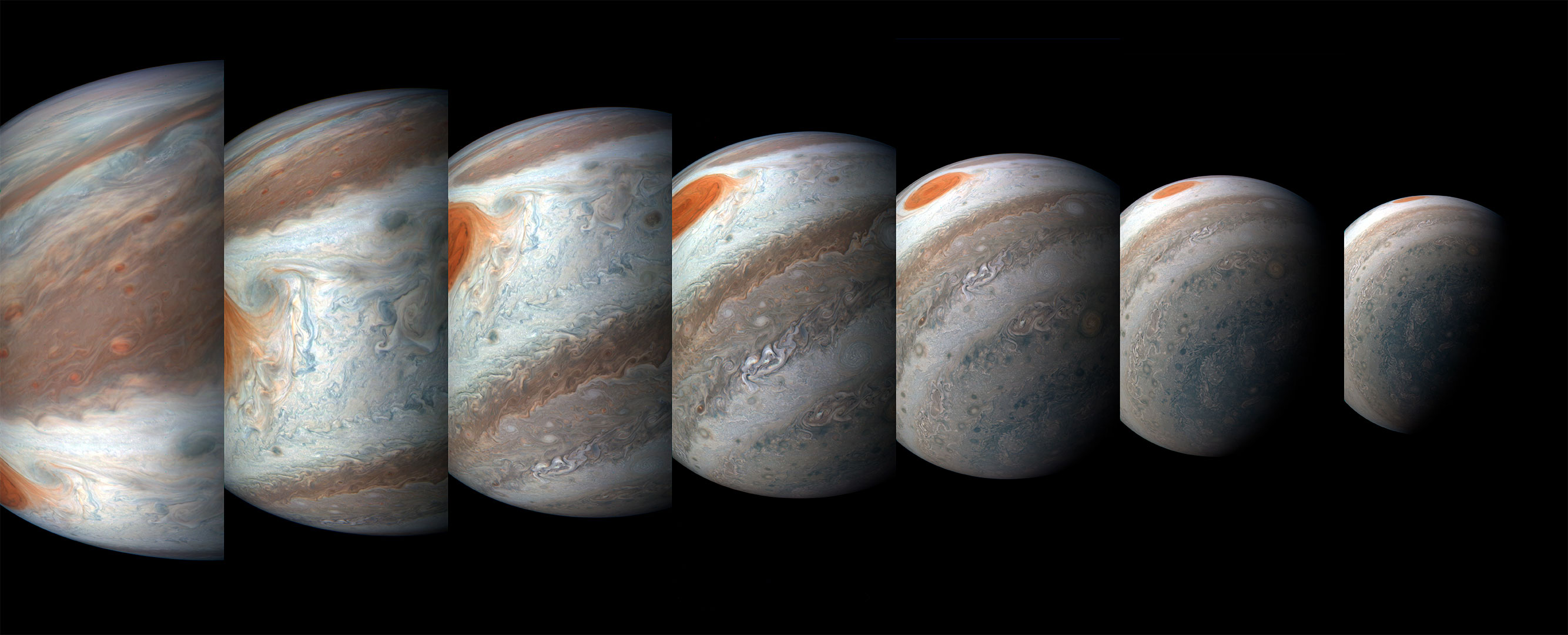
This movie was generated using imagery collected on October 29, 2018, during Juno’s 16th perijove (the point at which an orbit comes closest to Jupiter’s center). Citizen scientists Gerald Eichstädt created this movie using data from the spacecraft’s JunoCam imager. Credit: Enhanced image by Gerald Eichstädt based on images provided courtesy of NASA/JPL-Caltech/SwRI/MSSS
“With our 16th science flyby, we will have complete global coverage of Jupiter, albeit at coarse resolution, with polar passes separated by 22.5 degrees of longitude,” said Jack Connerney, Juno deputy principal investigator from the Space Research Corporation in Annapolis, Maryland. “Over the second half of our prime mission — science flybys 17 through 32 — we will split the difference, flying exactly halfway between each previous orbit. This will provide coverage of the planet every 11.25 degrees of longitude, providing a more detailed picture of what makes the whole of Jupiter tick.”

Launched on August 5, 2011, from Cape Canaveral, Florida, the spacecraft entered orbit around Jupiter on July 4, 2016. Its science collection began in earnest on the August 27, 2016, flyby. During these flybys, Juno’s suite of sensitive science instruments probes beneath the planet’s obscuring cloud cover and studies Jupiter’s auroras to learn more about the planet’s origins, interior structure, atmosphere, and magnetosphere.
“We have already rewritten the textbooks on how Jupiter’s atmosphere works, and on the complexity and asymmetry of its magnetic field,” said Scott Bolton, principal investigator of Juno, from the Southwest Research Institute in San Antonio. “The second half should provide the detail that we can use to refine our understanding of the depth of Jupiter’s zonal winds, the generation of its magnetic field, and the structure and evolution of its interior.”
Two instruments aboard Juno, the Stellar Reference Unit and JunoCam, have proven to be useful not only for their intended purposes, but also for science data collection. The Stellar Reference Unit (SRU) was designed to collect engineering data used for navigation and attitude determination, so the scientists were pleased to find that it has scientific uses as well.
“We always knew the SRU had a vital engineering job to do for Juno,” said Heidi Becker, Juno’s radiation monitoring investigation lead at NASA’s Jet Propulsion Laboratory in Pasadena, California. “But after making scientific discoveries in Jupiter’s radiation belts and taking a first-of-its-kind image of Jupiter’s ring, we realized the added value of the data. There is serious scientific interest in what the SRU can tell us about Jupiter.”
The JunoCam imager was conceived as an outreach instrument to bring the excitement and beauty of Jupiter exploration to the public.
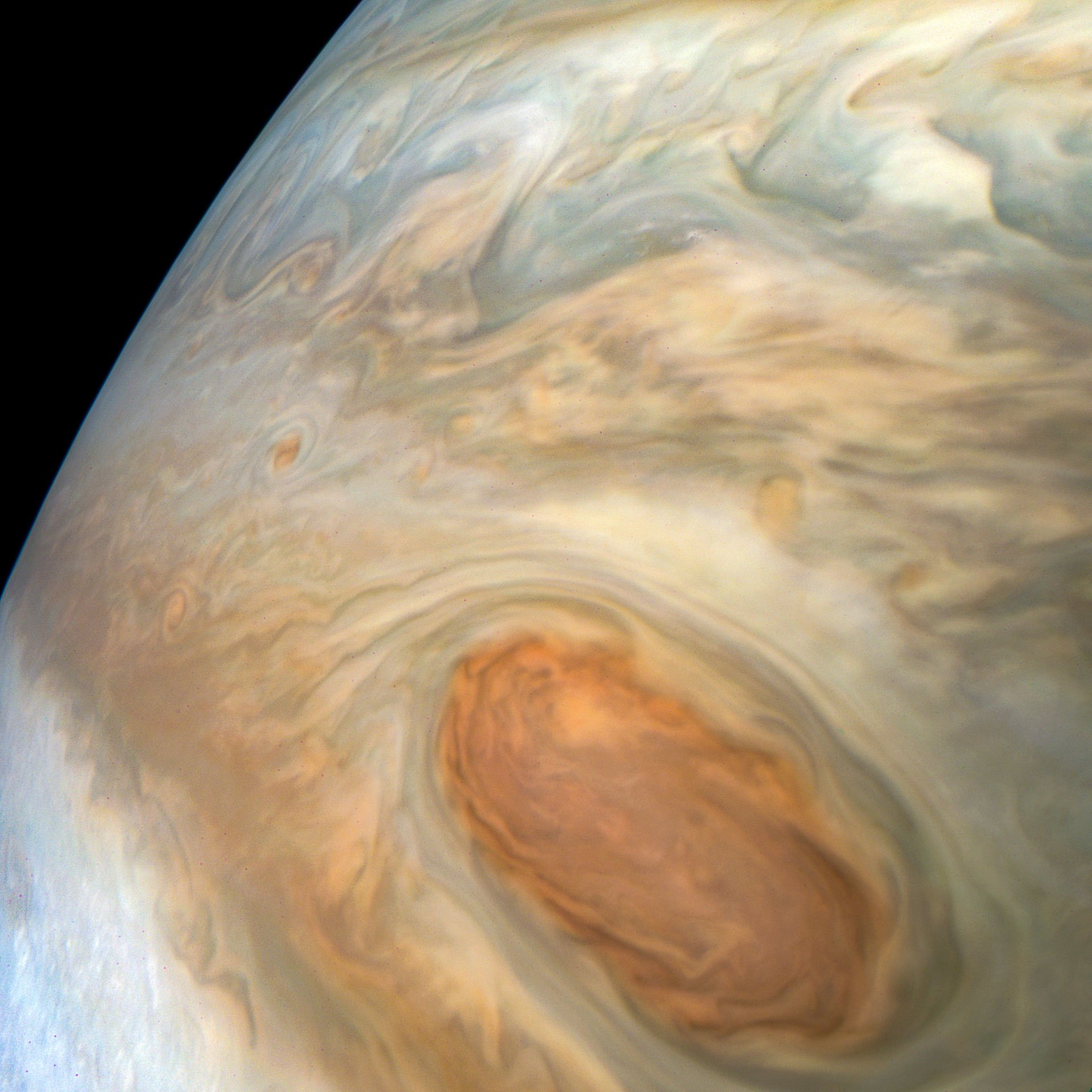
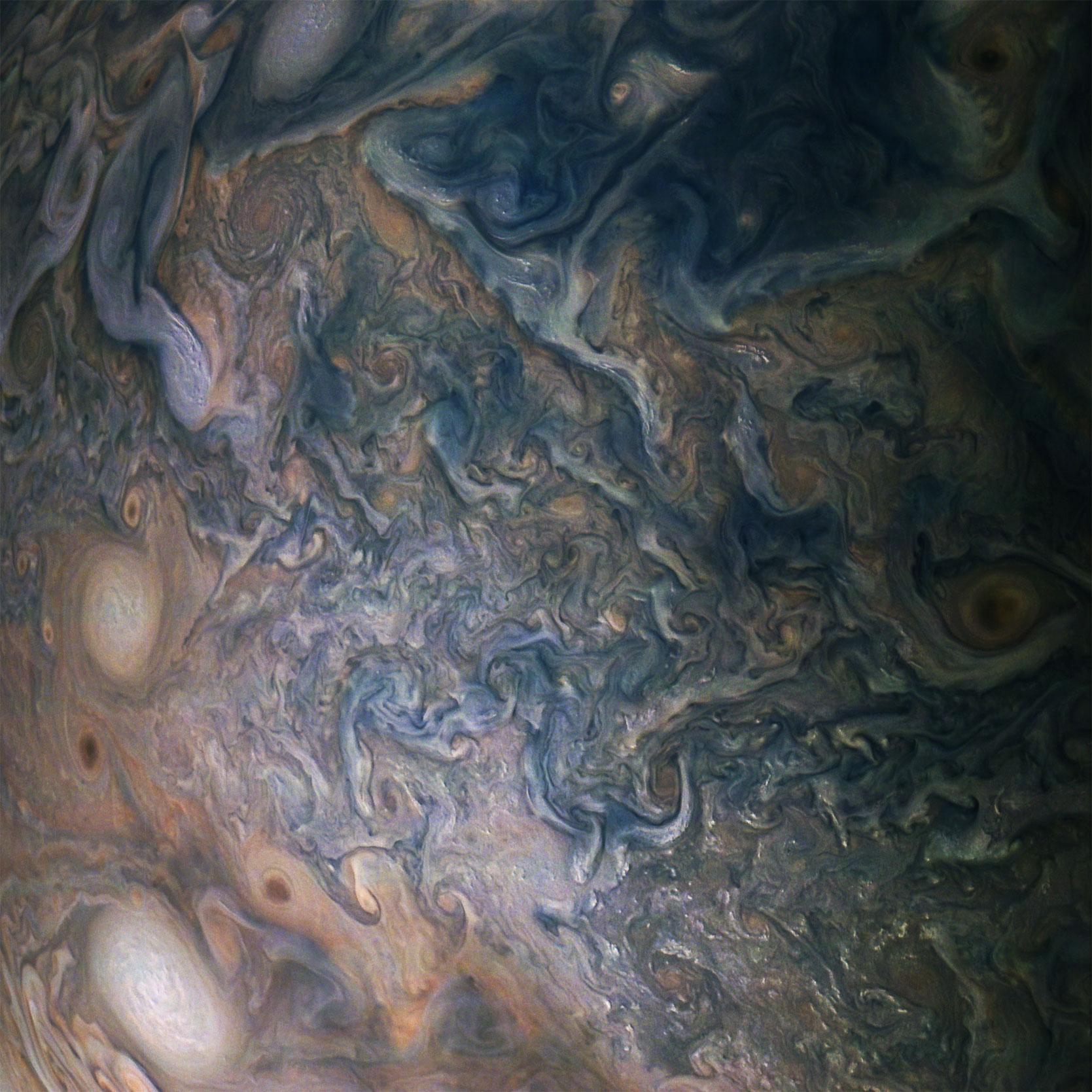
“While originally envisioned solely as an outreach instrument to help tell the Juno story, JunoCam has become much more than that,” said Candy Hansen, Juno co-investigator at the Planetary Science Institute in Tucson, Arizona. “Our time-lapse sequences of images over the poles allow us to study the dynamics of Jupiter’s unique circumpolar cyclones and to image high-altitude hazes. We are also using JunoCam to study the structure of the Great Red Spot and its interaction with its surroundings.”
The SRU and JunoCam teams both now have several peer-reviewed science papers —either published or in the works — to their credit.
NASA’s JPL manages the Juno mission for the principal investigator, Scott Bolton, of the Southwest Research Institute in San Antonio. Juno is part of NASA’s New Frontiers Program, which is managed at NASA’s Marshall Space Flight Center in Huntsville, Alabama, for NASA’s Science Mission Directorate. The Italian Space Agency (ASI) contributed two instruments, a Ka-band frequency translator (KaT) and the Jovian Infrared Auroral Mapper (JIRAM). Lockheed Martin Space in Denver built the spacecraft.
More information about Juno is available at:
https://www.missionjuno.swri.edu
Never miss a breakthrough: Join the SciTechDaily newsletter.
Follow us on Google and Google News.
1 Comment
What method was used to collect the data?
Based on the definition of Big Data, we can formulate the basic principles of working with such data:
1. Horizontal scalability. Since there can be as much data as you like, any system that involves processing big data must be extensible. The amount of data increased 2 times – the amount of iron in the cluster increased 2 times and everything continued to work.
2. Fault tolerance. The principle of horizontal scalability implies that there can be many machines in a cluster. For example, Yahoo’s Hadoop cluster has over 42,000 machines (see this link for cluster sizes across organizations). This means that some of these machines will be guaranteed to fail. Big data practices must take into account the possibility of such disruptions and survive them without meaningful consequences.
3. Locality of data. In large distributed systems, data is distributed across a large number of machines. If the data is physically located on one server and processed on another, the cost of data transfer may exceed the cost of the processing itself. Therefore, one of the most important design principles of BigData solutions is the principle of data locality – if possible, we process data on the same machine on which we store it.
All modern tools for working with big data somehow follow these three principles. In order to follow them, it is necessary to come up with some methods, methods and paradigms for developing data development tools. I will analyze one of the most classic methods in today’s article.