
Close Menu
    Facebook X (Twitter) Instagram
    SciTechDaily
    • Biology
    • Chemistry
    • Earth
    • Health
    • Physics
    • Science
    • Space
    • Technology
    Facebook X (Twitter) Pinterest YouTube RSS
    SciTechDaily
    Home»Biology»Scientists Discover Several Protein-Coding Genes That Were Misidentified
    Biology

    Scientists Discover Several Protein-Coding Genes That Were Misidentified

    By Ziba Kashef, Yale UniversityDecember 12, 2018No Comments2 Mins Read
    Facebook Twitter Pinterest Telegram LinkedIn WhatsApp Email Reddit
    Share
    Facebook Twitter LinkedIn Pinterest Telegram Email Reddit
    Misidentified Genes
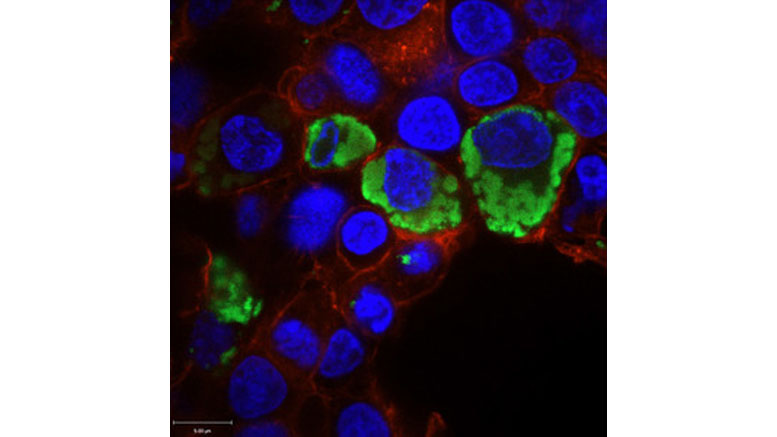
    Aw112010 protein (in green) in a cell. The blue is the nucleus and the red is the outer wall of the cell.

    The human genome contains regions that “code” for proteins, which means they have instructions to make protein molecules with specific functions in the body. But Yale researchers have discovered several protein-coding genes that were misidentified as non-protein-coding, and one, in particular, that plays a key role in the immune system.

    The research team suspected that the way genes are annotated, or categorized, within the genome has limited the identification of genes with the potential to code proteins. To test their theory, the researchers used mice models to study the interaction between RNA and ribosomes, which are minute structures that turn RNA into proteins. They also used a technique called ribosome profiling to investigate how ribosomes relate to RNA. With the combined techniques, the researchers found a number of genes previously identified as non-protein-coding that were actively making proteins.

    In further experiments, the researchers focused on one such gene, Aw112010, that was activated when mice were infected with bacteria. Through the use of CRISPR gene editing, they confirmed that immune cells were robustly synthesizing the protein made from Aw112010 gene in response to Salmonella infection.

    The findings suggest many more protein-coding genes and functions may be discovered. “A large portion of important protein-coding genes have been missed by virtue of their annotation,” said first author Ruaidhri Jackson. Without vetting and identifying these genes, “we can’t fully understand the protein-coding genome or adequately screen genes for health and disease purposes.”

    Reference: “The translation of non-canonical open reading frames controls mucosal immunity” by Ruaidhrí Jackson, Lina Kroehling, Alexandra Khitun, Will Bailis, Abigail Jarret, Autumn G. York, Omair M. Khan, J. Richard Brewer, Mathias H. Skadow, Coco Duizer, Christian C. D. Harman, Lelina Chang, Piotr Bielecki, Angel G. Solis, Holly R. Steach, Sarah Slavoff and Richard A. Flavell, 12 December 2018, Nature.
    DOI: 10.1038/s41586-018-0794-7

    Never miss a breakthrough: Join the SciTechDaily newsletter.
    Follow us on Google and Google News.

    CRISPR Genetics Immunity Yale University
    Share. Facebook Twitter Pinterest LinkedIn Email Reddit

    Related Articles

    Geneticists Show Temperature Change Makes Gene-Editing More Efficient

    Study Reveals Non-Inherited Mutations Account for Many Heart Defects

    piRNAs Key Role in Coordinating Biological Activity

    Study Shows that Genetics Play an Important Role in Anti-Tobacco Policies

    The Most Comprehensive Catalog of Human Genome Variations

    Atomic Level Splicing Further Establishes RNA’s Chemical and Structural Complexity

    Stem Cells Regenerate Tissue in an Uninjured Mammal

    Evolutionary Changes Surrounding the NOS1 Gene

    Researchers Study Regulatory Gene’s Role in Sperm Quality Control

    Leave A Reply Cancel Reply

    • Facebook
    • Twitter
    • Pinterest
    • YouTube

    Don't Miss a Discovery

    Subscribe for the Latest in Science & Tech!

    Trending News

    289-Million-Year-Old Reptile Mummy Reveals Origin of Human Breathing System

    New Brain Discovery Challenges Long-Held Theory of Teenage Brain Development

    Scientists Discover Plants “Scream” – We Just Couldn’t Hear Them Until Now

    Scientists Discover a Surprising Reason Intermittent Fasting Extends Life

    This Simple Fruit Wash Could Make Produce Safer and Last Days Longer

    Scientists Say Adding This Unusual Seafood to Your Diet Could Reverse Signs of Aging

    Scientists Say a Hidden Structure May Exist Inside Earth’s Core

    Doctors Surprised by the Power of a Simple Drug Against Colon Cancer

    Follow SciTechDaily
    • Facebook
    • Twitter
    • YouTube
    • Pinterest
    • Newsletter
    • RSS
    SciTech News
    • Biology News
    • Chemistry News
    • Earth News
    • Health News
    • Physics News
    • Science News
    • Space News
    • Technology News
    Recent Posts
    • Scientists Propose Radical New Way To Detect Alien Life – Without Traditional Biosignatures
    • Scientists Just Discovered Light Can Actually Slow Plant Growth
    • Scientists Finally Solved One of Water’s Biggest Mysteries
    • 7,000-Year-Old DNA Rewrites the Story of the “Neolithic Revolution”
    • Missing Medieval Relic of Legendary English King Found After Being Missing for 40 Years
    Copyright © 1998 - 2026 SciTechDaily. All Rights Reserved.
    • Science News
    • About
    • Contact
    • Editorial Board
    • Privacy Policy
    • Terms of Use

    Type above and press Enter to search. Press Esc to cancel.