
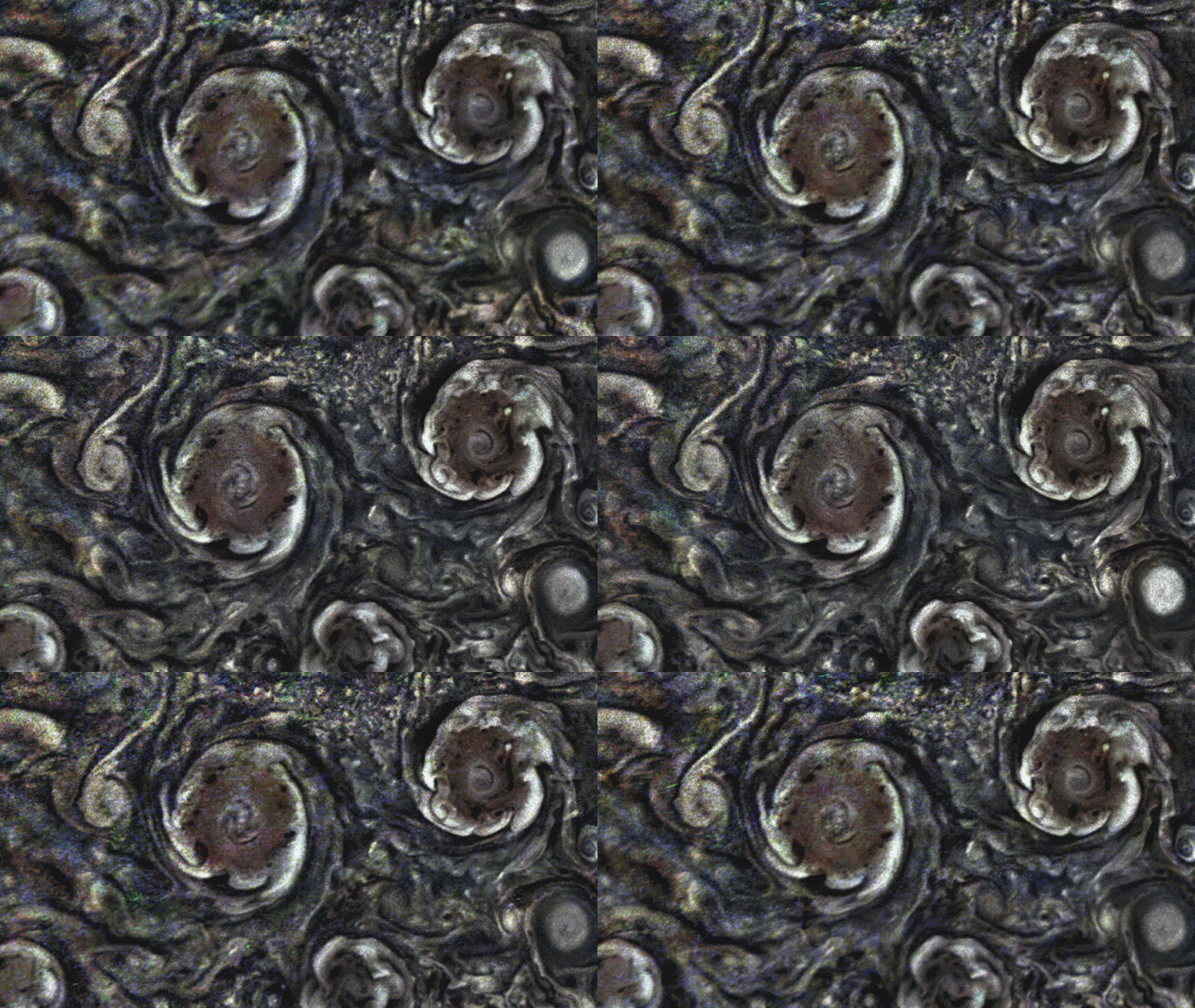
The spacecraft has been collecting data on the gas giant’s interior since July 2016. Some of its latest findings touch on “hot spots” in the planet’s atmosphere.
Twenty-five years ago, NASA sent history’s first probe into the atmosphere of the solar system’s largest planet. But the information returned by the Galileo probe during its descent into Jupiter caused head-scratching: The atmosphere it was plunging into was much denser and hotter than scientists expected. New data from NASA’s Juno spacecraft suggests that these “hot spots” are much wider and deeper than anticipated. The findings on Jupiter’s hot spots, along with an update on Jupiter’s polar cyclones, were revealed on December 11, 2020, during a virtual media briefing at the American Geophysical Union’s fall conference.

“Giant planets have deep atmospheres without a solid or liquid base like Earth,” said Scott Bolton, principal investigator of Juno at the Southwest Research Institute in San Antonio. “To better understand what is happening deep into one of these worlds, you need to look below the cloud layer. Juno, which recently completed its 29th close-up science pass of Jupiter, does just that. The spacecraft’s observations are shedding light on old mysteries and posing new questions — not only about Jupiter, but about all gas giant worlds.”
The latest longstanding mystery Juno has tackled stems from 57 minutes, 36 seconds of data Galileo beamed back on December 7, 1995. When the probe radioed back that its surroundings were dry and windy, surprised scientists attributed the finding to the fact that the 75-pound (34-kilogram) probe had descended into the atmosphere within one of Jupiter’s relatively rare hot spots — localized atmospheric “deserts” that traverse the gas giant’s northern equatorial region. But results from Juno’s microwave instrument indicate that the entire northern equatorial belt — a broad, brown, cyclonic band that wraps around the planet just above the gas giant’s equator — is generally a very dry region.
This time-lapse video clip shows the movement of the cyclones at Jupiter’s south pole from February 2017 through November 2020. The data was collected by the Jovian Infrared Auroral Mapper (JIRAM) instrument aboard NASA’s Juno spacecraft. Credit: NASA/JPL-Caltech/SwRI/ASI/INAF/JIRAM
The implication is that the hot spots may not be isolated “deserts,” but rather, windows into a vast region in Jupiter’s atmosphere that may be hotter and drier than other areas. Juno’s high-resolution data show that these Jovian hot spots are associated with breaks in the planet’s cloud deck, providing a glimpse into Jupiter’s deep atmosphere. They also show the hot spots, flanked by clouds and active storms, are fueling high-altitude electrical discharges recently discovered by Juno and known as “shallow lightning.” These discharges, which occur in the cold upper reaches of Jupiter’s atmosphere when ammonia mixes with water, are a piece of this puzzle.
“High up in the atmosphere, where shallow lightning is seen, water and ammonia are combined and become invisible to Juno’s microwave instrument. This is where a special kind of hailstone that we call ‘mushballs’ are forming,” said Tristan Guillot, a Juno co-investigator at the Université Côte d’Azur in Nice, France. “These mushballs get heavy and fall deep into the atmosphere, creating a large region that is depleted of both ammonia and water. Once the mushballs melt and evaporate, the ammonia and water change back to a gaseous state and are visible to Juno again.”
This animation takes the viewer high into a large storm high in Jupiter’s atmosphere, where a mushy water-ammonia particle (represented in green) descends through the atmosphere, collecting water ice. The process creates a “mushball” — a special hailstone formed of a partially liquid water-ammonia mush and a solid water-ice crust exterior. Within about 10 to 60 minutes (depending on their sizes), these mushballs reach Jupiter’s deeper layers, below the water clouds, where they rapidly melt and evaporate. Theoretical models predict these mushballs could grow to about 4 inches (10 centimeters) in diameter, weigh up to 2 pounds (1 kilogram), and reach speeds up to 450 mph (700 kph) during their descent. Credit: NASA/JPL-Caltech/SwRI/MSSS/CNRS
Jupiter Weather Report
Last year the Juno team reported on the cyclones of the south pole. At that time, Juno’s Jovian Infrared Auroral Mapper instrument captured images of a new cyclone appearing to attempt to join the five established cyclones revolving around the massive central cyclone at the south pole.
“That sixth cyclone, the baby of the group, appeared to be changing the geometric configuration at the pole — from a pentagon to a hexagon,” said Bolton. “But, alas, the attempt failed; the baby cyclone got kicked out, moved away, and eventually disappeared.”
With three giant blades stretching out some 66 feet (20 meters) from its cylindrical, six-sided body, the Juno spacecraft is a dynamic engineering marvel, spinning to keep itself stable as it makes oval-shaped orbits around Jupiter. View the full interactive experience at Eyes on the Solar System.
At present, the team doesn’t have an agreed-upon theory regarding how these giant polar vortices form — or why some appear stable while others are born, grow, and then die relatively quickly. Work continues on atmospheric models, but at present no one model appears to explain everything. How new storms appear, evolve, and are either accepted or rejected is key to understanding the circumpolar cyclones, which might help explain how the atmospheres of such giant planets work in general.
More About the Mission
JPL, a division of Caltech in Pasadena, California, manages the Juno mission for the principal investigator, Scott Bolton, of the Southwest Research Institute in San Antonio. Juno is part of NASA’s New Frontiers Program, which is managed at NASA’s Marshall Space Flight Center in Huntsville, Alabama, for the agency’s Science Mission Directorate in Washington. Lockheed Martin Space in Denver built and operates the spacecraft.
Never miss a breakthrough: Join the SciTechDaily newsletter.
Follow us on Google and Google News.
5 Comments
Truly remarkable pictures and Science
Outstanding stuff
Really enlightening information
So Jupiter has no solid mass?
Incredible images and discussion. They have failed when they believe “kph” is the metric representation for speed. There is NO symbol other than “km/h” to represent speed in the metric form. End of discussion.
No words