
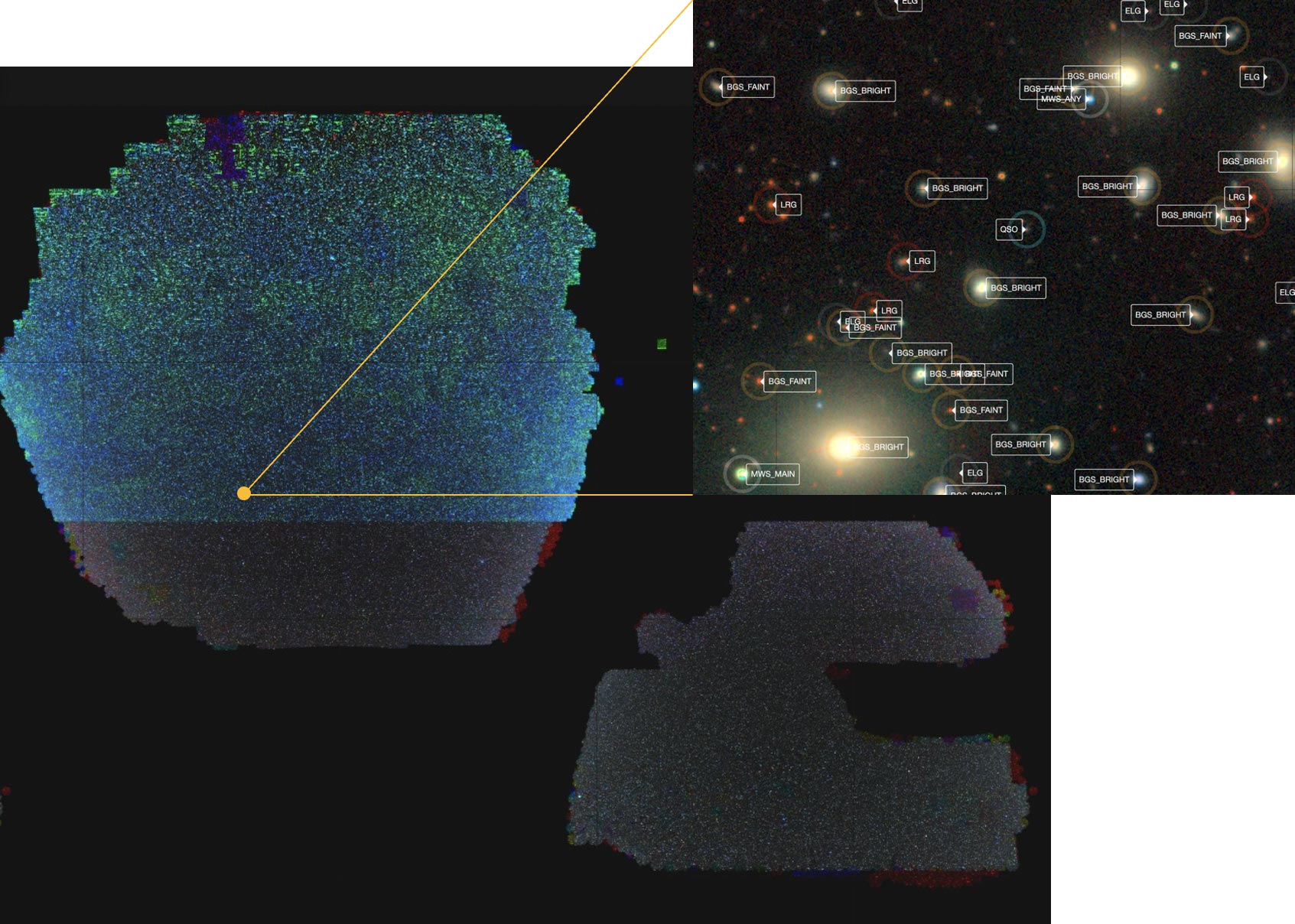
A massive new 2D universe map sets the stage for solving dark energy mysteries.
The Beijing-Arizona Sky Survey (BASS) team of National Astronomical Observatories of Chinese Academy of Sciences (NAOC) and their collaborators of the Dark Energy Spectroscopic Instrument (DESI) project released a giant 2D map of the universe, which paves the way for the upcoming new-generation dark energy spectroscopic survey.
Modern astronomical observations reveal that the universe is expanding and appears to be accelerating. The power driving the expansion of the universe is called dark energy by astronomers. Dark energy is still a mystery and accounts for about 68% of the substance of the universe.
Large-scale redshift measurements of galaxies can describe the 3D distribution of the matter and reveal the effect of dark energy on the expansion of the universe.
The DESI project is a new-generation cosmological redshift survey. ZHAO Gongbo, Deputy Director-General of NAOC and a member of DESI, said “DESI will execute a five-year mission to obtain the redshifts of millions of galaxies and construct the largest 3D universe. It is expected to solve the mystery of dark energy.”
Building a Base Map for DESI
“Before DESI begins, researchers need a larger and deeper 2D map of the universe to meet the targeting requirements of such large-scale spectroscopic observations,” said ZOU Hu, one of the BASS co-PIs and an associate professor in NAOC.
Nearly 200 researchers from the NAOC and DESI collaborations have put much effort into joint observing and data analysis over the past six years. They stitched together the observed images and formed a giant 2D map of the universe.
Nathalie Palanque-Delabrouille, DESI co-spokesperson and a cosmologist at the French Alternative Energies and Atomic Energy Commission (CEA), said “DESI wouldn’t be getting anywhere without such large imaging surveys.”
A Record-Breaking 2D Sky Map
“This is the biggest map by almost any measure. The map covers half of the sky, digitally sprawls over 10 trillion pixels, and contains about two billion objects,” said David Schlegel, the co-project scientist for DESI and leader of the imaging project.
In the 2D map of the universe, the BASS contributes to the northern sky. It is an international collaboration between NAOC and the University of Arizona in the U.S. XUE Suijian from NAOC said “Chinese astronomers have joined DESI as the builders due to the BASS contribution.”
The DESI imaging team also released eight versions of data, especially for the DESI targeting. This data release is the final release. It includes the largest imaging area and the most precise object measurements, according to CUI Chenzhou, the executive director of the National Astronomical Data Center.
This release will contribute to the successful implementation of the DESI project. Additionally, the data will serve as legacy data for the global astronomical community, playing a valuable role in scientific applications.
BASS was supported by the Strategic Priority Research Program and External Cooperation Program of the Chinese Academy of Sciences.
Never miss a breakthrough: Join the SciTechDaily newsletter.
Follow us on Google and Google News.
9 Comments
How is it possible to map something that many Cosmologists ( stars no hair does ) say doesn’t exist as it cannot be measured?
Not many cosmologists says darl energy do not exist, on the contrary they say it has been observed many times.
Hence the project and its many collaborators.
You may want to read up on what dark energy is:
“In physical cosmology and astronomy, dark energy is an unknown form of energy that affects the universe on the largest scales. The first observational evidence for its existence came from measurements of supernovae, which showed that the universe does not expand at a constant rate; rather, the expansion of the universe is accelerating.”
“Since the 1990s, dark energy has been the most accepted premise to account for the accelerated expansion. As of 2020, there are active areas of cosmology research aimed at understanding the fundamental nature of dark energy.”
“The “cosmological constant” is a constant term that can be added to Einstein’s field equation of general relativity. If considered as a “source term” in the field equation, it can be viewed as equivalent to the mass of empty space (which conceptually could be either positive or negative), or “vacuum energy”.”
[ https://en.wikipedia.org/wiki/Dark_energy ]
It is the expected vacuum energy of the sum of all the particle fields we see.
Direct evidence for an accelerating Universe came from observations of type Ia supernovae by the High-Z Supernova Search Team (Riess et al. 1998) and by the Supernova Cosmology Project team (Perlmutter et al. 1999).
Their research showed that remote supernovae are 10% to 25% dimmer and therefore further away than expected as compared to the nearby (local) supernovae.
Standard luminosities of type Ia supernovae helped the researchers to determine their distances, while the observed redshifts provided an estimate of their recession velocities – the relation between redshift and distance helped the researchers to determine the expansion rate (km/s/Mpc) of the Universe.
Remote measurement yields an expansion rate of 46 km/s/Mpc (Blanchard et al. 2003) which is much lower than the local measurement of 72 km/s/Mpc by the Hubble Key Project (Freedman et al.).
The expansion rate (km/s/Mpc) for remote supernovae is lower than the expansion rate for local supernovae, therefore, we say that the Universe is accelerating now and had a slower expansion in the past.
According to Durrer (2011), “our single indication for the existence of dark energy comes from distance measurements and their relation to redshift”.
Working on research made me analyse the data. The peer-reviewed paper presents a novel interpretation of the redshift-distance relationship of observed supernovae as reported by the scientific reviewer of one of the most prestigious astronomy journals.
I believe accelerating Universe is a surprising discovery due to an undiscovered aspect.
The results have been confirmed by plotting,
1) Scale factor vs. time relationship,
2) Expansion factor vs. time relationship,
3) Expansion rate vs. time relationship, and
4) Velocity-distance relationship
https://www.researchgate.net/publication/343484700
“According to Durrer (2011), “our single indication for the existence of dark energy comes from distance measurements and their relation to redshift”.”
I found that paper and its particle astrophysics author, so that is all well and good. However it is an old paper. A lot has happened since then, including that independent multimessenger observations with gravitational observatories concur with the current observed expansion rates. I suspect few cosmologist concur with her dismissal of all the independent yet consistent evidence, however redshift and theory dependent.
The CMB dismissal – where the energy components of normal matter, dark matter and dark energy can all be observed – is especially strained since the distance to the last scattering surface both comes in as merely a scale factor for the total energy budget *and* can be independently redshift identified by the spectral temperatur at last scattering versus now (the famous z ~ 1000 factor between T ~ 3,000 K and T ~ 3 K). Anyone can see both dark matter and dark energy in the cosmic background spectra!
In any case it remains that a nonexistence of dark energy is an extraordinary claim without extraordinary evidence. It was first with its discovery that modern cosmology went from imprecise with ages differing a factor 2 to a precision field with current imprecision ~ 1 % sigma [eBOSS collaboration galaxy survey cosmology paper, https://arxiv.org/abs/2007.08991 ].
In the end you self promote an article that is, contrary to your claim, not peer reviewed published according to your link and according to an independent web search. It is perhaps in review, and we may see of it stands.
Specifically on these types of observations, the supernova data is ladder dependent, data sparse and contains two populations.
“But he thinks cosmologists will run into trouble as they put their theories to more rigorous tests that require more precise standard candles. “Supernovae could be less useful for precision cosmology,” he says.
Astronomers already knew the peak brightness of type Ia supernovae isn’t perfectly consistent. To cope, they have worked out an empirical formula, known as the Phillips relation, that links peak brightness to the rate at which the light fades: Flashes that decay slowly are overall brighter than those that fade quickly. But more than 30% of type Ia supernovae stray far from the Phillips relation. Perhaps low-mass D6 explosions can explain these oddballs, Shen says. For now, those who wield the cosmic yardstick will need to “throw away anything that looks weird,” Gaensicke says, and hope for the best.”
[ https://www.sciencemag.org/news/2020/06/galaxy-s-brightest-explosions-go-nuclear-unexpected-trigger-pairs-dead-stars ]
Or we can integrate all the data to avoid having to “hope for the best” – we will know. Currently we know at 1 % uncertainty that dark energy is both an observation and part of a successful theory.
“According to Durrer (2011), “our single indication for the existence of dark energy comes from distance measurements and their relation to redshift”.”
I found that paper and its particle astrophysics author, so that is all well and good. However it is an old paper. A lot has happened since then, including that independent multimessenger observations with gravitational observatories concur with the current observed expansion rates. I suspect few cosmologist concur with her dismissal of all the independent yet consistent evidence, however redshift and theory dependent.
The CMB dismissal – where the energy components of normal matter, dark matter and dark energy can all be observed – is especially strained since the distance to the last scattering surface both comes in as merely a scale factor for the total energy budget *and* can be independently redshift identified by the spectral temperatur at last scattering versus now (the famous z ~ 1000 factor between T ~ 3,000 K and T ~ 3 K). Anyone can see both dark matter and dark energy in the cosmic background spectra!
In any case it remains that a nonexistence of dark energy is an extraordinary claim without extraordinary evidence. It was first with its discovery that modern cosmology went from imprecise with ages differing a factor 2 to a precision field with current imprecision ~ 1 % sigma [eBOSS collaboration galaxy survey cosmology paper, arxiv 2007.08991 ].
In the end you self promote an article that is, contrary to your claim, not peer reviewed published according to your link and according to an independent web search. It is perhaps in review, and we may see of it stands.
Specifically on these types of observations, the supernova data is ladder dependent, data sparse and contains two populations.
“But he thinks cosmologists will run into trouble as they put their theories to more rigorous tests that require more precise standard candles. “Supernovae could be less useful for precision cosmology,” he says.
Astronomers already knew the peak brightness of type Ia supernovae isn’t perfectly consistent. To cope, they have worked out an empirical formula, known as the Phillips relation, that links peak brightness to the rate at which the light fades: Flashes that decay slowly are overall brighter than those that fade quickly. But more than 30% of type Ia supernovae stray far from the Phillips relation. Perhaps low-mass D6 explosions can explain these oddballs, Shen says. For now, those who wield the cosmic yardstick will need to “throw away anything that looks weird,” Gaensicke says, and hope for the best.”
[ https://www.sciencemag.org/news/2020/06/galaxy-s-brightest-explosions-go-nuclear-unexpected-trigger-pairs-dead-stars ]
Or we can integrate all the data to avoid having to “hope for the best” – we will know. Currently we know at 1 % uncertainty that dark energy is both an observation and part of a successful theory.
Sorry for the double post – the version that accidentally had two links got held up in moderation, but then immediately got approved while I posted a modified version.
Hello Torbjörn Larsson, no issues with the double post, and thank you for the valuable insight on this.
As I stated, “direct evidence” for an accelerating Universe came from observations of type Ia supernovae that showed that remote supernovae are further away than expected as they appeared 10% to 25% dimmer than the local supernovae.
Possibilities included pervasive screen of grey dust between the local and the remote Universe, and the evolution of type Ia supernovae. These possibilities have been addressed and are no longer a concerning factor.
Can acceleration only be the reason why remote supernovae are further away than expected as compared to the nearby local supernovae?
If remote supernovae began expanding into the Universe before the expansion got initiated for the nearby local supernovae, then in this case also remote supernovae would end up being further away than expected. This is exactly what we observe – remote supernovae are indeed further away than expected as compared to the nearby local supernovae.
Remote supernovae are not only further away than expected, but they also yield a slower rate of expansion even with high recession velocities as compared to the higher rate of expansion obtained for the nearby local supernovae even with low recession velocities.
There can’t be any other reason for such a trend where an object with high recession velocity is not only further away than expected, but is also yielding a slower rate of expansion as compared to the expansion rate obtained for an object with low recession velocity. This is only possible if remote supernovae began expanding into the Universe before the expansion got initiated for the local supernovae.
The similarities incurred while plotting the following relationships confirm this claim to an extent,
1) Scale factor vs. time relationship (based on redshift),
2) Expansion factor vs. time relationship (based on redshift),
3) Expansion rate vs. time relationship (based on recession velocity), and
4) Velocity-distance relationship
Hello Karan R. Takkhi. Glad if you find my response appropriate!
Now, personally I take a dim view to the description “direct evidence”. Is there a testable difference between what would be direct or indirect evidence, or is it simply the personal opinion of the author? In any case, I note that the evidence of expansion comes from many observations, the change in CMB temperature the simplest such.
“There can’t be any other reason for such a trend where an object with high recession velocity is not only further away than expected, but is also yielding a slower rate of expansion as compared to the expansion rate obtained for an object with low recession velocity.”
I’m not sure I understand where you want to go with this apart from repeating the list that you put under your earlier link? The scale factor expansion is approaching an exponential due to the inner state change of the universe were dark energy dominates ever more, and that leads to a lower value of the expansion parameter.
“Current evidence suggests that the expansion rate of the universe is accelerating, which means that the second derivative of the scale factor {\displaystyle {\ddot {a}}(t)}{\ddot {a}}(t) is positive, or equivalently that the first derivative {\displaystyle {\dot {a}}(t)}{\dot {a}}(t) is increasing over time.[5] This also implies that any given galaxy recedes from us with increasing speed over time, i.e. for that galaxy {\displaystyle {\dot {d}}(t)}{\dot {d}}(t) is increasing with time. In contrast, the Hubble parameter seems to be decreasing with time, meaning that if we were to look at some fixed distance d and watch a series of different galaxies pass that distance, later galaxies would pass that distance at a smaller velocity than earlier ones.”
[ https://en.wikipedia.org/wiki/Scale_factor_(cosmology) ].
*************
As it happens, today I want to have my fun too. I just realized there is a hope that we can see the new result on dark matter nature with our own eyes from dark energy surveys! So of course I want to expand in that.
“Associate professor at the Niels Bohr Institute Charles Steinhardt, is intrigued by these new results. “If we are actually dealing with two disagreements, it means that our current model would be “broken in an interesting way,” he says. “In order to solve two problems, one regarding the composition of the Universe and one regarding the expansion rate of the Universe, rather different physical explanations are required than if we only want to explain a single discrepancy in the expansion rate.””
[“Measuring the Expansion of the Universe: Surprising Discrepancies Hint at Inconsistency in the Composition of the Universe”, Sci TechDaily]
The clear results from the paper is that the universe is flat and that you need really precise supernova redshifts, <= 10^-3 uncertainties [!], to derive unbiased cosmological parameters from them.
The hypothesis that these measurements may suggest new physics hinges on finding another tension in their data. The problem is that they cluster their data so it is hard to tell if it is a real tension.
As a comparison, this paper on supernova physics comes to another conclusion since they see different populations of supernovas, suggesting other types of clustering as well.
"“Supernovae could be less useful for precision cosmology,” he says."
["The galaxy’s brightest explosions go nuclear with an unexpected trigger: pairs of dead stars", Science]
If there is a real tension in the expansion rate observations after these population and uncertainty issues have been taken care of, the solution can be as simple as considering the magnetic fields that we observe between galaxies in the cosmic filaments. ["The Hidden Magnetic Universe Begins to Come Into View", Quanta Magazine]
But if the dark matter tension is real, that could be exciting!
The recent paper that use quantum field physics to constrain the nature and mass of dark matter suggest that at its simplest it is a scalar field particle which is unstable and is finetuned to last sufficiently long for galaxy formation ["Narrowing Down the Mass of Dark Matter", Universe Today; preprint arxiv 2009.11575].
If so, that was more overt finetuning than I expected. Even considering that the vacuum ("dark") energy and the normal matter sector (the Higgs mass) seems finetuned as well and potentially making all three energy sectors such.
Hello Torbjörn Larsson!
Thank you for the response.
I am talking about “direct evidence for accelerating expansion of Universe” – “direct” because it was the first evidence based directly on observations of observables, that is, redshift and standard luminosity.
Redshift gave recession velocity and the scale factor, whereas standard luminosity gave the distance.
“Scale factor is approaching an exponential” that is how we know the Universe is accelerating, correct?
Now, “scale factor approaching an exponential” can also be obtained “without acceleration” if remote supernovae began expanding into the Universe before the expansion began for the nearby local supernovae.
As I had asked, “Can acceleration only be the reason why remote supernovae are further away than expected as compared to the nearby local supernovae?”
The answer is, No!
Remote supernovae can also be further away than expected if they began expanding into the Universe before the expansion began for the nearby local supernovae.
I have already verified this by plotting the following relationships; the similarities confirm my claim.
1) Scale factor vs. time relationship (based on redshift),
2) Expansion factor vs. time relationship (based on redshift),
3) Expansion rate vs. time relationship (based on recession velocity), and
4) Velocity-distance relationship (based on recession velocity)