
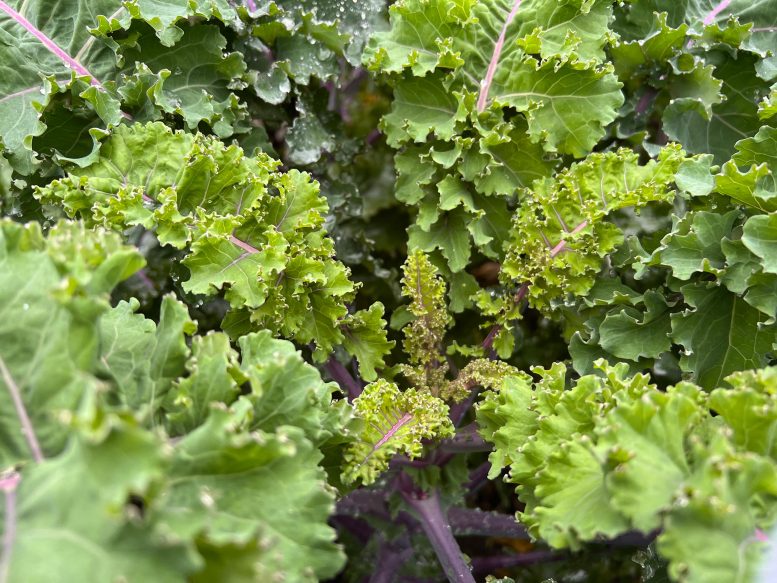
Researchers from Oldenburg and Bremen investigated the effect of environmental factors on genetically different varieties of kale.
Kale is widely recognized as a particularly healthy vegetable, largely due to its high content of secondary plant compounds. These include glucosinolates, which contribute to the vegetable’s characteristic cabbage flavor.
A team of German researchers, led by Dr. Christoph Hahn and Professor Dr. Dirk Albach from the University of Oldenburg, has recently published a study in the science journal Horticulturae. This study reveals that the composition of these substances, also known as mustard oil glycosides, is influenced by both environmental factors – in particular temperature – as well as genetic factors.
Variability in Glucosinolate Concentrations
The research team’s findings show that glucosinolate concentration in certain kale varieties increases under cold temperatures, while in others it decreases. “To obtain plants with an improved nutritional value, considering both temperature and the choice of cultivar is crucial,” Hahn stresses.
Previously, Dr. Hahn demonstrated that the approximately 150 worldwide kale varieties can be divided into several genetically distinct groups. These groups vary in appearance, taste, color, and phytochemical composition. Another group consists of Italian varieties with a milder taste and elongated, dark leaves known as “Lacinato kale,” “palm kale,” or “black cabbage.” A third group is made up of varieties with broad, smooth leaves which are commonly grown in the United States and are more similar to the wild form or “feral-type” cabbage.
Chemical Protection From Caterpillars and Snails
In the current study, Hahn’s team investigated the impact of cold temperatures on the glucosinolate composition in kale leaves. When the leaves are crushed, these substances are converted into mustard oils (isothiocyanates) which protect the vegetable from predators such as caterpillars and snails. These substances are also responsible for the vegetable’s characteristic, in some cases bitter and pungent taste. Glucosinolate levels are particularly high in feral-type kale and tend to be considerably lower in Lacinato varieties.
For their study the researchers selected the three varieties “Frostara,” “Palmizio,” and “Helgoländer,” which can be assigned to the curly kale, Lacinato kale, and feral-type kale groups, respectively. They grew 45 specimens of each variety in a climate chamber at the University and exposed the adult plants to temperatures of two degrees Celsius for one week. Leaf samples for analyses of glucosinolate levels and composition were taken at warm temperatures, after twelve hours of cold exposure, and after seven days of cold exposure. Concentrations of seven different glucosinolates were analyzed at all three time-points using a mass spectrometer.
Surprising Findings and Implications for Taste
The result: the scientists found that total glucosinolate levels increased at low temperatures in both the curly kale and Lacinato samples, but decreased in the feral type. This came as a surprise for the team: “Based on our previous experiments we would not have expected the Lacinato kale to react in exactly the same way as the curly variety, since it is adapted to different climatic conditions,” Hahn commented.
How these results affect the taste of kale was not investigated in the study. “For the taste not just the glucosinolates but also the sugar content is decisive,” Hahn explained. The biologist already demonstrated in a study published in 2020 that levels of sugar compounds in kale leaves also increase at low temperatures – however not only at sub-zero temperatures, as is often assumed, but already at temperatures in the above-zero single-digit range.
Reference: “A Cold Case—Glucosinolate Levels in Kale Cultivars Are Differently Influenced by Cold Temperatures” by Christoph Hahn, Anja Müller, Nikolai Kuhnert and Dirk C. Albach, 22 August 2023, Horticulturae.
DOI: 10.3390/horticulturae9090953
Never miss a breakthrough: Join the SciTechDaily newsletter.
Follow us on Google and Google News.
1 Comment
The world would be fine without kale.