
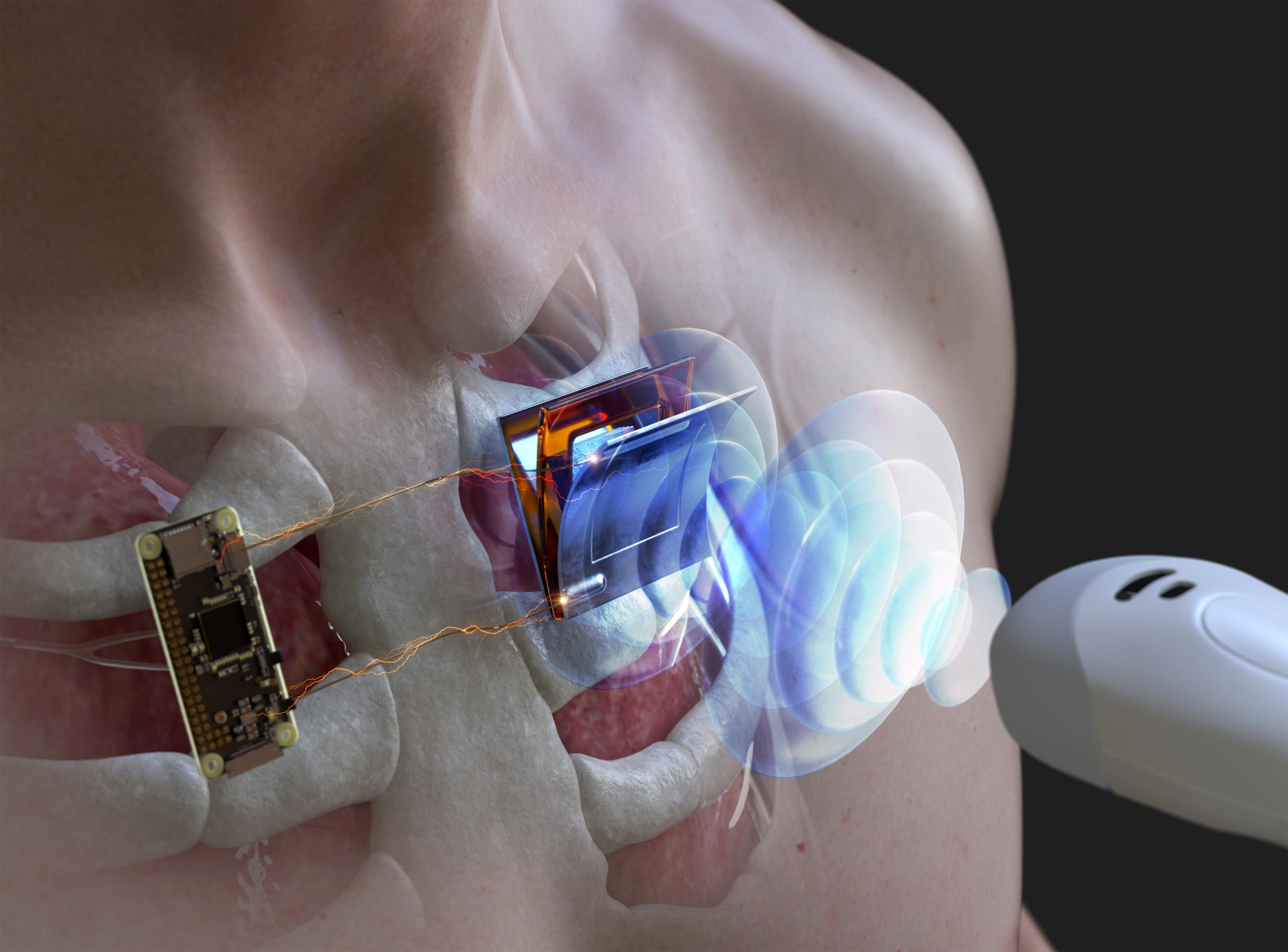
New technology improves the efficiency of wireless energy transfer of ultrasonic waves by triboelectric power generation. Ultrasonic waves have applications in wireless charging of batteries underwater or in body-implanted electronic devices.
The number of patients using implanted electronic devices, such as artificial pacemakers and defibrillators, is increasing worldwide as the population ages and medical technology advances. Currently, batteries for body-implanted devices are replaced through an incision operation, which can lead to health complications. As a result, a novel wireless energy transfer charging technique is being developed that can be used to charge body-implanted devices without surgery. This same technology can also be used to charge the batteries of underwater devices, such as sensors, that are used to monitor undersea cable conditions.
The Korea Institute of Science and Technology (KIST, President: Seok-Jin Yoon) announced that a research team led by Dr. Hyun-Cheol Song at the Electronic Materials Research Center developed an ultrasonic wireless power transmission technology that can be applied in the above-mentioned research areas.
Electromagnetic (EM) induction and magnetic resonance can be used in wireless energy transfer. EM induction is presently being used in smartphones and wireless earphones; however, its usage is limited because EM waves cannot pass through water or metal, resulting in short charging distance. In addition, this method cannot be easily used to recharge implanted medical devices as the heat generated during charging is harmful. The magnetic resonance method requires that the resonant frequencies of the magnetic field generator and transmitting device are exactly the same; moreover, a risk of interference with other wireless communication frequencies, such as Wi-Fi and Bluetooth, exists.
The Adoption of Ultrasonic Waves
The KIST team, therefore, adopted ultrasonic waves as an energy transmission medium, instead of EM waves or magnetic fields. Sonar, which uses ultrasound waves, is commonly used in underwater environments, and the safety of using ultrasonic waves in the human body has been guaranteed in various medical applications, such as organ or fetal condition diagnosis. However, the existing acoustic energy transfer methods are not commercialized easily due to the low transmission efficiency of acoustic energy.

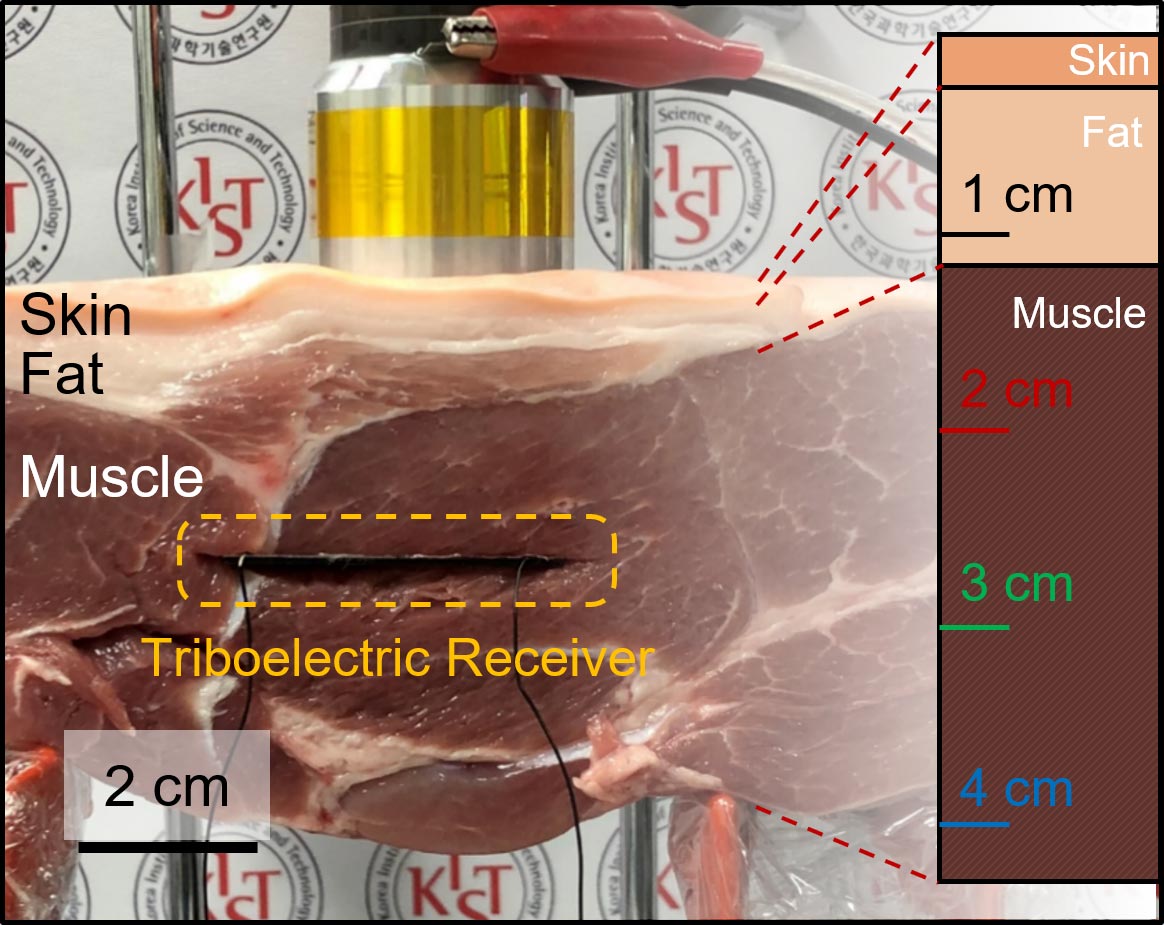
The research team developed a model that receives and converts ultrasonic waves into electrical energy using the triboelectric principle that allows for the conversion of small mechanical vibrations into electrical energy effectively. By adding a ferroelectric material to the triboelectric generator, the ultrasonic energy transfer efficiency was significantly improved from less than 1% to more than 4%. Moreover, charging of more than 8 mW power at a distance of 6 cm was possible, which was sufficient to simultaneously operate 200 LEDs or to communicate Bluetooth sensor data underwater. In addition, the newly developed device had high energy conversion efficiency and generated marginal amounts of heat.
Dr. Song explained the significance of the results as follows: “This study demonstrated that electronic devices can be driven by wireless power charging via ultrasonic waves. If the stability and efficiency of the device are further improved in the future, this technology can be applied to supply power wirelessly to implantable sensors or deep-sea sensors, in which replacing batteries is cumbersome.”
Reference: “Ferroelectrically augmented contact electrification enables efficient acoustic energy transfer through liquid and solid media” by Hyun Soo Kim, Sunghoon Hur, Dong-Gyu Lee, Joonchul Shin, Huimin Qiao, Seunguk Mun, Hoontaek Lee, Wonkyu Moon, Yunseok Kim, Jeong Min Baik, Chong-Yun Kang, Jong Hoon Jung and Hyun-Cheol Song, 22 Jan 2022, Energy & Environmental Science.
DOI: 10.1039/D1EE02623B
KIST was established in 1966 as the first government-funded research institute to establish a national development strategy based on science and technology and disseminate various industrial technologies to develop major industries. KIST is now raising Korean science and technology status through world-leading innovative research and development.
This research was supported the National Research Foundation of Korea (NRF) grant and the National Research Council of Science & Technology (NST) grant funded by the Ministry of Science and ICT (Ministrer: Hye-Sook Lim) and the Korea Institute of Energy Technology Evaluation & Planning (KETEP) grant funded by the Ministry of Trade, Industry and Energy (Minister: Sung Wook Moon). The research results have been published in the latest issue of the “Energy & Environmental Science” (IF: 38.5, top 0.182% in JCR), an renowned international academic journal in the field of energy.
Never miss a breakthrough: Join the SciTechDaily newsletter.
Follow us on Google and Google News.