
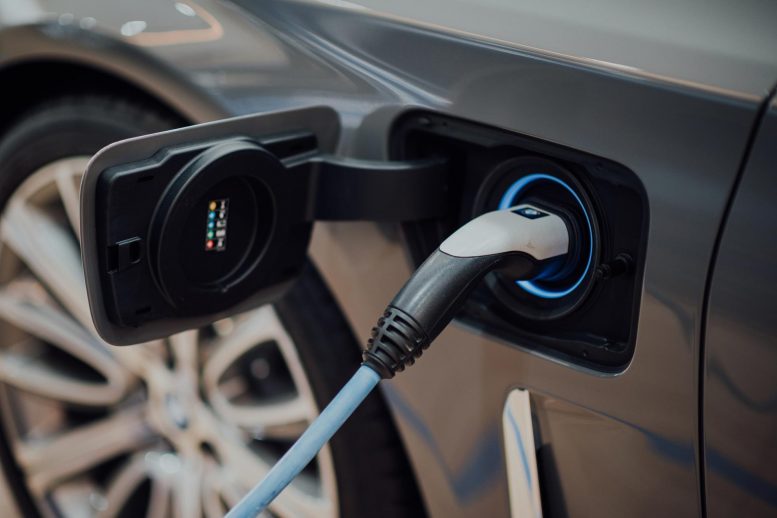
MIT researchers develop novel EV emissions model to quantify importance of vehicle charging patterns and impact of ambient temperature on EV emissions levels.
Transportation-related emissions are increasing globally. Currently, light-duty vehicles — namely passenger cars, such as sedans, SUVs, or minivans — contribute about 20 percent of the net greenhouse gas emissions in the United States. But studies have shown that switching out your conventional gas-guzzling car for a vehicle powered by electricity can make a significant dent in reducing these emissions.
A recent study published in Environmental Science and Technology takes this a step further by examining how to reduce the emissions associated with the electricity source used to charge an electric vehicle (EV). Taking into account regional charging patterns and the effect of ambient temperature on car fuel economy, researchers at the MIT Energy Initiative (MITEI) find that the time of day when an EV is charged significantly impacts the vehicle’s emissions.
“If you facilitate charging at particular times, you can really boost the emissions reductions that result from growth in renewables and EVs,” says Ian Miller, the lead author of the study and a research associate at MITEI. “So how do we do this? Time-of-use electricity rates are spreading, and can dramatically shift the time of day when EV drivers charge. If we inform policymakers of these large time-of-charging impacts, they can then design electricity rates to discount charging when our power grids are renewable-heavy. In solar-heavy regions, that’s midday. In wind-heavy regions, like the Midwest, it’s overnight.”
According to their research, in solar-heavy California, charging an electric vehicle overnight produces 70 percent more emissions than if it were charged midday (when more solar energy powers the grid). Meanwhile, in New York, where nuclear and hydro power constitute a larger share of the electricity mix during the night, the best charging time is the opposite. In this region, charging a vehicle overnight actually reduces emissions by 20 percent relative to daytime charging.
“Charging infrastructure is another big determinant when it comes to facilitating charging at specific times — during the day especially,” adds Emre Gençer, co-author and a research scientist at MITEI. “If you need to charge your EV midday, then you need to have enough charging stations at your workplace. Today, most people charge their vehicles in their garages overnight, which is going to produce higher emissions in places where it is best to charge during the day.”
In the study, Miller, Gençer, and Maryam Arbabzadeh, a postdoc at MITEI, make these observations in part by calculating the percentage of error in two common EV emission modeling approaches, which ignore hourly variation in the grid and temperature-driven variation in fuel economy. Their results find that the combined error from these standard methods exceeds 10 percent in 30 percent of the cases, and reaches 50 percent in California, which is home to half of the EVs in the United States.
“If you don’t model time of charging, and instead assume charging with annual average power, you can mis-estimate EV emissions,” says Arbabzadeh. “To be sure, it’s great to get more solar on the grid and more electric vehicles using that grid. No matter when you charge your EV in the U.S., its emissions will be lower than a similar gasoline-powered car; but if EV charging occurs mainly when the sun is down, you won’t get as much benefit when it comes to reducing emissions as you think when using an annual average.”
Seeking to lessen this margin of error, the researchers use hourly grid data from 2018 and 2019 — along with hourly charging, driving, and temperature data — to estimate emissions from EV use in 60 cases across the United States. They then introduce and validate a novel method (with less than 1 percent margin of error) to accurately estimate EV emissions. They call it the “average day” method.
“We found that you can ignore seasonality in grid emissions and fuel economy, and still accurately estimate yearly EV emissions and charging-time impacts,” says Miller. “This was a pleasant surprise. In Kansas last year, daily grid emissions rose about 80 percent between seasons, while EV power demand rose about 50 percent due to temperature changes. Previous studies speculated that ignoring such seasonal swings would hurt accuracy in EV emissions estimates, but never actually quantified the error. We did — across diverse grid mixes and climates — and found the error to be negligible.”
This finding has useful implications for modeling future EV emissions scenarios. “You can get accuracy without computational complexity,” says Arbabzadeh. “With the average-day method, you can accurately estimate EV emissions and charging impacts in a future year without needing to simulate 8,760 values of grid emissions for each hour of the year. All you need is one average-day profile, which means only 24 hourly values, for grid emissions and other key variables. You don’t need to know seasonal variance from those average-day profiles.”
The researchers demonstrate the utility of the average-day method by conducting a case study in the southeastern United States from 2018 to 2032 to examine how renewable growth in this region may impact future EV emissions. Assuming a conservative grid projection from the U.S. Energy Information Administration, the results show that EV emissions decline only 16 percent if charging occurs overnight, but more than 50 percent if charging occurs midday. In 2032, compared to a similar hybrid car, EV emissions per mile are 30 percent lower if charged overnight, and 65 percent lower if charged midday.
The model used in this study is one module in a larger modeling program called the Sustainable Energy Systems Analysis Modeling Environment (SESAME). This tool, developed at MITEI, takes a systems-level approach to assess the complete carbon footprint of today’s evolving global energy system.
“The idea behind SESAME is to make better decisions for decarbonization and to understand the energy transition from a systems perspective,” says Gençer. “One of the key elements of SESAME is how you can connect different sectors together — ‘sector coupling’ — and in this study, we are seeing a very interesting example from the transportation and electric power sectors. Right now, as we’ve been claiming, it’s impossible to treat these two sector systems independently, and this is a clear demonstration of why MITEI’s new modeling approach is really important, as well as how we can tackle some of these impending issues.”
In ongoing and future research, the team is expanding their charging analysis from individual vehicles to whole fleets of passenger cars in order to develop fleet-level decarbonization strategies. Their work seeks to answer questions such as how California’s proposed ban of gasoline car sales in 2035 would impact transportation emissions. They are also exploring what fleet electrification could mean — not only for greenhouse gases, but also the demand for natural resources such as cobalt — and whether EV batteries could provide significant grid energy storage.
“To mitigate climate change, we need to decarbonize both the transportation and electric power sectors,” says Gençer. “We can electrify transportation, and it will significantly reduce emissions, but what this paper shows is how you can do it more effectively.”
Reference: “Hourly Power Grid Variations, Electric Vehicle Charging Patterns, and Operating Emissions” by Ian Miller, Maryam Arbabzadeh and Emre Gençer, 26 November 2020, Environmental Science and Technology.
DOI: 10.1021/acs.est.0c02312
This research was sponsored by ExxonMobil Research and Engineering through the MIT Energy Initiative Low-Carbon Energy Centers.
Never miss a breakthrough: Join the SciTechDaily newsletter.
Follow us on Google and Google News.
2 Comments
Really now? But how can you go lower than 0? Wait, what? You mean an electric vehicle has emissions?!?! Typical stupid human tricks right here folks.
A more sure way to avoid the monopoly grid sins of the past is to go off grid and ONLY use pV solar power mounted to the elevated guideway.