
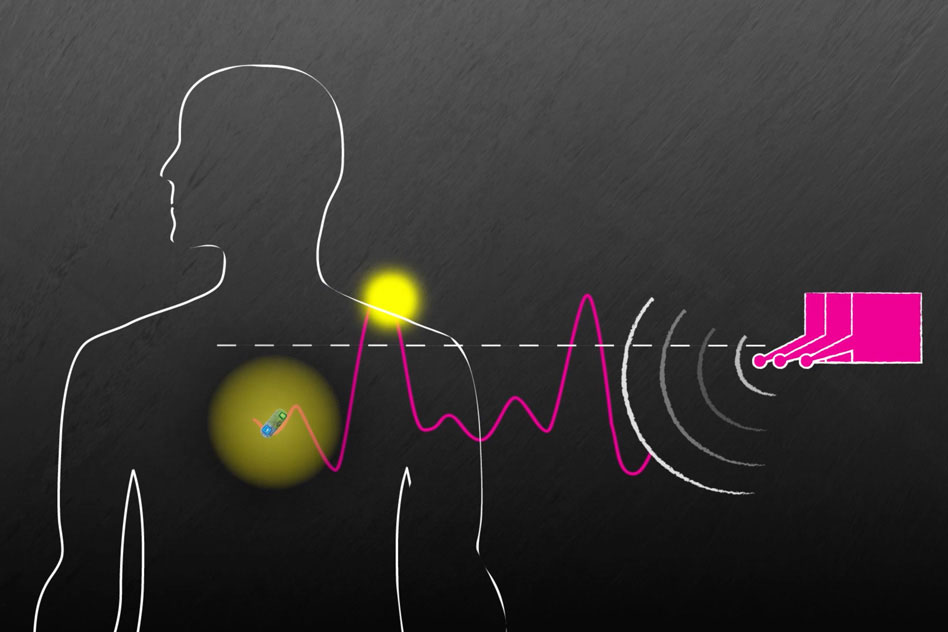
MIT researchers, working with scientists from Brigham and Women’s Hospital, have developed a new way to power and communicate with devices implanted deep within the human body. Such devices could be used to deliver drugs, monitor conditions inside the body, or treat disease by stimulating the brain with electricity or light.
The implants are powered by radio frequency waves, which can safely pass through human tissues. In tests in animals, the researchers showed that the waves can power devices located 10 centimeters deep in tissue, from a distance of 1 meter.
“Even though these tiny implantable devices have no batteries, we can now communicate with them from a distance outside the body. This opens up entirely new types of medical applications,” says Fadel Adib, an assistant professor in MIT’s Media Lab and a senior author of the paper, which will be presented at the Association for Computing Machinery Special Interest Group on Data Communication (SIGCOMM) conference in August.
Because they do not require a battery, the devices can be tiny. In this study, the researchers tested a prototype about the size of a grain of rice, but they anticipate that it could be made even smaller.
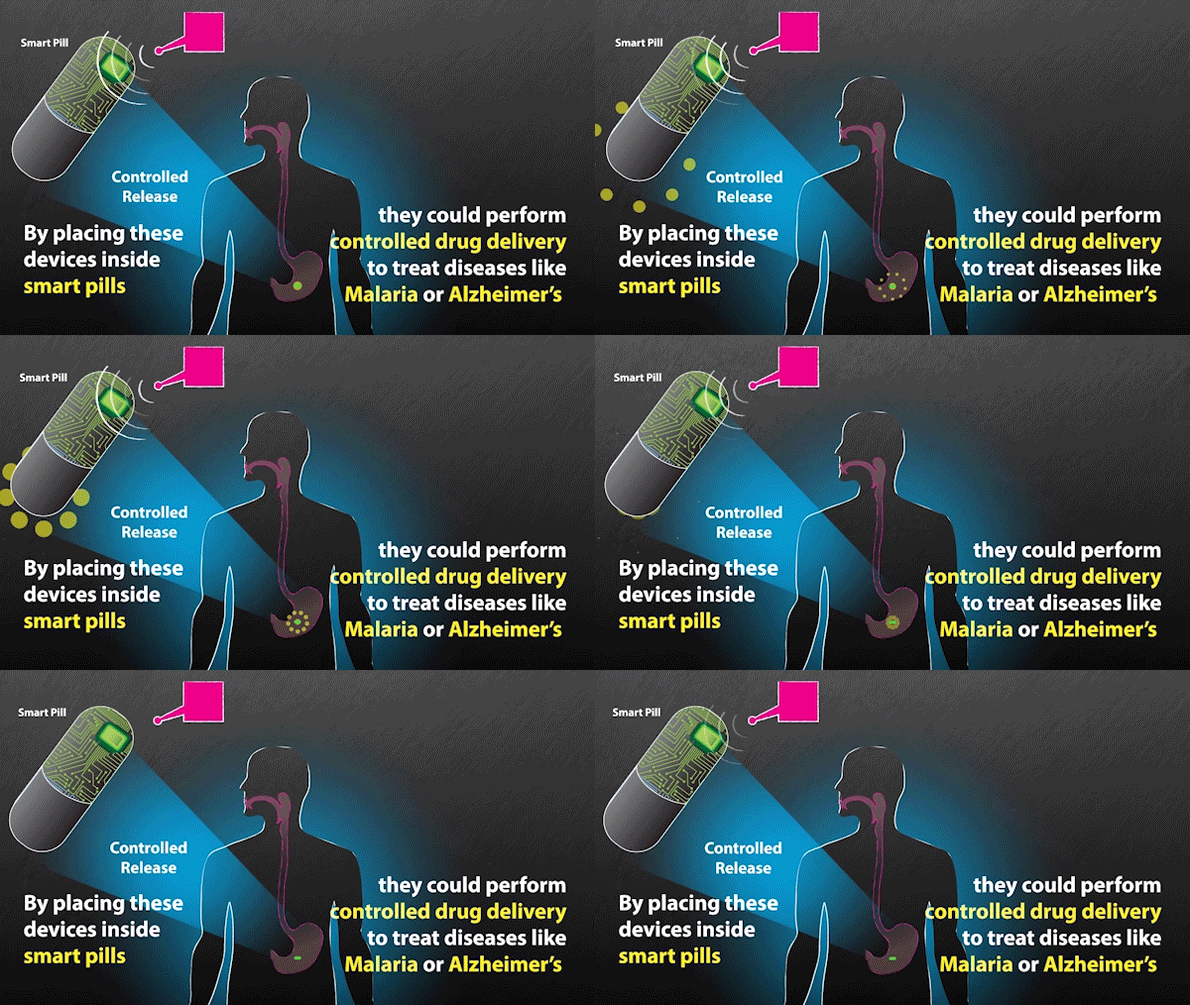
“Having the capacity to communicate with these systems without the need for a battery would be a significant advance. These devices could be compatible with sensing conditions as well as aiding in the delivery of a drug,” says Giovanni Traverso, an assistant professor at Brigham and Women’s Hospital (BWH), Harvard Medical School, a research affiliate at MIT’s Koch Institute for Integrative Cancer Research, and an author of the paper.
Other authors of the paper are Media Lab postdoc Yunfei Ma, Media Lab graduate student Zhihong Luo, and Koch Institute and BWH affiliate postdoc Christoph Steiger.
Researchers at MIT Media Lab, Harvard Medical School, and Brigham and Women’s Hospital have developed a new way to wirelessly power and communicate with devices implanted deep within the human body. Such devices could be used to deliver drugs, monitor conditions inside the body, or treat disease by stimulating the brain with electricity or light.
Wireless communication
Medical devices that can be ingested or implanted in the body could offer doctors new ways to diagnose, monitor, and treat many diseases. Traverso’s lab is now working on a variety of ingestible systems that can be used to deliver drugs, monitor vital signs, and detect movement of the GI tract.
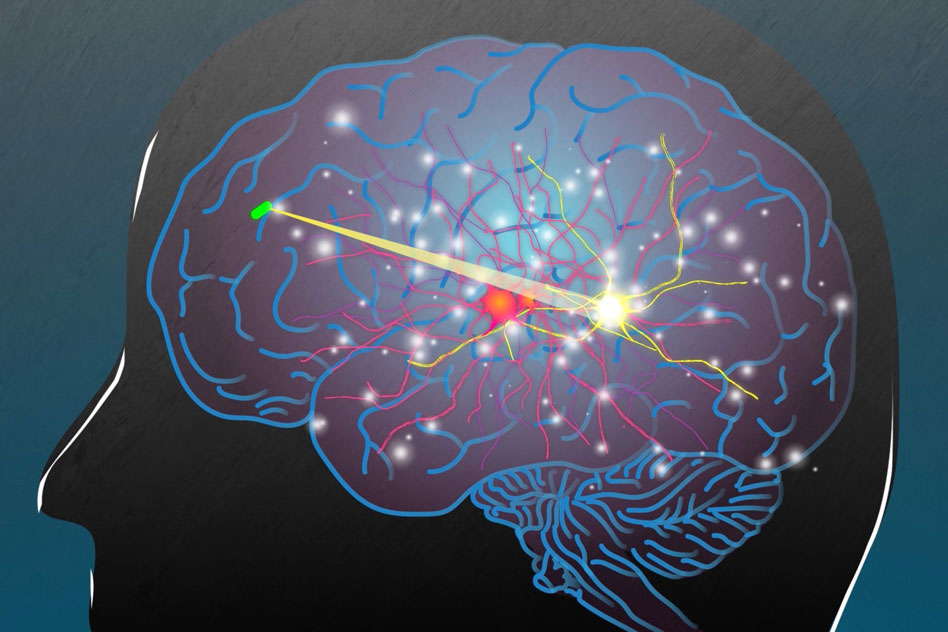
In the brain, implantable electrodes that deliver an electrical current are used for a technique known as deep brain stimulation, which is often used to treat Parkinson’s disease or epilepsy. These electrodes are now controlled by a pacemaker-like device implanted under the skin, which could be eliminated if wireless power is used. Wireless brain implants could also help deliver light to stimulate or inhibit neuron activity through optogenetics, which so far has not been adapted for use in humans but could be useful for treating many neurological disorders.
Currently, implantable medical devices, such as pacemakers, carry their own batteries, which occupy most of the space on the device and offer a limited lifespan. Adib, who envisions much smaller, battery-free devices, has been exploring the possibility of wirelessly powering implantable devices with radio waves emitted by antennas outside the body.
Until now, this has been difficult to achieve because radio waves tend to dissipate as they pass through the body, so they end up being too weak to supply enough power. To overcome that, the researchers devised a system that they call “In Vivo Networking” (IVN). This system relies on an array of antennas that emit radio waves of slightly different frequencies. As the radio waves travel, they overlap and combine in different ways. At certain points, where the high points of the waves overlap, they can provide enough energy to power an implanted sensor.
“We chose frequencies that are slightly different from each other, and in doing so, we know that at some point in time these are going to reach their highs at the same time. When they reach their highs at the same time, they are able to overcome the energy threshold needed to power the device,” Adib says.
With the new system, the researchers don’t need to know the exact location of the sensors in the body, as the power is transmitted over a large area. This also means that they can power multiple devices at once. At the same time that the sensors receive a burst of power, they also receive a signal telling them to relay information back to the antenna. This signal could also be used to stimulate release of a drug, a burst of electricity, or a pulse of light, the researchers say.
Long-distance power
In tests in pigs, the researchers showed they could send power from up to a meter outside the body, to a sensor that was 10 centimeters deep in the body. If the sensors are located very close to the skin’s surface, they can be powered from up to 38 meters away.
“There’s currently a tradeoff between how deep you can go and how far you can go outside the body,” Adib says.
The researchers are now working on making the power delivery more efficient and transferring it over greater distances. This technology also has the potential to improve RFID applications in other areas such as inventory control, retail analytics, and “smart” environments, allowing for longer-distance object tracking and communication, the researchers say.
The research was funded by the Media Lab Consortium and the National Institutes of Health.
Paper: Enabling Deep-Tissue Networking for Miniature Medical Devices
Never miss a breakthrough: Join the SciTechDaily newsletter.
Follow us on Google and Google News.
1 Comment
WOW! My skin has never felt so good. I’m most impressed with the technology…you barely feel anything from the probe, but boy does it work! I noticed a difference after just a few uses. Very pleased with LYFT.