
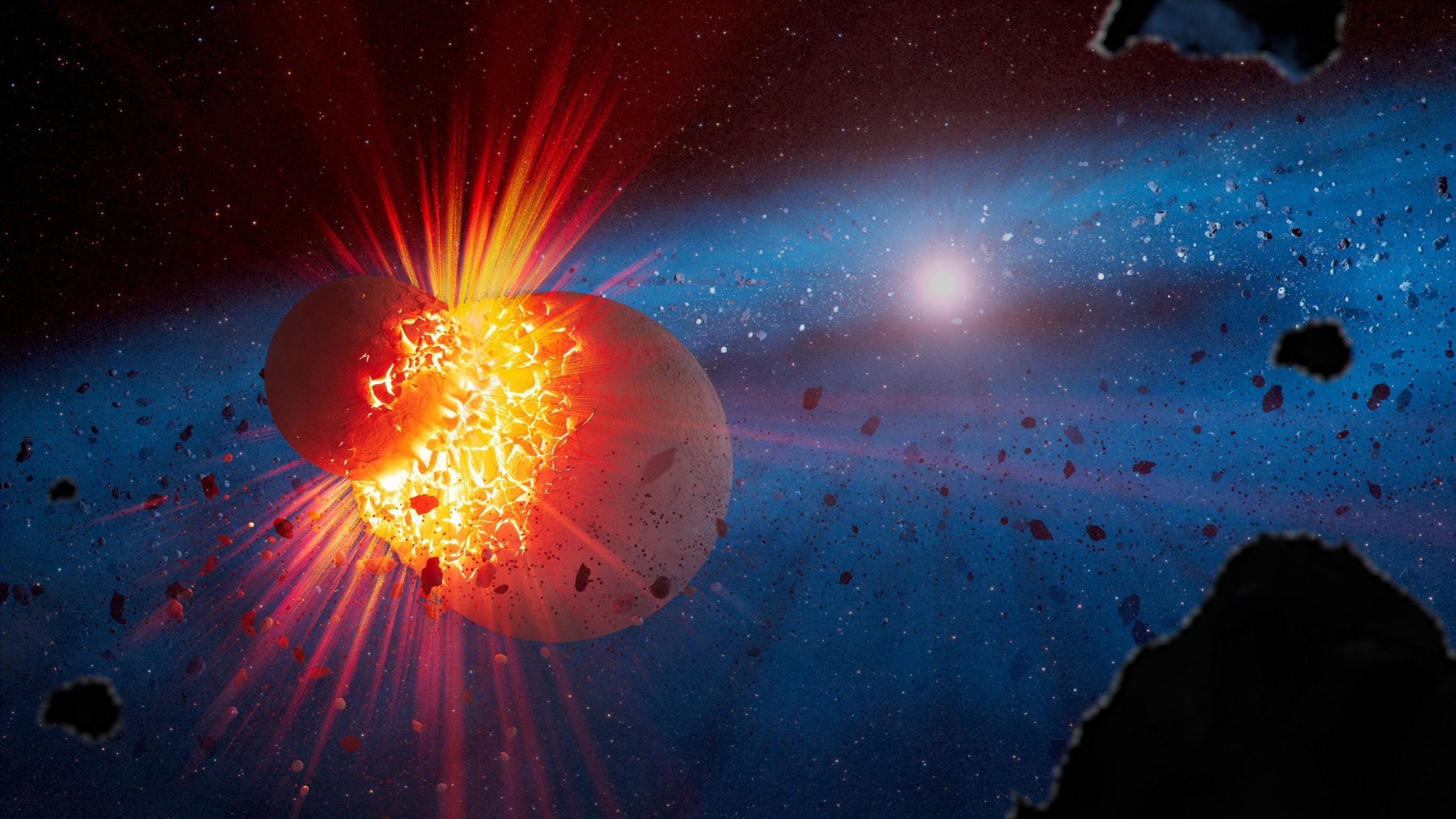
Dust around distant stars may reveal whether colliding worlds grazed one another or hit hard enough to vaporize rock.
Vaporizing vast amounts of solid rock, a Mars-sized world called Theia may have slammed into the infant Earth, blasting debris into space that eventually gathered into the Moon. Astronomers searching for similar collisions around distant stars cannot observe the developing planets directly because they appear too small at such great distances. They look for clues in the dust those impacts may leave behind, though these unusually dusty environments appear around only about 1% of young stars.
Kate Su of the Space Science Institute in Boulder, Colorado, and her colleagues used NASA’s James Webb Space Telescope to examine these environments, known as extreme debris disks. Using observations from Webb and NASA’s retired Spitzer Space Telescope, the team identified minerals through distinctive features in the dust’s mid-infrared light. Their findings, published in The Astrophysical Journal, suggest that those minerals could distinguish impacts powerful enough to vaporize rock from less energetic encounters.
From glancing blows to vaporized rock
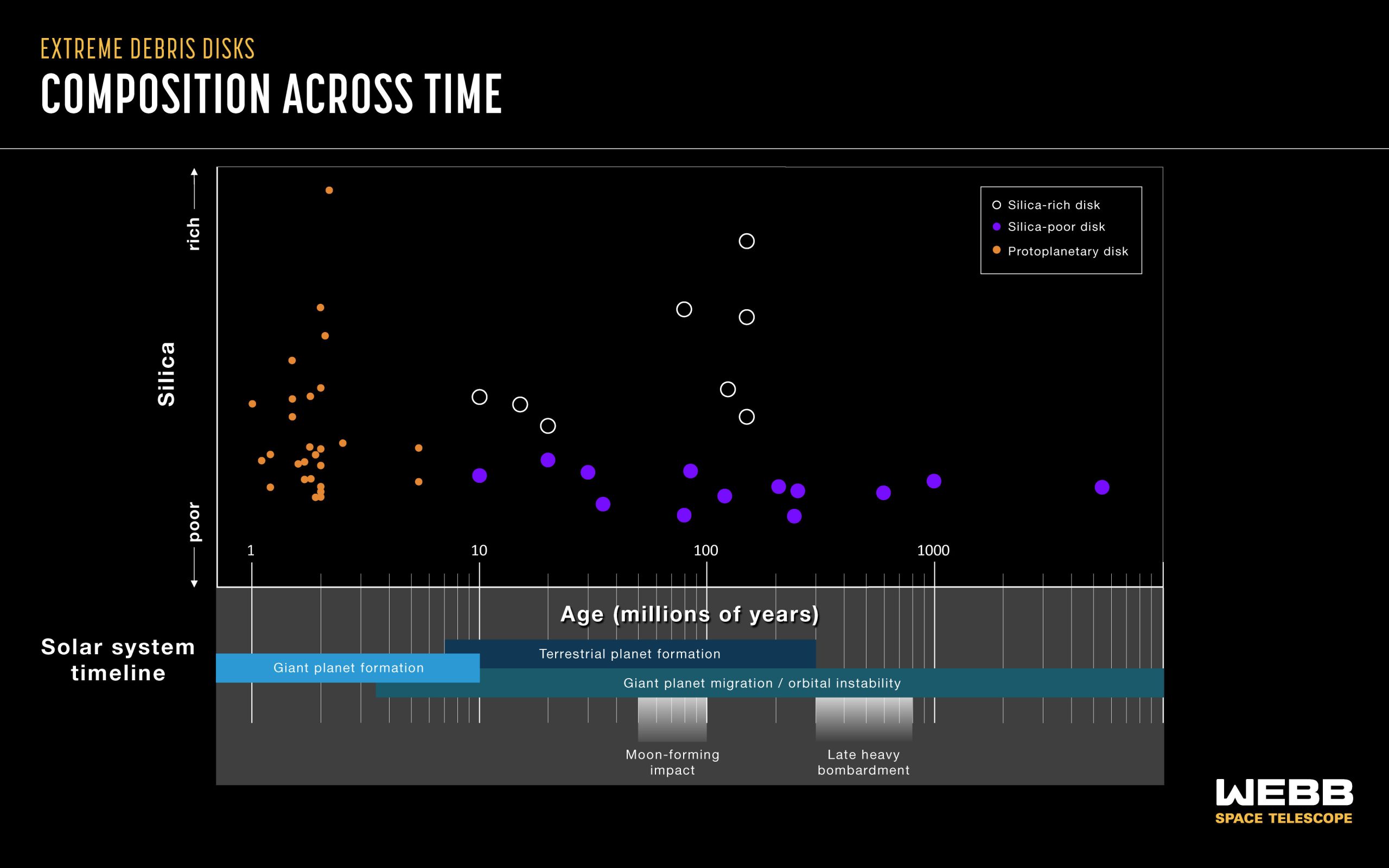
Mars-sized bodies slamming together could vaporize substantial amounts of material and produce silica-rich debris, the researchers suggest. They found silica-rich dust in about one-third of the disks, a composition with a familiar counterpart on Earth in volcanic glass such as obsidian.
Moon-sized bodies grazing one another could account for the silica-poor debris that characterized the remaining two-thirds of the sample. Forsterite, a silica-poor mineral, appears as green sand grains on some Hawaiian beaches. Around distant stars, the distinction between these mineral groups offers clues to the scale and energy of collisions that astronomers cannot watch directly.
“To just see their mid-infrared emission and beautiful spectral features with Webb, which allowed us to identify their compositions, was the most exciting thing for me,” said Agnes Kospal of Konkoly Observatory in Budapest, Hungary, a coauthor of the study. “We have no other way to study these planetary embryos directly because they are too small.”
Extreme debris disks are unexpectedly rare
Spitzer first singled out these unusually dusty systems while examining the gas-poor debris disks that develop after the gas-rich disks where planets begin taking shape. The extreme disks concentrate warm dust close to their stars, in regions comparable to the rocky planets’ orbits in our solar system. Webb and Spitzer also confirmed that their grains are smaller than those in either gas-rich planet-forming disks or ordinary debris disks, and that their brightness changes irregularly.
Su’s team assembled observations of 21 extreme debris disks, which have proved much scarcer than theoretical predictions suggest. Five were represented by archival Spitzer data, while Webb supplied observations of 16, including 12 newly observed disks and follow-up observations of four previously studied with Spitzer.
“This is the first time we have gathered enough systems to truly understand this subclass that we call extreme debris disks,” said Su, the study’s lead author. “Before Webb, we had limited information. We knew that they are weird and very different from the typical cold debris disks that we know, like Vega and Fomalhaut. Now that we have more data, we can pin down what these disks represent for planet formation and evolution.”
Silica-rich dust favors young stars
Every silica-rich disk in the sample surrounded a star younger than 300 million years, while silica-poor disks appeared across a much broader range of ages. The silica-poor systems also tended to vary more in infrared brightness. The team proposes that fresh debris moves into different orbits and undergoes further impacts, rapidly changing the dust responsible for that fluctuating glow.
“Of course, there’s many things we still don’t know about these disks,” said Attila Moor of Konkoly Observatory, a coauthor of the study. “We expect no silica-rich systems among older extreme debris disks. We only have three disks in our sample that fit that age criteria, so it’ll be nice to observe more of these systems to confirm our hypothesis.”
Our solar system may have turned dusty twice
Gas giants migrating through our own solar system may have disturbed the orbits of smaller bodies, triggering catastrophic collisions and brief surges of dust, according to the Late Heavy Bombardment hypothesis. Older silica-poor disks would be broadly consistent with that scenario if their changing brightness reflects similar orbital instability. Our Sun may therefore have experienced these dusty phases more than once, both as rocky planets formed and as later disruptions set off additional collisions.
“How rocky planets formed and giant planets evolved are part of the broader story of the solar system’s formation. It’s all one story,” said Su. “Our work on extreme debris disks helps us bring together the big picture of what we currently understand.”
Simulations place rocky planet formation within the first few hundred million years of a system’s life, matching the ages of the silica-rich disks. Earth and the Moon are estimated to have formed about 100 million years after the Sun. In the glow of those young disks, astronomers may be seeing the aftermath of collisions like the one thought to have struck the infant Earth and supplied the debris that became the Moon.
Reference: “Extreme Debris Disks: Insights into Violent Collisions in Planet Formation and Destruction” by Kate Y. L. Su, Attila Moór, Ágnes Kóspál, George H. Rieke, Antranik A. Sefilian, Renu Malhotra, Ilaria Pascucci, Alan P. Jackson, Péter Ábrahám and Nicholas P. Ballering, 31 September 2026, The Astrophysical Journal.
DOI: 10.3847/1538-4357/ae88fe
Never miss a breakthrough: Join the SciTechDaily newsletter.
Follow us on Google and Google News.