
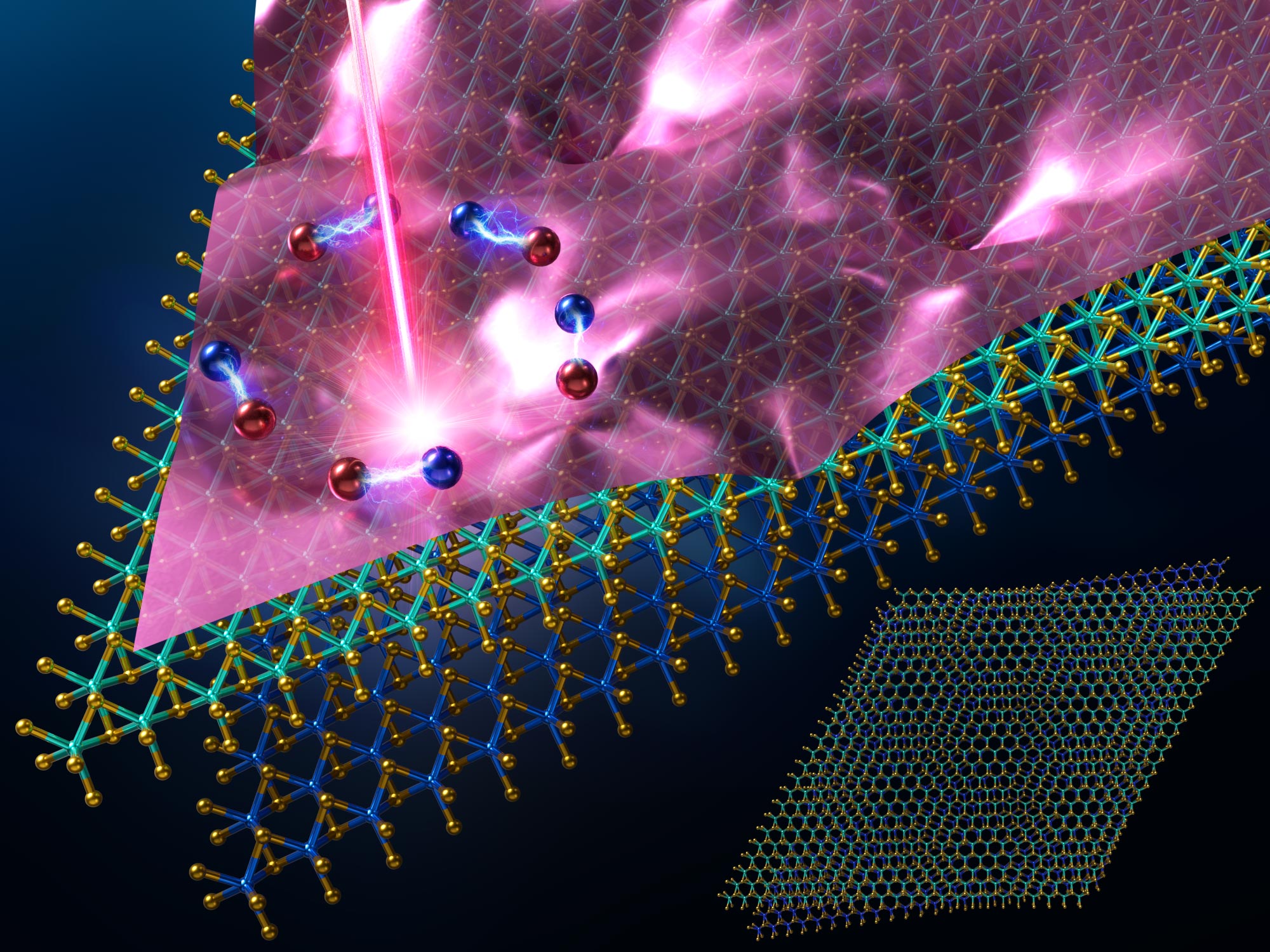
A study of twisted two-dimensional semiconductors reveals how subtle material disorder can emerge at different spatial scales.
Two distinct forms of hidden disorder may influence how ultrathin semiconductors emit light. One extends across relatively large areas of the material, while the other is concentrated around tiny defects. A new theoretical approach offers a way to identify these patterns by analyzing changes in light emission rather than attempting to separate individual spectral signals.
Developed by Katsunori Wakabayashi at the Research Center for Materials Nanoarchitectonics (MANA), part of the National Institute for Materials Science (NIMS), the framework could provide a more reliable way to investigate imperfections in materials used for advanced optical and quantum devices.
Why Twisted Semiconductor Layers Are Difficult to Analyze
The research examines moiré heterostructures, which form when two extremely thin semiconductor layers are stacked with a slight rotational misalignment. In materials such as molybdenum diselenide and tungsten diselenide (MoSe2/WSe2), this arrangement creates a repeating moiré pattern that alters how the combined layers interact with and emit light.
These structures produce complex photoluminescence spectra containing numerous overlapping emission peaks. Scientists typically study such spectra by identifying individual peaks and determining their physical origins. However, the dense, overlapping signals in moiré heterostructures make those assignments difficult and potentially uncertain.
Using Light to Map Hidden Material Disorder
Wakabayashi developed a mathematical framework that examines how simpler spectral properties, including peak energy and average emission energy, change across a material’s surface. Applying the approach to previously reported spectral correlations in a MoSe2/WSe2 heterostructure suggested that different optical features respond to different scales of structural disorder.
The analysis identified two possible components of this hidden disorder. The first is a smoothly varying ‘background’ extending over distances of a few micrometers (roughly 0.0001 inch). The second is much more localized and may arise from small defects or sites where excitons become trapped. Excitons are bound pairs of electrons and positively charged holes that can release energy as light.
By comparing spatial variations in the spectral measurements with theoretical predictions, the framework makes it possible to infer the underlying disorder without assigning an origin to every emission peak. This approach could eventually help researchers evaluate material quality and improve the consistency of semiconductor manufacturing.
“This work could help researchers make better and more reproducible materials for light-emitting devices, optical sensors, and quantum technologies,” remarks Wakabayashi.
Reference: “Hierarchical disorder in moiré exciton photoluminescence probed by spectral-descriptor correlations” by Katsunori Wakabayashi, 7 August 2026, Physical Review Research.
DOI: 10.1103/jt25-c8fp
Never miss a breakthrough: Join the SciTechDaily newsletter.
Follow us on Google and Google News.
1 Comment
THE NEW TYPTICAL VARIETY AND DEVELOPMENTALS ISSUES AND SERIES ARE CONNECTIONS MEASURES NOT MASSIVE SERIES ASSUMPTIONS MIGHTY STRENGTHS ARE DESCRIPITONS DECREASED AND SERIES OF FORMS ARE DECREASED DEPARTMENTS INTO THESE QUESTIONS MASSIVE COLLECTIONS ASSUMPITIONS OF RATIO(S) ARE VALID COMPLETED AND DESCRIPTIONS MEASURES A VALUES OF FORMS FEATURES ALL:THE NEW AREAS NOT AMPOUNTS OF RASTIO(S) FOLLOW ING ISSUES OF REALITY ARE DESCRIPTIONS DECREASED QUESTIONS DECREASED OFTEN ISSUES AREA DECREASE ITS QUESTS OF REALITY INNER-CORE ISSUES QUESTIONS AREAS OF REMAINS AND RESULTS AND SERVICES & DUE ITS COLLECTIONS MEASURES INNER-CORE: THE FEATURES OF LOGICAL-COLLECTIONS AND SERIES OF FORMS INNER-CORE & THESE QUESTIONS MEASUREMENTS INTO MATHAEMATICAL-ENCOUNTER-INTO A ASSUMPTIONSS DECREASED “MIGHTY”INTO SEQUENCES GENERAL AS DECREASEWD FORMS INNER -COUFRSE NOT “CORE” FOR REASONS ARE DISCOVERISES ARE DASSUMPTIONS OF REALITY EFINES AND ALL ASSUMPTIONS INTO PROCESSIAZATIONS ARE (BIO-THEORIES) & DEFINES AND ACCOMPLISHED AND DEFINES ASSUMPTIONS DECREASED INNER-CORE & DECREASED-DEPTHS-DELEVERY & DEFIEND AND SERIES QUESTIONS ARE DESCRIPTIONS MIGHTY FACTORS DEFINED RESULTS OF THINGS AND SERIES INNER-CORE INTO THESE ISSUES ARE DEPENDS ALL-SERIES & INNER-CORE INNER-CORE ISSUES OFFER AND DESCRIPTIONS AND SERIES INTO THESE QUESTIONS INTO THESE INNER-CORE AND DESCRIPTIONS:THE NEW FOUNDATIONS OF REALITY ASSUMPTIONS ARE DESCRIPTIONS MEASURES A SIMPLE-FOOUNDATION OF ALL DUE TO THEORIES ASSUMPTIONS INTO THESE QEUSTIONS INTO THESE ASSUMPTIONS .THE FEATURE ALL NOTED REASONS-OF-REALITY & THESE ASSUMPTIONS QUESTIONS THESE ASSUMPTIONS ARE DECREASED HOWEVER DEEVLOPMENTALS-PROCESS & DUE “THESIS”ARE DESCRIPTIONS ASSUMPTIONS MEASURES-ALL-VIRTUES ISSOLATIONS ARE DEPENDS AND DEFINES A SERIES OF FORMS DECREASED VALUES AND SIMPLE INTO THESE QUESTIONS ARE DIFFERENCES REPEATS & “QUESTS” AND EARTHS & THESE ASSUMPTIONS ARE COMMOPN-ISSUES AND DESCREASED INNER-CORE & DEPTH-OFTEN REVISE AND DEPEND ARE ALL-SERIES INTO THESE QUESTIONS ARE DECERAED VALUES OF REALITY INNER-CORE INNER-CORE QUESTIONS ARE DESCRIPTIONS ‘MEASURED’ NOTES ALL VIRTUES INTO THESE VARIABLES OFTEN ISSUES ARE COLLECTIONS WELL-KNOWN ISSUES ARE DEFINTIONS MEASURES ALL-LOGICAL & MASSIVE DEPATRTURE AND DESREASED AND NOTICE EACH DECREASED GENERAL OPPOSITEES RESULTS NATURE(S) ARE DESCRIBES & SIMPLE FOUND ATONS ARE DECREASED-COLLECTIONS MEASURES ASSSUMPTIONS ARE DECREASED FEATURES & DUE INTO THEORTCIAL-PROCESS AND SERIES ASSUMPTIONS QEUSTIONS ALL SERIES ].THE FOLLOWING-EACH ARE DE
FINTIONS NOT DESCRIPTIONS BEACUSE OF MEASUREMENTS.