

A new ultrathin photodetector captures light across the full spectrum in just 125 picoseconds, opening the door to faster, smarter imaging technologies.
Engineers at Duke University have built the fastest pyroelectric photodetector ever demonstrated, a device that senses light by capturing the heat it produces when absorbed.
This ultrathin sensor can detect light across the entire electromagnetic spectrum. It runs at room temperature, requires no external power, and can be integrated directly into on-chip systems. The technology could lead to a new generation of multispectral cameras with applications in skin cancer detection, food safety inspection, and large-scale agriculture.
The findings were published in Advanced Functional Materials.
Limits of Traditional Light Detection
Most modern digital cameras rely on semiconductor photodetectors, which generate an electrical current when struck by visible light. That signal is then processed into an image.
However, semiconductors are limited to a narrow portion of the electromagnetic spectrum, similar to the human eye. To detect wavelengths beyond that range, researchers often use pyroelectric detectors, which produce electrical signals when they heat up after absorbing light.
These thermal detectors have historically been less effective than semiconductor-based systems. Capturing certain wavelengths requires generating enough heat, which typically demands thick materials or very bright light. As a result, these devices tend to be bulky and slow.
“Commercial pyroelectric detectors aren’t very responsive, so they need a very bright light or very thick absorbers to work, which naturally makes them slow because heat doesn’t move that fast,” said Maiken Mikkelsen, professor of electrical and computer engineering at Duke. “Our approach cleverly integrates near-perfect absorbers and super-thin pyroelectrics to achieve a response time of 125 picoseconds, which is a huge improvement for the field.”
Metasurface Design and Light Trapping
The team’s solution relies on a structure known as a metasurface. It consists of carefully arranged silver nanocubes placed on a transparent layer positioned just 10 nanometers above a thin sheet of gold.
When light hits one of these nanocubes, it excites electrons in the silver. This interaction traps the light’s energy through a process called plasmonics. The specific wavelengths captured depend on the size of the nanocubes and how they are spaced.
Because this light trapping is extremely efficient, only a very thin layer of pyroelectric material is needed beneath the surface to generate an electrical signal. The group first demonstrated this concept in 2019, although they did not measure its speed at the time.
“Thermal photodetectors are supposed to be slow, so this was mind-boggling to the entire community,” Mikkelsen said. “We were taken off guard that it seemed to be working on time scales similar to that of silicon photodetectors.”
Faster Design and Measurement Breakthrough
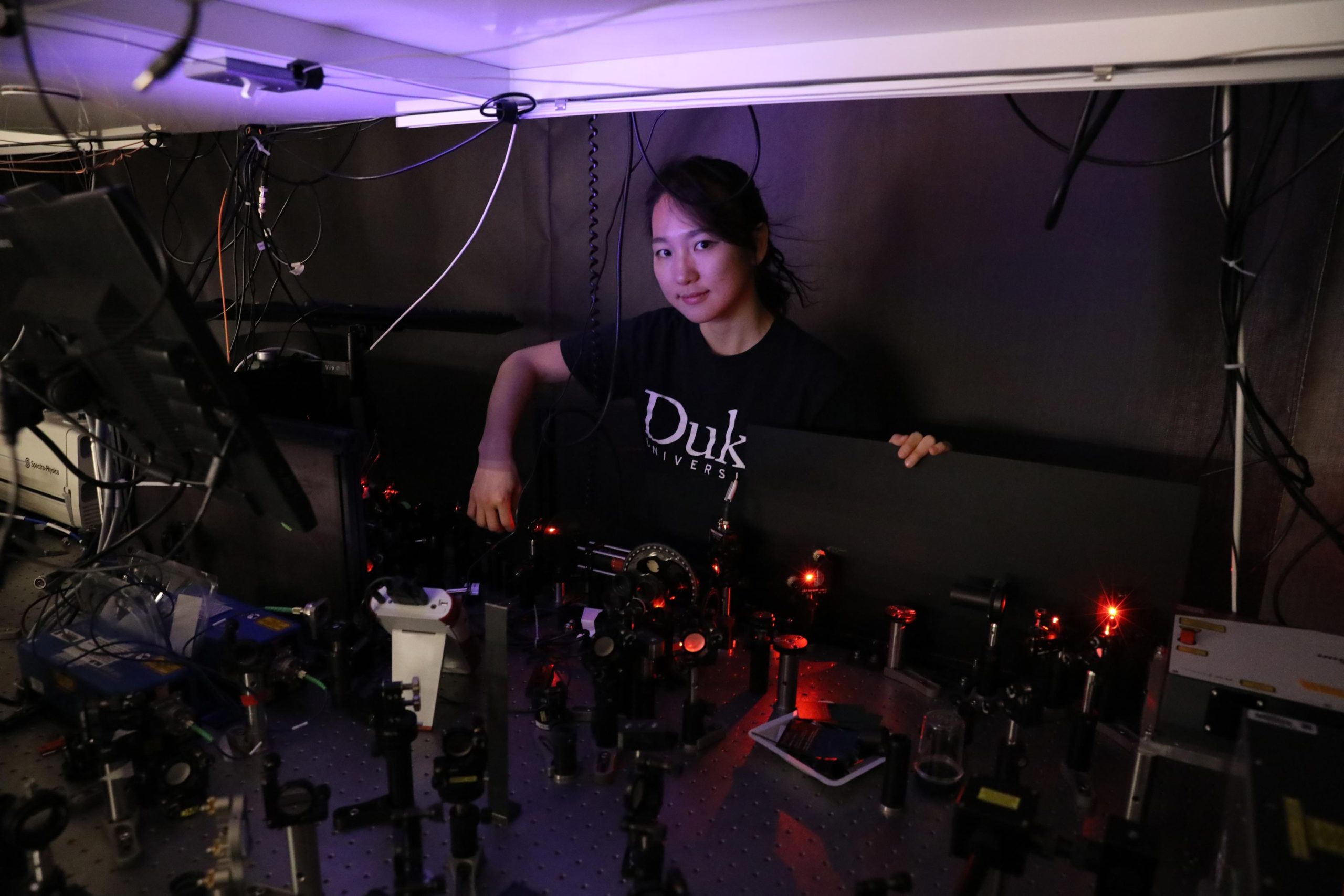
In recent years, Eunso Shin, a PhD student in Mikkelsen’s lab, has worked to refine the device and develop a cost-effective way to measure its speed without relying on expensive equipment.
The updated design features a circular metasurface instead of a rectangular one, increasing exposure to incoming light while shortening the path the signal must travel. The team also incorporated thinner pyroelectric layers from collaborators and improved the circuitry used to read and transmit the signals.
To measure performance, Shin created an experimental setup using two distributed feedback lasers. These lasers intensified when their frequencies approached the detector’s operating speed, allowing the team to determine how quickly the device responds.
The results showed that the photodetector can operate at speeds up to 2.8 GHz. This means it can generate an electrical signal from incoming light in just 125 picoseconds.
“Pyroelectric photodetectors commonly operate in the nano-to-microsecond range, so this is hundreds or thousands of times faster,” Shin said. “These results are really exciting, but we’re still working to make them even faster while figuring out the kinetic limit of pyroelectric photodetectors.”
Future Applications in Imaging and Sensing
The researchers believe further improvements are possible by placing the pyroelectric material and electrical readout components in the narrow space between the nanocubes and the gold layer. They are also exploring designs that use multiple metasurfaces to detect several wavelengths of light and their polarity at the same time.
As development continues and manufacturing challenges are addressed, the technology could enable powerful new imaging systems. Because the detectors do not require external power, they could be used in drones, satellites, and spacecraft.
This capability could support precision agriculture by identifying which crops need water or fertilizer in real time.
“When you get into the ability to detect lots of frequencies at once, you open the door to so many different things,” Mikkelsen said. “Cancer diagnosis, food safety, remote sensing vehicles. Those are all still pretty far down the line, but that’s the direction we’re heading in.”
Reference: “Metasurface-Enhanced Thermal Photodetector Operating at Gigahertz Frequencies” by Eunso Shin, Rachel E. Bangle, Nathaniel C. Wilson, Stefan B. Nikodemski, Jarrett H. Vella and Maiken H. Mikkelsen, 11 December 2025, Advanced Functional Materials.
DOI: 10.1002/adfm.202420953
This research was supported by the Air Force Office of Scientific Research (FA9550-21-1-0312) and the Gordon and Betty Moore Foundation (GBMF8804).
Never miss a breakthrough: Join the SciTechDaily newsletter.
Follow us on Google and Google News.