
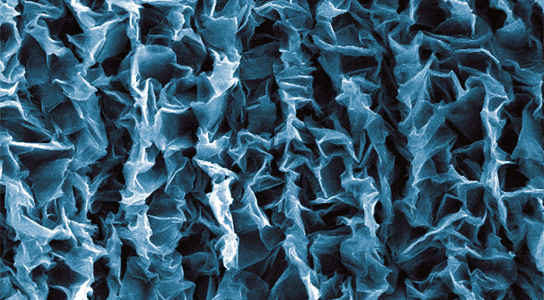
By developing a method to reversibly control the crumpling and unfolding of large-area graphene sheets, researchers at Duke University were able to demonstrate that crumpled graphene–polymer laminates can be used as artificial-muscle actuators.
Duke University engineers are layering atom-thick lattices of carbon with polymers to create unique materials with a broad range of applications, including artificial muscles.
The lattice, known as graphene, is made of pure carbon and appears under magnification like chicken wire. Because of its unique optical, electrical, and mechanical properties, graphene is used in electronics, energy storage, composite materials, and biomedicine.
However, graphene is extremely difficult to handle in that it easily “crumples,” which, depending on circumstances, can be a positive or negative characteristic. Unfortunately, scientists have been unable to control the crumpling and unfolding of large-area graphene to take advantage of its properties.
Duke engineer Xuanhe Zhao, assistant professor in Duke’s Pratt School of Engineering, likens the challenge of controlling graphene to the difference between unfolding paper and wet tissue.
“If you crumpled up normal paper, you can pretty easily flatten it out,” Zhao said. “However, graphene is more like wet tissue paper. It is extremely thin and sticky and difficult to unfold once crumpled. We have developed a method to solve this problem and control the crumpling and unfolding of large-area graphene films.”
The Duke engineers attached the graphene to a rubber film that had been pre-stretched multiple times of its original size. Once the pre-stretch in the rubber film was relaxed, part of the graphene detached from the rubber while the other part kept adhering to the rubber, forming an attached-detached pattern with a size of a few nanometers. As the rubber was relaxed, the detached graphene was compressed to crumple. Once the rubber film was stretched back, the adhered graphene will pull on the crumpled graphene to unfold it.
“In this way, the crumpling and unfolding of large-area atomic-thick graphene can be controlled by simply stretching and relaxing a rubber film, even by hand,” Zhao said.
The results were published online in the journal Nature Materials.
“Our approach has opened avenues to exploit unprecedented [Crumpled graphene] properties and functions of graphene,” said Jianfeng Zang, a postdoctoral fellow in Zhao’s group and the first author of the paper. “For example, we can tune the graphene from being transparent to opaque by crumpling it, and tune it back by unfolding it.”
In addition, the Duke engineers layered the graphene with different polymer films to make a “soft” material that can act like muscle tissues by contracting and expanding on demand. When electricity is applied to the graphene, the artificial muscle expands in area; when the electricity is cut off, it relaxes. Varying the voltage controls the degree of contraction and relaxation, giving actuation strains over 100 percent.
“Indeed, the crumpling and unfolding of graphene allows large deformation of the artificial muscle,” Zang said.
“New artificial muscles are enabling diverse technologies ranging from robotics and drug delivery to energy harvesting and storage,” Zhao said. “In particular, they promise to greatly improve the quality of life for millions of disabled people by providing affordable devices such as lightweight prostheses and full-page Braille displays. The broad impact of new artificial muscles is potentially analogous to the impact of piezoelectric materials on the global society.”
Reference: “Multifunctionality and control of the crumpling and unfolding of large-area graphene” by Jianfeng Zang, Seunghwa Ryu, Nicola Pugno, Qiming Wang, Qing Tu, Markus J. Buehler and Xuanhe Zhao, 20 January 2013, Nature Materials.
DOI: 10.1038/nmat3542
Zhao’s work is supported by the National Science Foundation’s (NSF) Triangle Materials Research Science and Engineering Center, NSF Materials and Surface Engineering program, and National Institutes of Health (NIH).
Other members of the team are Duke’s Qiming Wang and Qing Tu; Seunghwa Ryu and Markus Buehler of the Massachusetts Institute of Technology, and Nicola Pugno of the Universita di Trento, Italy.
Never miss a breakthrough: Join the SciTechDaily newsletter.
Follow us on Google and Google News.