
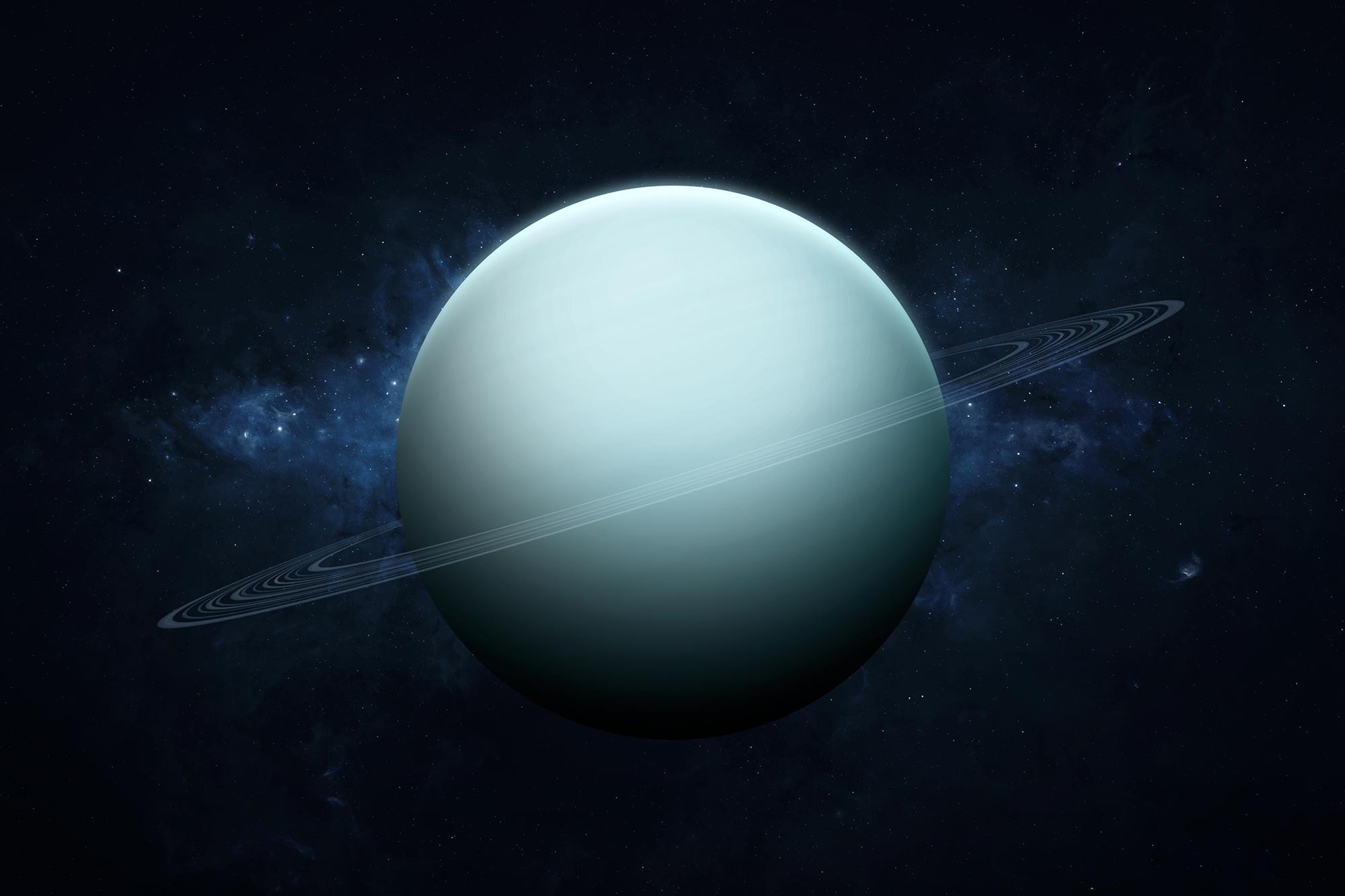
Uranus and Neptune have long been considered planetary twins, but new research suggests their similarities may conceal surprisingly different origins.
Neptune may have formed from material that originated much closer to the young Sun, challenging the long-standing belief that it and Uranus developed from the same reservoir of cosmic ingredients. New research suggests the two ice giants, despite their striking similarities, have significantly different chemical histories.
An international research team, including scientists from Southwest Research Institute (SwRI), found evidence that Neptune’s deep atmosphere contains substantially more oxygen than Uranus’s. Published in the September 2026 issue of Astronomy & Astrophysics, the study uses atmospheric observations and computer models to investigate how the planets acquired their chemical compositions roughly 4.5 billion years ago.
Two Similar Planets With Different Chemical Histories
Uranus and Neptune have comparable sizes, masses, and atmospheric conditions, making them appear almost like planetary twins. Neither has a solid surface like Earth. Instead, their atmospheres extend thousands of miles into their interiors, with water, ammonia, and methane among the compounds present. Methane in their upper atmospheres helps produce their distinctive blue-green colors by absorbing red wavelengths of sunlight.
“Uranus and Neptune may resemble twins today, but their chemistry is telling us that they are more like cousins with very different histories,” said Dr. Olivier Mousis, a program director in SwRI’s Solar System Science and Exploration Division in Boulder, Colorado, and a co-author of the study. “Their atmospheric compositions may be connected to different regions of the protoplanetary disk where the planets formed, which would make their similarities a noteworthy coincidence.”
Carbon Monoxide Offers a Window Into Hidden Atmospheres
To investigate the planets’ chemical differences, researchers analyzed carbon monoxide measurements, including recent observations from the Atacama Large Millimeter/Submillimeter Array (ALMA). Although scientists cannot directly sample the deep atmospheres of Uranus and Neptune, carbon monoxide concentrations in their upper atmospheres can help constrain the chemistry of the layers below.
The team combined these observations with atmospheric chemistry models to estimate oxygen abundances and carbon-to-oxygen ratios. Their results indicate that Neptune’s deeper atmosphere is considerably more oxygen-rich than Uranus’s, suggesting that the two planets incorporated different proportions of carbon-bearing and oxygen-bearing materials during formation.
“We can’t directly access the deep atmospheres of Uranus and Neptune, but chemical tracers allow us to probe the conditions hidden beneath their visible clouds,” Mousis said. “Studying carbon monoxide, or CO, is particularly useful because of its abundance in the upper troposphere. Using this data, we can model the chemical evolution of the protoplanetary disk and the origins of its materials.”
Neptune’s Building Blocks May Have Traveled Across the Early Solar System
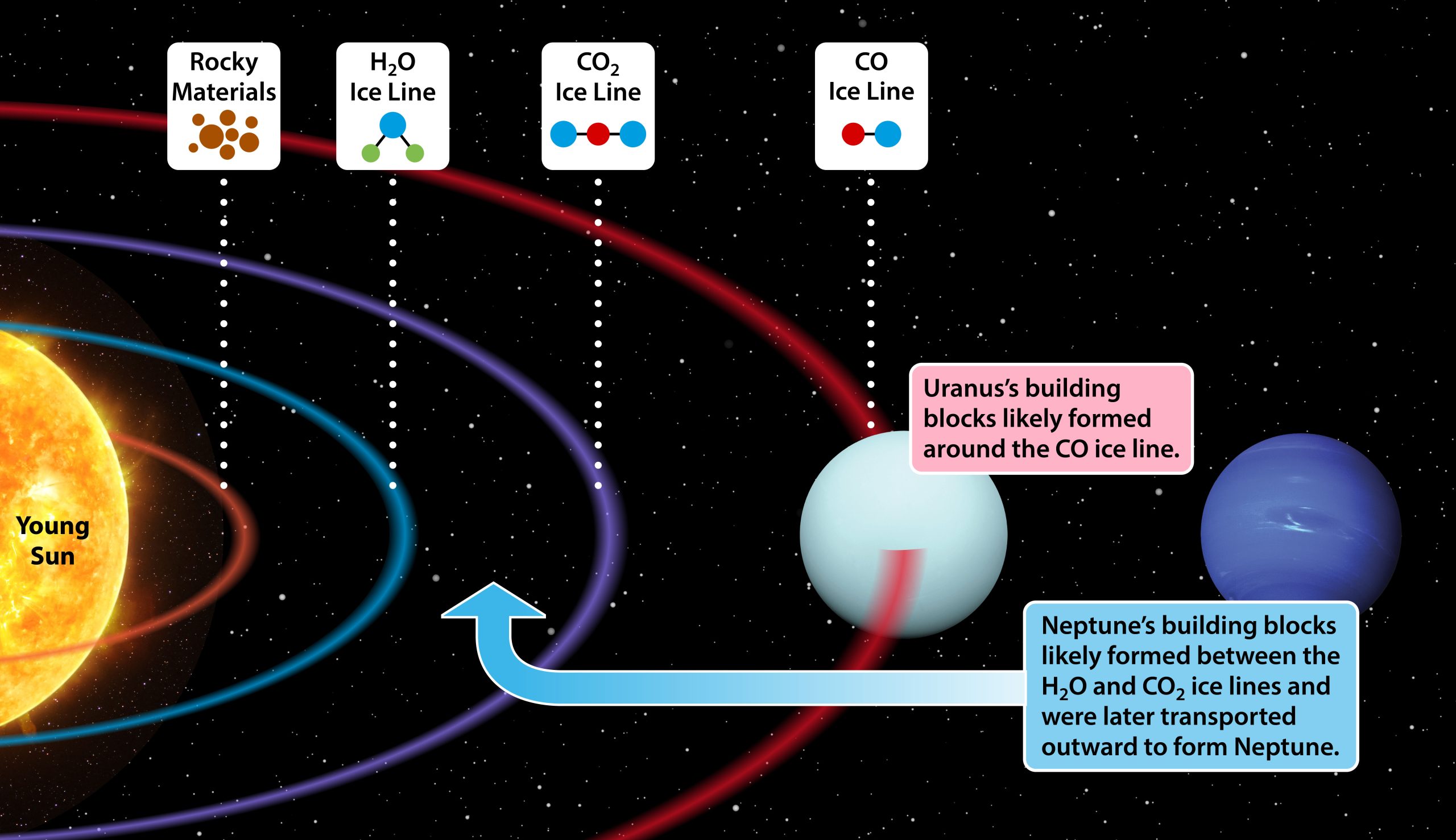
The researchers then examined how these chemical differences could have developed within the protoplanetary disk, the rotating collection of gas and dust surrounding the young Sun. As the disk cooled, volatile compounds condensed into solids at different temperatures and distances. This process created reservoirs of material with distinct chemical compositions, providing different ingredients for growing planets.
By comparing the planets’ inferred carbon-to-oxygen ratios with models of the evolving disk, the team identified a possible explanation for Neptune’s unusual composition. Rather than forming entirely from materials available near its present orbit, Neptune may have accumulated building blocks that originated closer to the Sun and subsequently migrated outward. This would give Neptune a different chemical history from Uranus, even if the two planets formed during roughly the same period.
“Neptune’s chemistry is difficult to reconcile with the idea that it formed where we see it today, pulling from the same reservoir of cosmic materials as Uranus,” Mousis said. “Instead, our models lead us to believe that its building blocks traveled a long way to where Neptune could accrete them. In short, two superficially similar worlds may have reached their present locations and formations through two very distinct evolutionary paths.”
What Future Missions Could Reveal
The proposed formation scenario remains dependent on atmospheric and planetary formation models. Without direct measurements from deep within Uranus and Neptune, scientists cannot fully determine their internal compositions or reconstruct the movement of materials that shaped them. Future spacecraft observations and atmospheric probes could provide more precise constraints on their chemistry and formation histories.
“Our findings have implications beyond Neptune and Uranus and even far beyond our Solar System,” Mousis said. “Planets comparable in size to Uranus and Neptune are common around other stars, which is why Uranus and Neptune are essential benchmarks for understanding how planets form and evolve throughout the galaxy, and it is precisely why missions like NASA’s planned Uranus Orbiter and Probe, expected to launch sometime in the next decade, are so important.”
Reference: “Contrasting C/O ratios in Uranus and Neptune from disequilibrium chemistry: A clue to distinct evolutionary pathways?” by T. Briand, V. Hue, O. Mousis, T. Cavalié, T. Benest Couzinou, A. Schneeberger and M. D. Hofstadter, 19 October 2026, Astronomy & Astrophysics.
DOI: 10.1051/0004-6361/202660770
Never miss a breakthrough: Join the SciTechDaily newsletter.
Follow us on Google and Google News.