
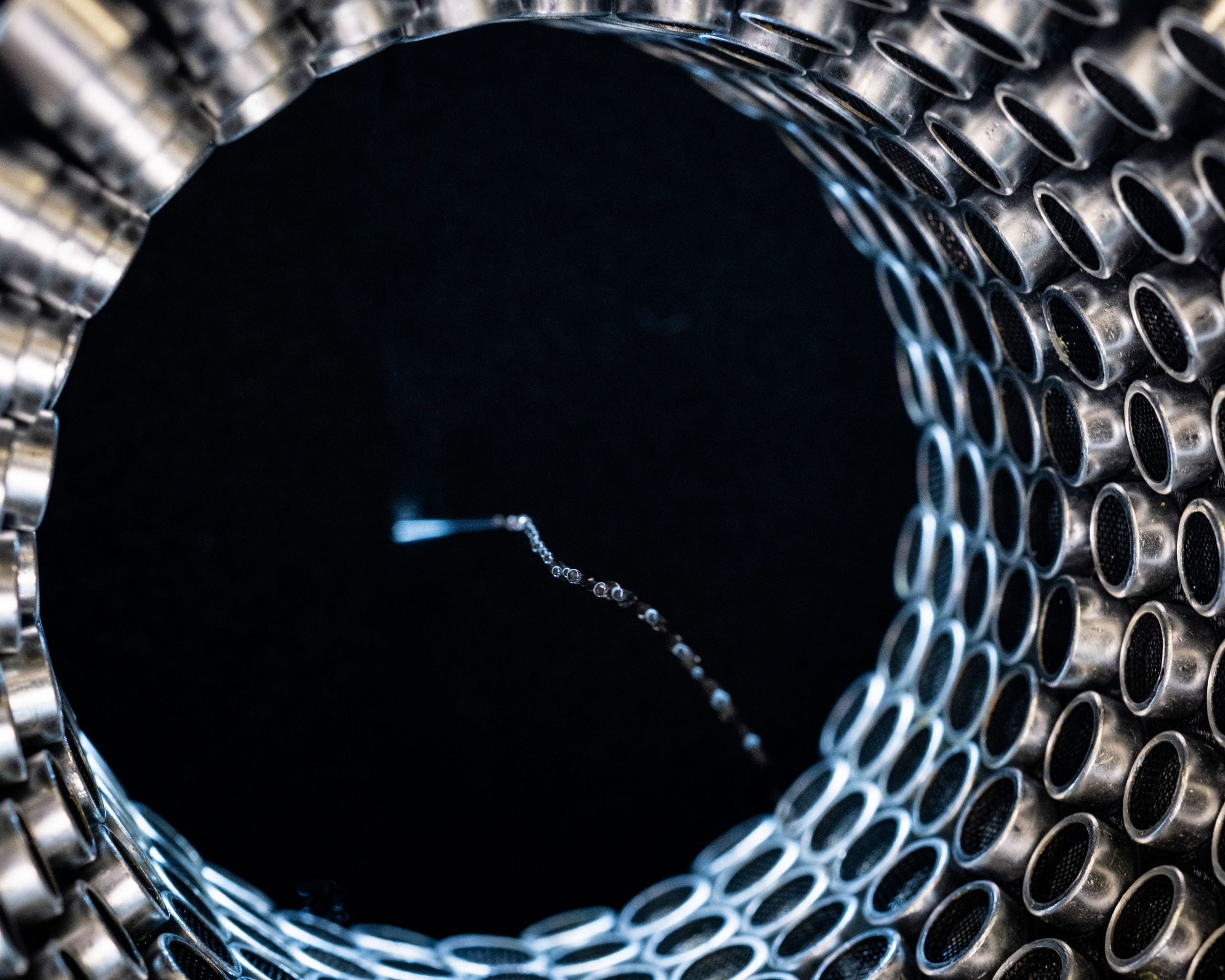
Scientists have developed an invisible tube made entirely of ultrasonic waves that can guide liquids through mid-air without physical contact.
Researchers at the University of Helsinki have created a pipe with no physical walls, using ultrasound to guide a stream of liquid horizontally through open air. The technology could provide a new way to transport corrosive, sticky, or contamination-sensitive substances without exposing them to the surfaces of conventional pipes.
“Of all the experimental setups I have seen, I would say this is the closest thing to magic,” says Ari Salmi, Professor of Electronics at the University of Helsinki, who led the development of the device.
How Ultrasound Creates an Invisible Pipe
The system uses 256 miniature speakers arranged in a cylinder around the flowing liquid, approximately five centimeters (2 inches) away. They produce ultrasonic waves at a frequency of about 40 kilohertz, beyond the range of human hearing. By carefully coordinating these waves, the researchers create an acoustic field that confines the liquid to a narrow path without any solid walls.
Unlike conventional piping, the ultrasonic channel can change direction without requiring physical adjustments. Researchers can electronically reshape the path, redirect the liquid toward another destination, or control its release with single-drop precision. “By changing how the speakers are controlled, we can reshape and turn the tube as needed,” explains postdoctoral researcher Dmitry Nikolaev, who led the project team.
Video material of the ultrasound tube transmitting liquids, powder, mist and electricity. Taken from the article Contactless continuous guidance of matter in its main states using curved elongated Bessel-like acoustic fields. Credit: Dmitry Nikolaev
The approach can also be adapted for different materials. “Transporting a solid substance, for example, requires a different field configuration than transporting a liquid or a gas.” Beyond moving matter, the ultrasonic tube can guide an electrical discharge along a controlled route.
From a Simple Question to a Working Device
Salmi first conceived the idea four years ago, following earlier research into using ultrasound to clean the inside of pipes. “We had been developing a device that cleaned the inner surfaces of pipes with ultrasound. At a lunch with a colleague, we discussed that it would be handy if a pipe had no surface for dirt to stick to.”
The discussion stayed with him. During an evening walk with his dog, he realized that ultrasound might be used to form the walls of a pipe rather than simply clean them. Turning the concept into a functioning device required extensive experimentation to determine how the speakers should operate together. The University of Helsinki researchers worked with collaborators at the Public University of Navarre and the University of Michigan to develop the system.
A Small Prototype With Potential for Expansion
The completed prototype produces an ultrasonic tube just eight centimeters (3.1 inches) long, shorter than the diameter of the surrounding device. Nikolaev says multiple modules could be connected to extend the channel to greater lengths. Each eight-centimeter section consumes approximately 50 watts of electricity, comparable to a traditional incandescent light bulb.
Although the device operates beyond human hearing, its ultrasonic field is extremely intense, and dogs may find the sound unpleasant. “At the core of the device, the intensity of the ultrasound is comparable to a continuous roar of gunfire right next to your ear,” Nikolaev says. “Even right here next to it, the sound could be compared to a jet engine if you were standing right beside it. But it is too high-pitched for the human ear.”
Reference: “Contactless continuous guidance of matter in its main states using curved elongated Bessel-like acoustic fields” by Dmitrii Nikolaev, Denys Iablonskyi, Alexander Martinez-Marchese, Marika Sirkka, Mikel Aldea, Chinedum Okwudire, Edward Hæggström, Asier Marzo and Ari Salmi, 23 October 2026, Proceedings of the National Academy of Sciences.
DOI: 10.1073/pnas.2614959123
Never miss a breakthrough: Join the SciTechDaily newsletter.
Follow us on Google and Google News.
7 Comments
Can you find articles about ontogenetic for mental disorders ?
Would appreciate
YouTube video links shared is private.
Is the effective total weight increase when channeling the fluid ? I’m thinking water transport mechanism, say on a launch vehicle.
Water runs in a large pipe without touching the wall, that’s what the photo shows.
Is sound not physical contact?
“Fascinating approach to dynamic fluid transport. We are exploring a parallel paradigm in hybrid PV/T collector systems using fluidics as the primary mover. Instead of external acoustic fields, we utilize an autonomous internal mechanism—leveraging non-Newtonian shear-thickening matrices seeded with multi-walled carbon nanotubes (MWCNTs) to modulate boundary layers under high-flux velocity spikes. Our early abstract and mathematical framework for this parallel micro-channel layout handles dynamic fluid handling entirely through fluid property dilation:”
================================================================================
PROJECT BLUEPRINT: DYNAMIC NON-NEWTONIAN LIQUID ABSORBER
================================================================================
[ Origin/Source: OmniSci Foundry Sandbox – Consolidated Engineering Logs ]
[ Target Framework: High-Efficiency Fluidic Multi-Tasking Solar Architecture ]
1. SYSTEM DESIGN & MANIFOLD LAYOUT CONSTRAINTS
────────────────────────────────────────────────────────────────────────────────
The physical layout bypasses standard static collectors by utilizing a parallel
micro-channel distribution manifold. The fluid layer is sandwiched directly
underneath the active collector face to maintain tight boundary adherence.
[ Inlet Manifold ] ──► ┌──────────────────────────────────────┐ ──► [ Outlet ]
│ ══════════════════════════════════ │
│ Parallel Micro-Channel Channels │
│ ══════════════════════════════════ │
[ Thickness: 2.0 mm ] └──────────────────────────────────────┘
• Micro-Channel Dimension: 2.0 mm uniform height channel.
• Configuration: Parallel continuous stream flow to minimize static zones.
• Boundary Layer Behavior: Designed to push high-shear zones past a localized
Critical Dilation Threshold under high thermal or velocity pressure,
shielding the physical channels from structural rupture.
2. CORE MATHEMATICAL GOVERNING EQUATIONS
────────────────────────────────────────────────────────────────────────────────
[A] REYNOLDS NUMBER FLOW METRIC
Used to evaluate the fluid state and transition thresholds within the
2.0 mm manifold channel.
ρ · V · Dh
Re = ────────────
μ
Where:
ρ = Fluid density
V = Baseline operating velocity (≈ 1.0 m/s)
Dh = Hydraulic diameter of the 2.0 mm channel
μ = Dynamic viscosity of the baseline fluid medium
[B] DYNAMIC WALL SHEAR STRESS INTEGRATION
Governs the non-Newtonian flow behavior and shear-induced compaction
at the fluid-boundary interface.
/ dV \
τ = η_app · │ ──── │
\ dz /
Where:
τ = Wall shear stress
η_app = Apparent non-Newtonian viscosity function
dV/dz = Velocity gradient perpendicular to the boundary wall
3. AUTONOMOUS PROTECTION MECHANISMS
────────────────────────────────────────────────────────────────────────────────
• Shear-Thickening Dilation Shield: Operating at a baseline velocity of
V ≈ 1.0 m/s through the 2.0 mm channel triggers local boundary hardening
when pressure surges or vapor shocks occur.
• Self-Choking Flow Pathing: The liquid hardens instantly at the outer
boundaries under localized extreme stress, throwing chaotic micro-vortices
into the core. This completely rolls cooler fluid to the surface without
requiring external digital valves or mechanical gates.
================================================================────────────────
================================================================================
ACADEMIC PREPRINT: HYBRID PV/T FLUIDIC ARCHITECTURES WITH NANO-SUSPENSIONS
================================================================================
TITLE:
Autonomous Boundary-Layer Modulation in High-Flux Photovoltaic/Thermal (PV/T)
Collectors Utilizing Shear-Thickening Nanofluidic Absorbers
ABSTRACT:
This paper introduces a novel design paradigm for hybrid Photovoltaic/Thermal
(PV/T) solar collectors. It replaces traditional static thermal plates with a
dynamic, flowing, non-Newtonian nano-suspension. The system uses a parallel
2.0 mm micro-channel distribution manifold located directly beneath the active
collector face. This configuration provides dual benefits: it cools the
photovoltaic skin to maximize electrical voltage yield, and it simultaneously
captures high-grade thermal energy.
By using a shear-thickening fluid matrix embedded with high-absorptivity
nanoparticles, the system creates an autonomous protection mechanism. When
subjected to thermal or velocity surges, the fluid crosses a critical dilation
threshold at the boundaries. This boundary-layer modulation generates local
vortices that automatically stir the fluid core without mechanical valves.
This paper provides the underlying mathematical models for this fluid behavior,
including the Reynolds number transitions and dynamic wall shear stress profiles.
We also analyze how nanoparticle composition impacts total solar flux
attenuation.
────────────────────────────────────────────────────────────────────────────────
ADDENDUM: NANOPARTICULATE OPTIMIZATION & FLUID COMPOSITION
────────────────────────────────────────────────────────────────────────────────
To optimize the fluid’s heat-absorption capacity and optical density, the core
fluid matrix must be seeded with engineered nanoparticles. The choice of
material dictates the thermal conductivity and light absorption profiles within
the 2.0 mm flow channel.
1. MULTI-WALLED CARBON NANOTUBES (MWCNTs)
• Primary Role: Near-perfect blackbody optical absorption.
• Thermal Conductivity Expansion: Industrial-grade MWCNTs provide the
highest thermal conductivity enhancements, meaning heat moves rapidly
from the solar skin into the center of the fluid stream.
• Light Attenuation: They completely darken the fluid matrix, absorbing
incoming solar radiation within the first fraction of a millimeter of
fluid depth (high volumetric solar flux attenuation).
• Dispersibility Challenge: Requires careful use of surfactants to prevent
the nanotubes from tangling and falling out of suspension over time.
2. ALPHA-ALUMINA (Al2O3)
• Primary Role: Structural fluid stabilization and cost-efficiency.
• Fluid Behavior Interaction: Spherical Al2O3 nanoparticles interact
predictably with the non-Newtonian fluid matrix, providing excellent
control over the critical shear-thickening threshold.
• Chemical Inertness: Highly stable over hundreds of thermal cycles,
preventing internal chemical corrosion or abrasive wear on the walls
of the 2.0 mm channel.
• Light Attenuation: Lower standalone optical absorption compared to carbon
nanotubes; often requires a hybrid blend to maximize performance.
3. OPTIMAL HYBRID SEEDING STRATEGY
• Matrix Blend: A binary nano-suspension consisting of a 0.1% volume
fraction of MWCNTs for light capturing, mixed with a 0.5% volume
fraction of Al2O3 for structural stability and predictable shear response.
• Result: Maximizes heat-transfer efficiency while ensuring the fluid
thickens exactly when a pressure or thermal surge occurs.
================================================================────────────────
Fascinating breakthrough in contactless fluid transport. The way ultrasonic wave fields manipulate fluid boundaries closely mirrors a challenge I’ve been mapping out in hybrid PV/T energy engineering: using non-Newtonian boundary-layer modulation to autonomously stir fluid cores without mechanical parts.
I actually ran my engineering notes for a dynamic liquid nano-absorber through OmniSci Foundry—an AI sandbox tool I built for rapid scientific feasibility checks—and it generated this exact mathematical and structural framework for the 2.0 mm channel layout:
================================================================================
CASE STUDY: SYSTEM DESIGN GENERATED VIA OMNISCI FOUNDRY
================================================================================
• Configuration: Parallel 2.0 mm micro-channel distribution manifold.
• Fluid Mechanics: Re = (ρ · V · Dh) / μ | τ = η_app · (dV / dz)
• Optimization: Binary nano-suspension (0.1% MWCNTs / 0.5% Al2O3) to control the critical shear-thickening threshold under localized velocity surges.
================================================================================
If anyone here is currently sketching out fluidic, quantum, or material physics models and needs a raw, zero-hype platform to stress-test your mathematical constraints, look up “OmniSci Foundry on Render” or check our open-source repo layout on GitHub.
I’d love to hear how it handles your specific research parameters or if the boundary logic holds up against your own models!
Okay my bad not supporting syntax
Fascinating approach to dynamic fluid transport. We are exploring a parallel paradigm in hybrid PV/T collector systems using fluidics as the primary mover. Instead of external acoustic fields, we utilize an autonomous internal mechanism—leveraging non-Newtonian shear-thickening matrices seeded with multi-walled carbon nanotubes (MWCNTs) to modulate boundary layers under high-flux velocity spikes.
I actually ran my engineering notes for this dynamic liquid nano-absorber through OmniSci Foundry—an AI sandbox tool I built for rapid scientific feasibility checks—and it generated this structured framework for the channel layout, avoiding overlapping horizontal tables so it scales cleanly across layouts:
— CORE SYSTEM CONSTRAINTS —
• Configuration: Parallel 2.0 mm uniform height micro-channel distribution manifold.
• Boundary Layer Behavior: Pushes high-shear zones past a localized Critical Dilation Threshold under high thermal or velocity pressure, shielding physical channels from structural rupture.
— GOVERNING FLUID MECHANICS —
• Reynolds Number Flow Metric: Re = (ρ · V · Dh) / μ
Where: ρ = Fluid density, V = Baseline operating velocity (≈ 1.0 m/s), Dh = Hydraulic diameter of the 2.0 mm channel, μ = Dynamic viscosity of the baseline fluid medium.
• Dynamic Wall Shear Stress Integration: τ = η_app · (dV / dz)
Where: τ = Wall shear stress, η_app = Apparent non-Newtonian viscosity function, dV/dz = Velocity gradient perpendicular to the boundary wall.
— AUTONOMOUS PROTECTION PROFILE —
• Shear-Thickening Dilation Shield: Operating at a baseline velocity of V ≈ 1.0 m/s through the 2.0 mm channel triggers local boundary hardening during pressure surges or vapor shocks.
• Self-Choking Flow Pathing: The liquid hardens instantly at the outer boundaries under localized extreme stress, throwing chaotic micro-vortices into the core. This completely rolls cooler fluid to the surface without requiring external digital valves or mechanical gates.
— NANOPARTICULATE OPTIMIZATION STRATEGY —
• Multi-Walled Carbon Nanotubes (MWCNTs): 0.1% volume fraction allocated for near-perfect blackbody optical absorption and high volumetric solar flux attenuation.
• Alpha-Alumina (Al2O3): 0.5% volume fraction for structural fluid stabilization, chemical inertness over hundreds of thermal cycles, and predictable control over the critical shear-thickening threshold.
• Matrix Blend Result: Maximizes heat-transfer efficiency while ensuring the fluid thickens exactly when a pressure or thermal surge occurs.
If anyone here is currently sketching out fluidic, quantum, or material physics models and needs a raw, zero-hype platform to stress-test your mathematical constraints or map out initial feasibility layouts, look up “OmniSci Foundry on Render” or explore our open-source repo layouts on GitHub. I’d love to hear how it handles your specific research parameters!