
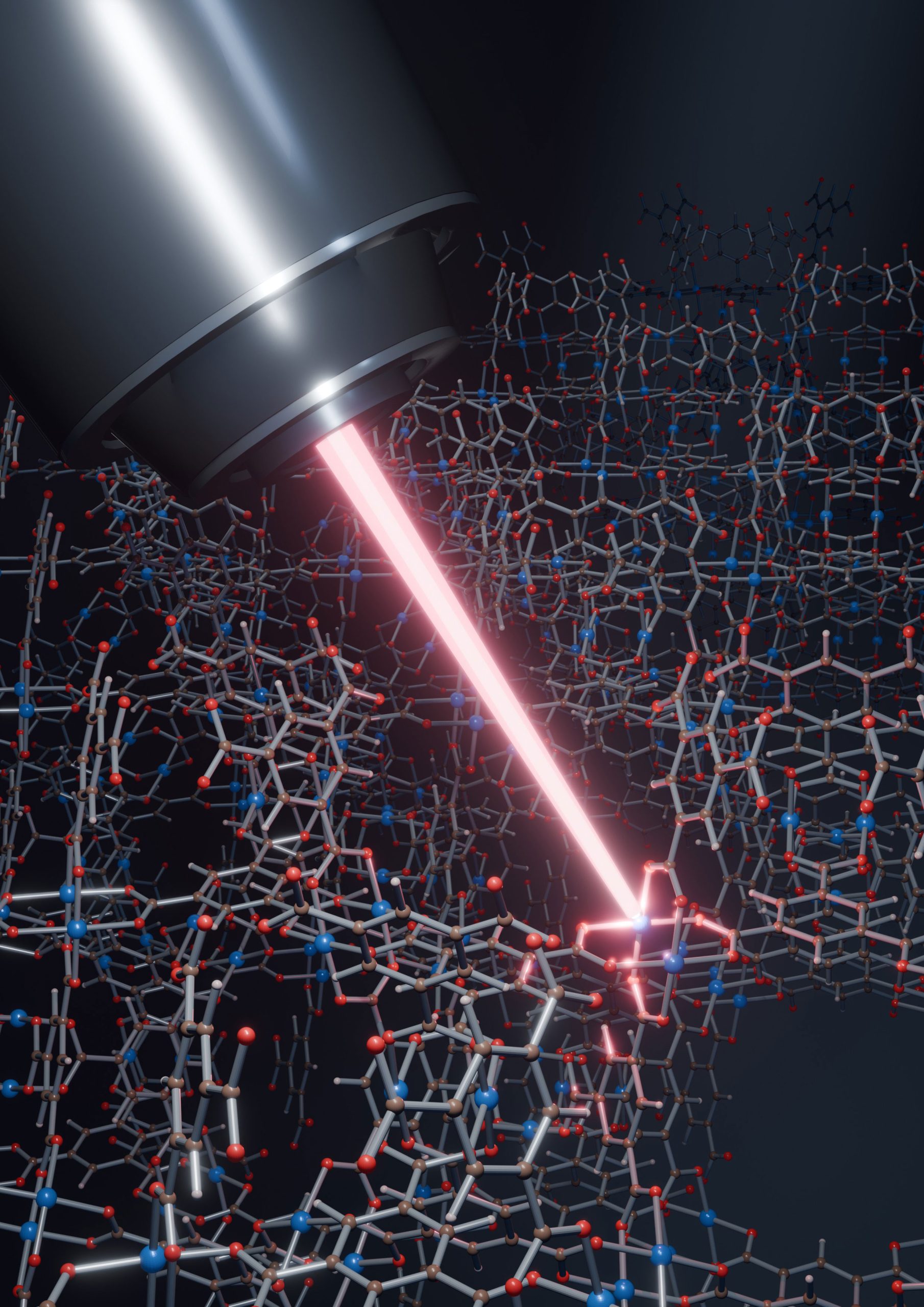
By filling the tiny pores of fragile materials with an unusual liquid, scientists have found a way to create intricate patterns without destroying their structures.
Metal-organic frameworks (MOFs) contain networks of tiny pores that can trap gases, capture pollutants, and support chemical reactions. These properties make them attractive for advanced sensors and electronic devices, but their fragile structures are easily damaged by the processes used to manufacture such devices. Researchers in Japan have now developed a way to carve precise patterns into these materials at room temperature without causing the extensive structural damage normally associated with the process.
The technique, developed at Tokyo University of Science (TUS), involves filling the pores of MOFs with an ionic liquid before exposing them to a focused ion beam. In experiments, the liquid strengthened a copper-based MOF and substantially reduced damage, allowing researchers to produce intricate features only a few hundred nanometers wide.
Why These Porous Materials Are So Difficult to Shape
The origins of MOFs trace back to 1974, when University of Melbourne chemistry professor Richard Robson began exploring whether molecules and chemical bonds could replace the wooden balls and metal rods used in structural models. His experiments with copper ions connected by four-armed organic molecules helped establish the foundations of a new class of porous materials. Today, approximately 100,000 MOFs are known, with potential applications ranging from gas storage and chemical separation to pollution control.
Turning these materials into functional devices requires precise fabrication, often involving dry etching, which removes material using energetic particles such as ions. Unfortunately, ion beams can disrupt the delicate crystalline frameworks and produce unwanted cavities. Cryogenic etching has offered a way to limit this damage, but it requires specialized cooling equipment and liquid nitrogen.
Protecting MOFs With Ionic Liquids
Led by Assistant Professor Yumeng Zheng and Professor Kentaro Kinoshita from TUS’s Department of Applied Physics, the researchers investigated whether ionic liquids could make MOFs more resistant to ion beam damage. Their approach builds on earlier findings from Kinoshita’s team showing that these liquids can improve the mechanical stability of MOFs. The study was scheduled for publication in Communications Materials.
The team tested four imidazolium-based ionic liquids in Cu3BTC2, a copper-based MOF containing benzene-1,3,5-tricarboxylic acid (BTC). Each liquid occupied approximately 50% to 60% of the material’s pore volume. The researchers then used a focused gallium ion beam to etch patterns into the samples at room temperature.
Untreated MOFs suffered substantial structural damage, including the formation of large cavities. Samples containing ionic liquids showed considerably less visible microstructural damage under the same conditions. The researchers successfully etched a square measuring 5 × 5 micrometers (approximately 0.0002 × 0.0002 inches), a pillar, and a Chinese character with lines just 130 to 300 nanometers (about 5 to 12 millionths of an inch) wide.
“In this study, we developed a simple method for room-temperature dry etching of this fragile class of materials. By infiltrating MOFs with ionic liquids, their mechanical stability is greatly improved, and the damage from electron and ion beams is reduced, achieving harmless ion beam etching,” says Dr. Zheng.
How Ionic Liquids Help Prevent Structural Damage
The researchers propose that ionic liquids protect MOFs through a combination of thermal and electrical effects. The liquids may absorb heat generated during ion bombardment, reducing local temperature changes, while their mobile ions could help redistribute accumulated electrical charge and screen local electric fields. These mechanisms remain proposed explanations rather than directly established causes of the reduced damage.
Additional measurements confirmed that all four ionic liquid treatments increased the MOF’s hardness without substantially changing its stiffness. Thermal analysis also showed that treated samples decomposed at higher temperatures than untreated material, indicating improved thermal stability.
Although the experiments focused on a single copper-based MOF, the researchers believe the approach could potentially work with other frameworks. If its effectiveness extends to additional materials, room-temperature etching could provide a more accessible route to manufacturing MOF-based devices without the cooling requirements of cryogenic processing.
“We can foresee applications in high-sensitivity sensors, separation and analysis devices, and catalytic devices. This technology has the potential to become a foundational technology for bridging the exceptional material functionalities of MOFs with their use in practical devices,” says Prof. Kinoshita.
Reference: “Ionic-liquid-assisted room-temperature dry etching of metal–organic frameworks” by Yumeng Zheng, Momoka Muraoka, Koki Egawa and Kentaro Kinoshita, 10 November 2026, Communications Materials.
DOI: 10.1038/s43246-026-01396-3
This work was partly supported by JSPS KAKENHI Grant Number 26K00987.
Never miss a breakthrough: Join the SciTechDaily newsletter.
Follow us on Google and Google News.