

An experimental injectable sensor could give people with diabetes a more affordable way to track blood sugar, with early tests showing that a cheaper sensing ingredient performed similarly to its costlier alternative.
For millions of people with diabetes, knowing how glucose levels are changing helps guide decisions about medication, meals, and daily activities. Continuous glucose monitors provide that information in real time, but their cost keeps the devices out of reach for some patients. Making monitoring more affordable requires attention to the materials inside a sensor, as well as how reliably they work.
Researchers at Texas A&M University have identified a less expensive ingredient for an experimental injectable glucose sensor. Their study, published in ACS Measurement Science AU, found that a sensing material costing roughly one-tenth as much as an alternative used in earlier versions delivered comparable performance.
An injectable gel holds glucose-sensing chemistry
The proposed sensor houses its sensing chemistry in a small hydrogel, a water-rich material that can be injected into tissue and sit beneath the skin. The gel provides a stable home for the sensing materials while allowing glucose to pass through. In testing, it retained more than 94% of the sensing mixture over seven days, demonstrating that the chemistry could function within an injectable platform.
“Our long-term goal is to develop a reliable, affordable injectable glucose sensor that can expand access to continuous glucose monitoring, particularly for people in under-resourced communities and those without adequate insurance coverage,” said Dr. Gérard L. Coté, the study’s principal investigator and a professor of biomedical engineering in Texas A&M’s College of Engineering. “Reducing the cost of the sensing materials is one step toward making these technologies accessible to more people who need them.”
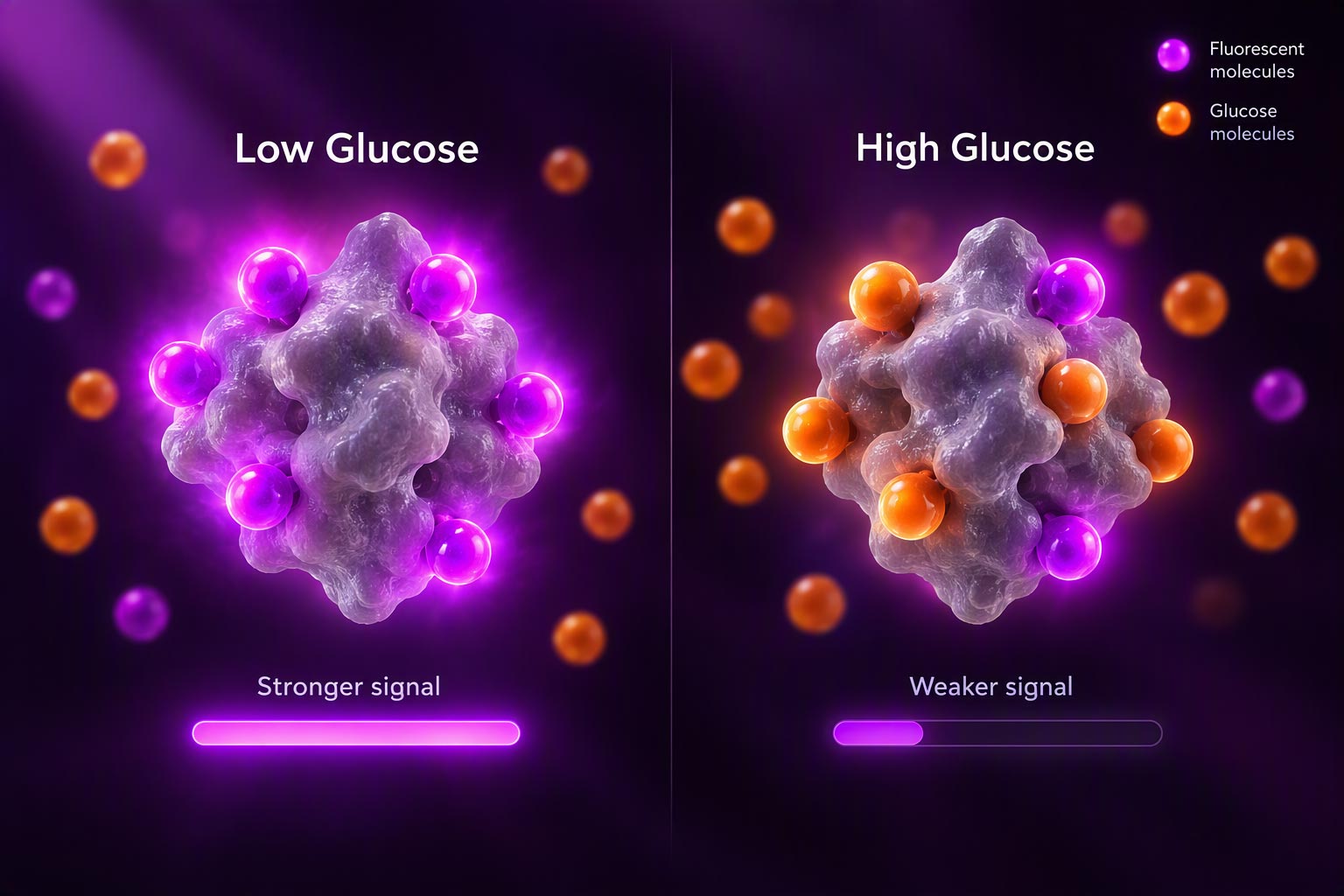
To measure glucose, the platform uses changes in near-infrared fluorescence, a light signal beyond the visible range. Many glucose-monitoring systems rely on enzymes, which help chemical reactions occur. This approach instead detects glucose through a competition between molecules.
Glucose and a fluorescent sugar compound compete for available binding sites on a protein called concanavalin A, or ConA. As glucose concentrations rise, more glucose molecules enter that competition, changing the fluorescent signal. This process, known as competitive binding, allows the researchers to track glucose concentrations without enzymes.
A cheaper sugar matches sensing performance
The team compared several glucose-binding compounds, including two forms of a sugar called mannopentaose. Earlier versions of the technology used α-mannopentaose. The much less expensive β-mannopentaose provided comparable sensing performance and also performed well in artificial interstitial fluid, a solution designed to mimic the environment beneath the skin.
“The surprising part was how closely the lower-cost material matched the performance of the more expensive alternative,” said Dr. Sayantan Tripathy, an assistant research scientist in Texas A&M’s Optical and Bio-Sensing Laboratory and the study’s lead author. “In this case, the cheaper option wasn’t really a compromise, and that’s an important finding when you’re thinking about future glucose-monitoring technologies.”
The injectable sensor remains experimental
The cost comparison concerns one sensing component. The technology remains at the proof-of-concept stage and needs additional development and testing before it could be considered for clinical use.
“Developing an affordable glucose sensor means considering the cost of the individual materials as well as how well they work together,” Coté said. “This study shows that we can substantially reduce the cost of one sensing component while maintaining comparable performance, giving us a promising foundation for further development.”
Reducing manufacturing costs could eventually help expand access to future diabetes-monitoring technologies. That possibility makes affordability a consideration throughout development, alongside technical performance.
“When new medical technologies are expensive, access can be limited,” said Dr. Melissa Grunlan, a study co-author, professor of biomedical engineering in the College of Engineering, and professor of chemistry in the College of Arts and Sciences. “Our goal is to develop sensors that are not only effective but affordable for the people who rely on them.”
The team plans to refine the platform and evaluate additional components that may improve its performance, longevity, and practicality.
“While the work remains in the research stage, the findings suggest that future glucose-monitoring technologies may not have to rely on expensive materials to deliver effective results,” Tripathy said.
Reference: “β-Anomeric Mannopentaose-Based Nonenzymatic NIR Glucose Sensor Enabling Cost-Effective Continuous Monitoring” by Sayantan Tripathy, Diana Al Husseini, Carolina I. Martinez, Anthony Dongchau, Samyucktha Ganesapandian, Melissa A Grunlan and Gerard L Cote, 19 August 2026, ACS Measurement Science Au.
DOI: 10.1021/acsmeasuresciau.6c00076
This research was funded by the National Science Foundation (NSF) Engineering Research Center for Precise Advanced Technologies and Health Systems for Under-resourced Populations.
Never miss a breakthrough: Join the SciTechDaily newsletter.
Follow us on Google and Google News.