

A Penn State team created a breath sensor that identifies diabetes by detecting acetone. The device is fast, non-invasive, and built with laser-induced graphene for precision.
In the United States, nearly one in five of the 37 million adults living with diabetes is unaware of their condition. Standard methods for diagnosing diabetes and prediabetes often involve clinic visits and laboratory tests, which can be both costly and time-consuming. Researchers now suggest that detection may soon be as simple as analyzing a person’s breath.
A team led by Huanyu “Larry” Cheng, the James L. Henderson, Jr. Memorial Associate Professor of Engineering Science and Mechanics at Penn State, has created a sensor capable of diagnosing diabetes and prediabetes within minutes using only a breath sample. Their findings were recently reported in Chemical Engineering Journal.
Acetone as a biomarker for diabetes
Traditional diagnostic approaches have typically relied on measuring glucose levels in blood or sweat. This new sensor, however, focuses on acetone in exhaled breath. Although acetone is naturally present as a byproduct of fat metabolism, levels higher than approximately 1.8 parts per million are a strong indicator of diabetes.
“While we have sensors that can detect glucose in sweat, these require that we induce sweat through exercise, chemicals, or a sauna, which are not always practical or convenient,” Cheng said. “This sensor only requires that you exhale into a bag, dip the sensor in, and wait a few minutes for results.”
Cheng noted that previous breath-analysis devices often targeted biomarkers that still required laboratory confirmation. In contrast, this new design enables on-site detection of acetone, making it both practical and affordable.
Designing a selective and efficient sensor
Beyond identifying acetone as the target biomarker, Cheng emphasized that the innovation also lies in the sensor’s construction and materials—particularly the use of laser-induced graphene. This material is produced when a carbon-based substrate, such as polyimide film, is exposed to a CO₂ laser, which transforms it into a patterned, porous graphene with defects that make it highly effective for sensing applications.
“This is similar to toasting bread to carbon black if toasted too long,” Cheng said. “By tuning the laser parameters such as power and speed, we can toast polyimide into few-layered, porous graphene form.”
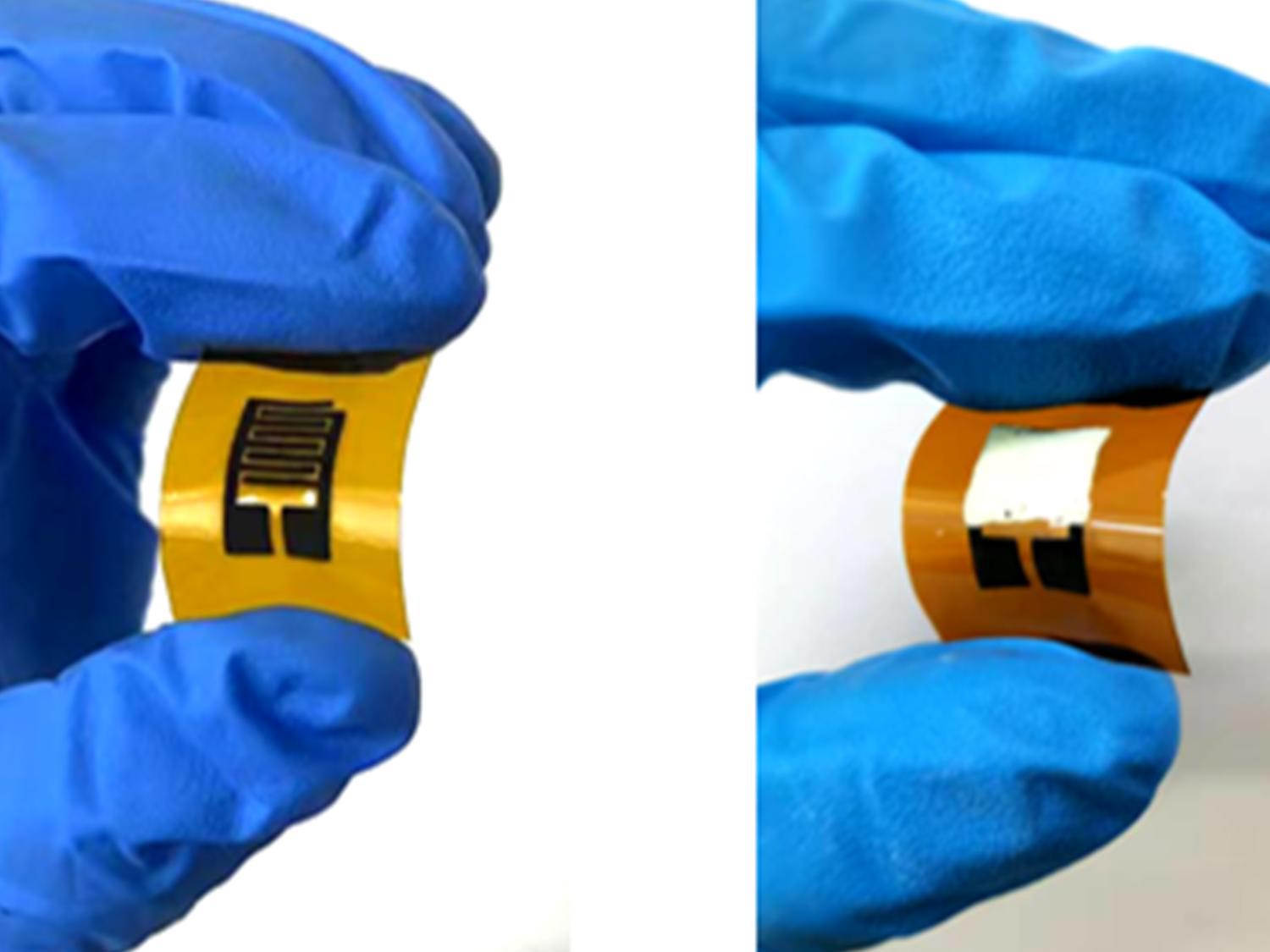
The researchers used laser-induced graphene because it is highly porous, meaning it lets gas through. This quality leads to a greater chance of capturing the gas molecule, since breath exhalation contains a relatively high concentration of moisture. However, by itself, the laser-induced graphene was not selective enough of acetone over other gases and needed to be combined with zinc oxide.
“A junction formed between these two materials that allowed for greater selective detection of acetone as opposed to other molecules,” Cheng said.
Overcoming challenges and future directions
Cheng said another challenge was that the sensor surface could also absorb water molecules, and because breath is humid, the water molecules could compete with the target acetone molecule. To address this, the researchers introduced a selective membrane, or moisture barrier layer, that could block water but allow the acetone to permeate the layer.
Cheng said that right now, the method requires that a person breathe directly into a bag to avoid interference from factors such as airflow in the ambient environment. The next step is to improve the sensor so that it can be used directly under the nose or attached to the inside of a mask, since the gas can be detected in the condensation of the exhaled breath. He said he also plans to investigate how an acetone-detecting breath sensor could be used to optimize health initiatives for individuals.
“If we could better understand how acetone levels in the breath change with diet and exercise, in the same way we see fluctuations in glucose levels depending on when and what a person eats, it would be a very exciting opportunity to use this for health applications beyond diagnosing diabetes,” Cheng said.
Reference: “ZnO/LIG nanocomposites to detect acetone gas at room temperature with high sensitivity and low detection limit” by Li Yang, Wenyuan Fu, Ya Wang, Zhida Wang, Longbiao Mao, Luxiang Xu, Chengpeng Yao, Hongyu Zhang, Sisi Chen, Hui Zhang and Huanyu Cheng, 13 June 2025, Chemical Engineering Journal.
DOI: 10.1016/j.cej.2025.164857
Funding from the U.S. National Institutes of Health and the U.S. National Science Foundation supported the Penn State contributions to this work.
Never miss a breakthrough: Join the SciTechDaily newsletter.
Follow us on Google and Google News.