
Close Menu
    Facebook X (Twitter) Instagram
    SciTechDaily
    • Biology
    • Chemistry
    • Earth
    • Health
    • Physics
    • Science
    • Space
    • Technology
    Facebook X (Twitter) Pinterest YouTube RSS
    SciTechDaily
    Home»Health»New Portable Analyzer Can Detect Antivirus Antibody in Just 20 Minutes
    Health

    New Portable Analyzer Can Detect Antivirus Antibody in Just 20 Minutes

    By Hokkaido UniversityMay 24, 2020No Comments4 Mins Read
    Facebook Twitter Pinterest Telegram LinkedIn WhatsApp Email Reddit
    Share
    Facebook Twitter LinkedIn Pinterest Telegram Email Reddit
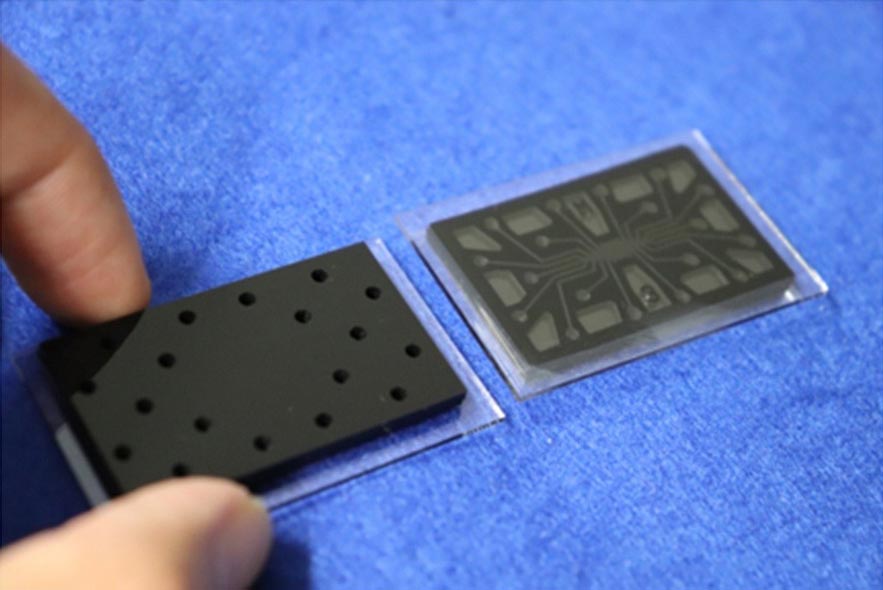
    Microfluidic Virus Antibody Analyzer Device
    The microfluidic device to which 20 μL of samples containing 2 μL of serum will be applied. Credit: Nishiyama K. et al., Sensors and Actuators B: Chemical. April 21, 2020

    Researchers have succeeded in detecting anti-avian influenza virus antibody in blood serum within 20 minutes, using a portable analyzer they have developed to conduct rapid on-site bio tests. If a suitable reagent is developed, this technology could be used to detect antibodies against SARS-CoV-2, the virus that causes COVID-19.

    Avian influenza is a poultry disease caused by influenza A virus infection. Rapid initial response for a suspected infection and continuous surveillance are essential to mitigate the damage from highly pathogenic, transmittable pathogens such as avian influenza viruses.

    Generally, the polymerase chain reaction (PCR) method is used to detect the viral genome, but its complicated procedure requires a considerable amount of time. Another method involves detecting antibodies produced in the body in reaction to virus infection. However, widely used antibody detection methods can be inaccurate because the antibodies’ existence is generally determined by eyesight.
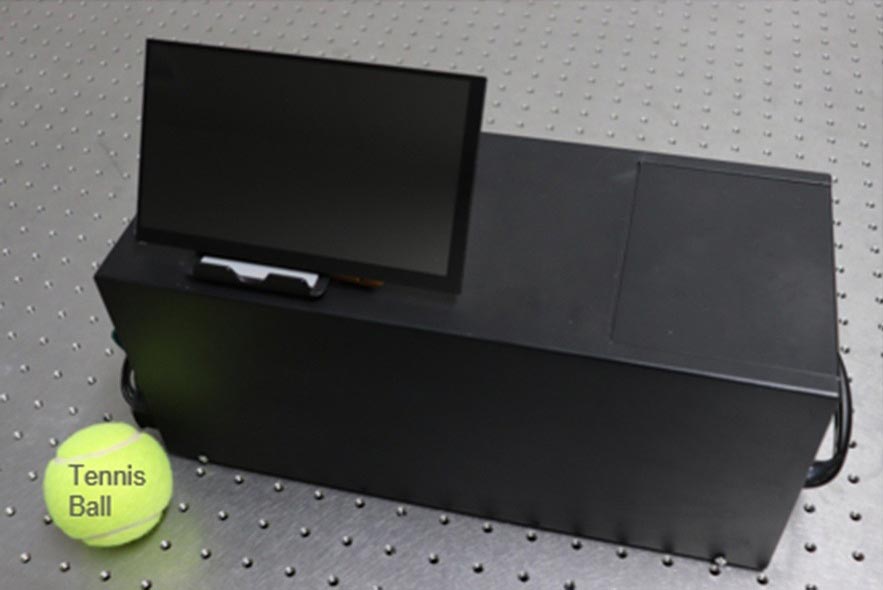
    Portable Virus Antibody Device Analyzer
    The newly developed portable fluorescence polarization analyzer (35 cm wide, 15 cm high, 15 cm long, and weighs 5.5 kg) combines a microfluidic device, an optical system, a liquid crystal, and an image sensor, enabling the rapid analysis of multiple samples. Credit: Nishiyama K. et al., Sensors and Actuators B: Chemical. April 21, 2020

    The group, including Keine Nishiyama, a doctoral student at Hokkaido University’s Graduate School of Chemical Science and Engineering, and Professor Manabu Tokeshi of the university’s Faculty of Engineering, conducted this study to develop a new method and analyzer capable of rapid, facile and selective detection of antibodies. The method is based on conventional fluorescence polarization immunoassay (FPIA) but applies a different measurement mechanism to make the analyzer much smaller and portable. The analyzer weighs only 5.5 kilograms.

    The combined use of liquid crystal molecules, an image sensor and the microfluidic device makes it possible to simultaneously examine multiple samples and reduces the volume of each sample required. Liquid crystal molecules are capable of controlling the polarization direction of fluorescent light, while the microfluidic device has a number of microchannels as a measurement vessel.
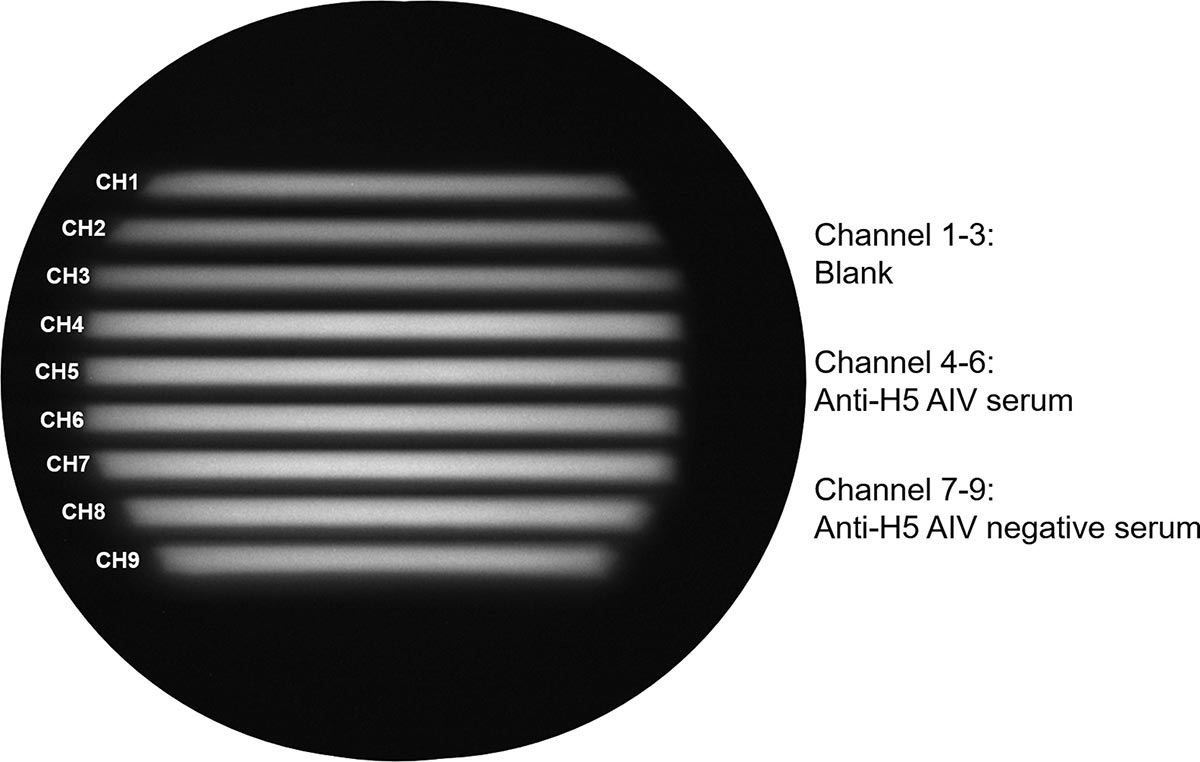
    Virus Antibody Device Analyzer
    An image obtained by the device and to be analyzed by the image analyzer. Samples show different degrees of polarization of light depending on the presence, absence, or the amount of anti-H5 avian influenza virus antibodies. Credit: Nishiyama K. et al., Sensors and Actuators B: Chemical. April 21, 2020

    The group also developed a reagent to detect anti-H5 avian influenza virus antibody, a fluorescein-labeled protein that binds only with the antibody. The reagent was made by reproducing hemagglutinin (HA) protein fragments, which are expressed on the surface of H5 avian influenza virus, through gene recombination and by labeling fluorescent molecules to the fragments.

    To make the measurement, serum collected from birds was mixed with the reagent and left for 15 minutes. The mixture was injected into the microfluidic device and measured with the portable fluorescence polarization analyzer. Molecular movements of the reagent bound with the antibody will be smaller in the liquid, producing a different degree of polarization from the reagent not bound with the antibody. The system can detect anti-H5 avian influenza virus antibody with only 2 microliters of serum sample and within 20 minutes.

    “Our analyzer could be used to conduct other bio tests if suitable reagents are developed,” says Tokeshi. The group has already successfully detected mycotoxin and drug constituents. “By reproducing fragments of spike proteins expressed in the novel coronavirus, and using them as the reagent, the analyzer should be able to detect anti-coronavirus antibodies.”

    Reference: “Rapid detection of anti-H5 avian influenza virus antibody by fluorescence polarization immunoassay using a portable fluorescence polarization analyzer” by Keine Nishiyama, Yohei Takeda, Masatoshi Maeki, Akihiko Ishida, Hirofumi Tani, Koji Shigemura, Akihide Hibara, Yutaka Yoneza, Kunitoshi Imai, Haruko Ogawa and Manabu Tokeshi, 21 April 2020, Sensors and Actuators B: Chemical.
    DOI: 10.1016/j.snb.2020.128160

    This study was supported by the JST-SENTAN program (JPMJSN16A2).

    Never miss a breakthrough: Join the SciTechDaily newsletter.
    Follow us on Google and Google News.

    Biomedical Engineering Biotechnology COVID-19 Hokkaido University Public Health Virology
    Share. Facebook Twitter Pinterest LinkedIn Email Reddit

    Related Articles

    New Biosensors Quickly Detect COVID-19 Coronavirus Proteins and Antibodies

    Smartphone-Based COVID-19 Test Developed That Delivers Results in 10 Minutes

    New COVID-19 Vaccine: Nanoparticle Immunization Technology Could Protect Against Many Strains of Coronaviruses

    Engineers Designing More Responsive SARS-COV-2 Wastewater Testing to Monitor COVID-19 Spread

    Scientists Find That Age Does NOT Contribute to COVID-19 Susceptibility

    MIT’s New CRISPR-Based Rapid Test for COVID-19 Shows Improved Sensitivity

    Bioengineered Membrane to Capture Airborne COVID-19 Droplets – Inspired by Plant That Traps Insects

    Groundbreaking Development in Rapid Large-Scale COVID-19 Testing

    Companies Affiliated With MIT Take On COVID-19 Pandemic Using Technology

    Leave A Reply Cancel Reply

    • Facebook
    • Twitter
    • Pinterest
    • YouTube

    Don't Miss a Discovery

    Subscribe for the Latest in Science & Tech!

    Trending News

    Scientists Discover 132-Million-Year-Old Dinosaur Tracks on South Africa’s Coast

    Scientists Uncover the Secret Ingredient Behind the Spark That May Have Started Life on Earth

    Physicists Observe Matter in Two Places at Once in Mind-Bending Quantum Experiment

    Stanford Scientists Discover Hidden Brain Circuit That Fuels Chronic Pain

    New Study Reveals Why Ozempic Works Better for Some People Than Others

    Climate Change Is Altering a Key Greenhouse Gas in a Way Scientists Didn’t Expect

    New Study Suggests Gravitational Waves May Have Created Dark Matter

    Scientists Discover Why the Brain Gets Stuck in Schizophrenia

    Follow SciTechDaily
    • Facebook
    • Twitter
    • YouTube
    • Pinterest
    • Newsletter
    • RSS
    SciTech News
    • Biology News
    • Chemistry News
    • Earth News
    • Health News
    • Physics News
    • Science News
    • Space News
    • Technology News
    Recent Posts
    • 320 Light-Years Away, a Planet Confirms a Fundamental Cosmic Assumption
    • Astronomers Solve Decades-Long Mystery About Saturn’s Spin – “Something Strange Was Happening”
    • Scientists Uncover Strange New State of Matter Inside Uranus and Neptune
    • The Crown Jewel of Dentistry? Breakthrough Tech Could Transform Tooth Repair
    • The Surprising Non-Medical Factor That Determines Cancer Survival
    Copyright © 1998 - 2026 SciTechDaily. All Rights Reserved.
    • Science News
    • About
    • Contact
    • Editorial Board
    • Privacy Policy
    • Terms of Use

    Type above and press Enter to search. Press Esc to cancel.