
New research studies early stages of coronavirus outbreak to re-evaluate rate of initial spread in U.S.
Many epidemiologists believe that the initial COVID-19 infection rate was undercounted due to testing issues, asymptomatic and alternatively symptomatic individuals, and a failure to identify early cases.
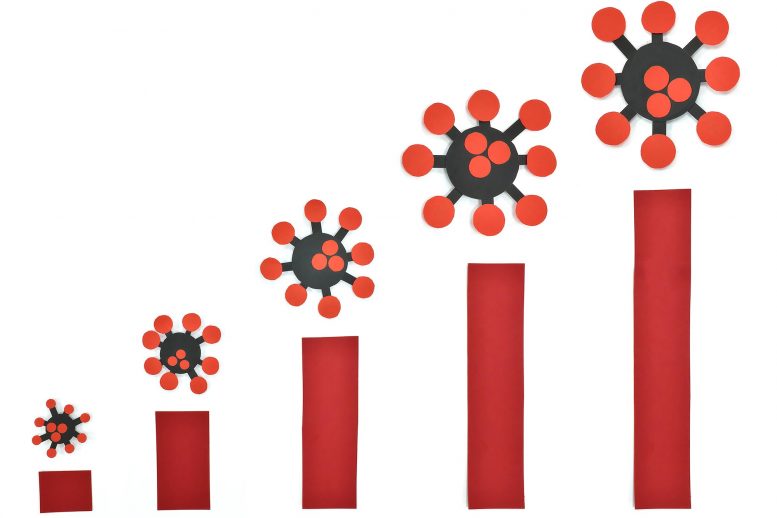
Now, a new study from Penn State estimates that the number of early COVID-19 cases in the U.S. may have been more than 80 times greater and doubled nearly twice as fast as originally believed.
In a paper published today (June 22) in the journal Science Translational Medicine, researchers estimated the detection rate of symptomatic COVID-19 cases using the Centers for Disease Control and Prevention’s influenza-like illnesses (ILI) surveillance data over a three week period in March 2020.
“We analyzed each state’s ILI cases to estimate the number that could not be attributed to influenza and were in excess of seasonal baseline levels,” said Justin Silverman, assistant professor in Penn State’s College of Information Sciences and Technology and Department of Medicine. “When you subtract these out, you’re left with what we’re calling excess ILI – cases that can’t be explained by either influenza or the typical seasonal variation of respiratory pathogens.”
The researchers found that the excess ILI showed a nearly perfect correlation with the spread of COVID-19 around the country.
Said Silverman, “This suggests that ILI data is capturing COVID cases, and there appears to be a much greater undiagnosed population than originally thought.”
Remarkably, the size of the observed surge of excess ILI corresponds to more than 8.7 million new cases during the last three weeks of March, compared to the roughly 100,000 cases that were officially reported during the same time period.
“At first, I couldn’t believe our estimates were correct,” said Silverman. “But we realized that deaths across the U.S. had been doubling every three days and that our estimate of the infection rate was consistent with three-day doubling since the first observed case was reported in Washington state on Jan. 15.”
The researchers also used this process to estimate infection rates for each state, noting that states showing higher per capita rates of infection also had higher per capita rates of a surge in excess ILI. Their estimates showed rates much higher than initially reported but closer to those found once states began completing antibody testing.
In New York, for example, the researchers’ model suggested that at least 9% of the state’s entire population was infected by the end of March. After the state conducted antibody testing on 3,000 residents, they found a 13.9% infection rate, or 2.7 million New Yorkers.
Excess ILI appears to have peaked in mid-March as, the researchers suggest, fewer patients with mild symptoms sought care and states implemented interventions which led to lower transmission rates. Nearly half of the states in the country were under stay-at-home orders by March 28.
The findings suggest an alternative way of thinking about the COVID-19 pandemic.
“Our results suggest that the overwhelming effects of COVID-19 may have less to do with the virus’ lethality and more to do with how quickly it was able to spread through communities initially,” Silverman explained. “A lower fatality rate coupled with a higher prevalence of disease and rapid growth of regional epidemics provides an alternative explanation to the large number of deaths and overcrowding of hospitals we have seen in certain areas of the world.”
Reference: “Using influenza surveillance networks to estimate state-specific prevalence of SARS-CoV-2 in the United States” by Justin D. Silverman, Nathaniel Hupert and Alex D. Washburne, 22 June 2020, Science Translational Medicine.
DOI: 10.1126/scitranslmed.abc1126
Other collaborators on the project included Nathaniel Hupert of Cornell University and the New York-Presbyterian Hospital, and Alex Washburne of Montana State University.
Never miss a breakthrough: Join the SciTechDaily newsletter.
Follow us on Google and Google News.