
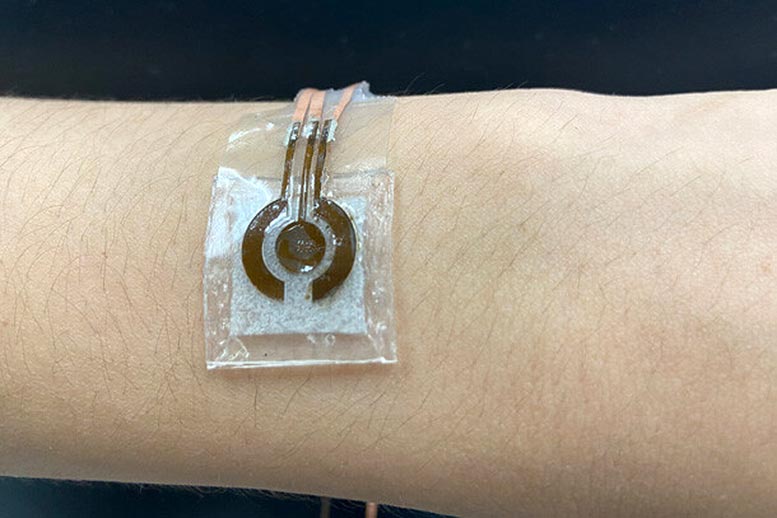
Penn State researchers develop first-of-its-kind wearable, noninvasive glucose monitoring device prototype.
Noninvasive glucose monitoring devices are not currently commercially available in the United States, so people with diabetes must collect blood samples or use sensors embedded under the skin to measure their blood sugar levels. Now, with a new wearable device created by Penn State researchers, less intrusive glucose monitoring could become the norm.
Led by Huanyu “Larry” Cheng, Dorothy Quiggle Career Development Professor in Penn State’s Department of Engineering Science and Mechanics, the researchers published the details of the noninvasive, low-cost sensor that can detect glucose in sweat in Biosensors and Bioelectronics. The paper, available online, will be published in the journal’s December print issue.
The researchers constructed the device first with laser-induced graphene (LIG), a material consisting of atom-thick carbon layers in various shapes. With high electrical conductivity and a convenient fabrication time of just seconds, LIG appeared to be an ideal framework for the sensing device — but there was a significant caveat.
Nickel-Gold Alloy Provides Glucose Sensitivity
“The challenge here is that LIG is not sensitive to glucose at all,” Cheng said. “So, we needed to deposit a glucose-sensitive material onto the LIG.”
The team chose nickel because of its robust glucose sensitivity, according to Cheng, and combined it with gold to lower the potential risks of an allergic reaction. The researchers hypothesized that the LIG outfitted with the nickel-gold alloy would be able to detect low concentrations of glucose in sweat on the skin’s surface.
Noninvasive glucose monitoring devices are not currently commercially available in the United States, so people with diabetes must collect blood samples or use sensors embedded under the skin to measure their blood sugar levels. Now, with a new wearable device created by Penn State researchers, less intrusive glucose monitoring could become the norm.
A material with high glucose sensitivity was a priority. Sweat exhibits remarkably low glucose concentrations compared to blood — but, according to Cheng, there is a strong correlation between glucose levels in sweat and blood. While the concentration of glucose in sweat is about 100 times less than the concentration in blood, the team’s device is sensitive enough to accurately measure the glucose in sweat and reflect the concentration in blood.
The nickel-gold alloy’s sensitivity allowed Cheng’s team to exclude enzymes, which are often used to measure glucose in more invasive, commercially available devices or in noninvasive monitors proposed by other researchers. These enzymes, however, can degrade quickly with time and changing temperatures.
“An enzymatic sensor has to be kept at a certain temperature and pH, and the enzyme can’t be stored in the long term,” Cheng said. “A nonenzymatic glucose sensor, on the other hand, is advantageous in terms of stable performance and glucose sensitivity regardless of these changes.”
Overcoming Skin Safety Issues with Microfluidic Chambers
Nonenzymatic sensors require alkaline solution, which can damage the skin and typically limits device wearability. To curb this issue, Cheng and his team attached a microfluidic chamber to the LIG alloy. This chamber is smaller than previously developed configurations to promote wearability and porous to allow for a range of movement, such as stretching or crushing. It is connected to a collection inlet that passes sweat into the solution without allowing the solution to touch the skin. The basic solution interacts with the glucose molecules to produce a compound that reacts with the alloy. This reaction triggers an electrical signal, indicating the concentration of glucose in the sweat.
With a smaller alkaline solution chamber, the entire device is roughly the size of a quarter and is flexible enough to maintain a secure attachment to the human body, Cheng said.
In a proof-of-concept test, the researchers used a skin-safe adhesive to attach the reusable device to a person’s arm one hour and three hours after a meal. The subject performed a brief workout — just enough to produce sweat — right before each measurement time. A few minutes after collecting the sweat, the researchers found that the detected glucose concentration dropped from the first measurement to the next. The glucose measurements from the device were verified by measurements made with a commercially available glucose monitor.
Cheng and the team plan to improve upon their prototype for future applications, including addressing how patients or clinicians may use the sensor for incremental glucose measurements or continuous monitoring to determine treatment actions, such as administering insulin. They also intend to refine and expand this platform for more comfortable monitoring of other biomarkers that can be found in the sweat or interstitial fluids that fill the space between cells in the body.
“We want to work with physicians and other health care providers to see how we can apply this technology for daily monitoring of a patient,” Cheng said. “This glucose sensor serves as a foundational example to show that we can improve the detection of biomarkers in sweat at extremely low concentrations.”
Reference: “Laser-induced graphene non-enzymatic glucose sensors for on-body measurements” by Jia Zhu, Shangbin Liu, Zhihui Hu, Xianzhe Zhang, Ning Yi, Kairui Tang, Michael Gregory Dexheimer, Xiaojun Lian, Qing Wang, Jian Yang, Jennifer Gray and Huanyu Cheng, 1 September 2021, Biosensors and Bioelectronics.
DOI: 10.1016/j.bios.2021.113606
Other contributors include co-first author Jia Zhu, co-first author Shangbin Liu, Zhihui Hu, Xianzhe Zhang, Ning Yi, Kairui Tang and Michael Gregory Dexheimer, Department of Engineering Science and Mechanics; Qing Wang with the Department of Materials Science and Engineering in the College of Earth and Mineral Sciences; Xiaojun Lian and Jian Yang with the Department of Biomedical Engineering; and Jennifer Gray with the Materials Research Institute. Hu is also affiliated with the Wuhan University of Technology in China, and Yi is also affiliated with the Penn State Department of Materials Science and Engineering. Cheng is also affiliated with the architectural engineering and biomedical engineering departments in the College of Engineering and the Department of Materials Science and Engineering in the Penn State College of Earth and Mineral Sciences, as well as the Engineering Energy and Environmental Institute, Materials Research Institute, and the Institute for Computational and Data Sciences.
The National Science Foundation and the National Heart, Lung and Blood Institute of the National Institutes of Health (award number R61HL154215) supported this work.
Never miss a breakthrough: Join the SciTechDaily newsletter.
Follow us on Google and Google News.
14 Comments
I’m in Singapore can get to use I’m very intereste in the First-of-Its-Kind Wearable Glucose Monitoring Device – No Needles Required
When will it be on sale ?
Id like to particpate in the clinical trials.
I am Sunil Chati,senior citizen,age app80 years, lioving in Nashik,India.I am diabetic since last more tha n40 years.I am interested in this product if I can afford.Also I am willing to undergo tests if you wish to enroll me.Please let me know.
Thanks.
Noninvasive blood glucose monitors are “commercially available” with a prescription. There are at least three that I am aware of so this article doesn’t have much credibility for accurate reporting IMO.
I am aged 65 and intrested for any test for non-invasive Diabetic tests whenever required. I will be available wholeheartedly as me and my wife are Diabetic patient since long
Sign me up for trial test
@Frugal Yankee you’re wrong. How do you think the monitor stays on the skin, magic? There is a needle. Stop saying incorrect things to try and make yourself feel smart.
When can we purchase this inAlabama?
Plenty of Noninvasive blood glucose monitors are “commercially available on Amazon or the in. What the H
Whoa, all. This is a proof of concept for an underlying technology. We are a LONG way away from this being a finished product, much less trials before release to the public. Also, basic rules of the internet apply. For your own safety, please do mot put your contact info in a public comment area.
I agree this is exciting, but we are nowhere near the finish line on this.
I have low blood sugar.I almost pass out before I know that my blood sugar is 59. I’m 62 would love to be a test subject.
I’m willing to go through test trails this amazing medical device. I’ve had type one diabetes for many years and this would help all people will this to keep better control.
I would like to participate in clinical trial for this device.
Kay in Georgia