
Close Menu
    Facebook X (Twitter) Instagram
    SciTechDaily
    • Biology
    • Chemistry
    • Earth
    • Health
    • Physics
    • Science
    • Space
    • Technology
    Facebook X (Twitter) Pinterest YouTube RSS
    SciTechDaily
    Home»Health»New Graphene Sensor Detects Cancer Biomarkers
    Health

    New Graphene Sensor Detects Cancer Biomarkers

    By Institute of PhysicsSeptember 19, 2014No Comments3 Mins Read
    Facebook Twitter Pinterest Telegram LinkedIn WhatsApp Email Reddit
    Share
    Facebook Twitter LinkedIn Pinterest Telegram Email Reddit
    New Graphene Sensor Tracks Down Cancer Biomarkers
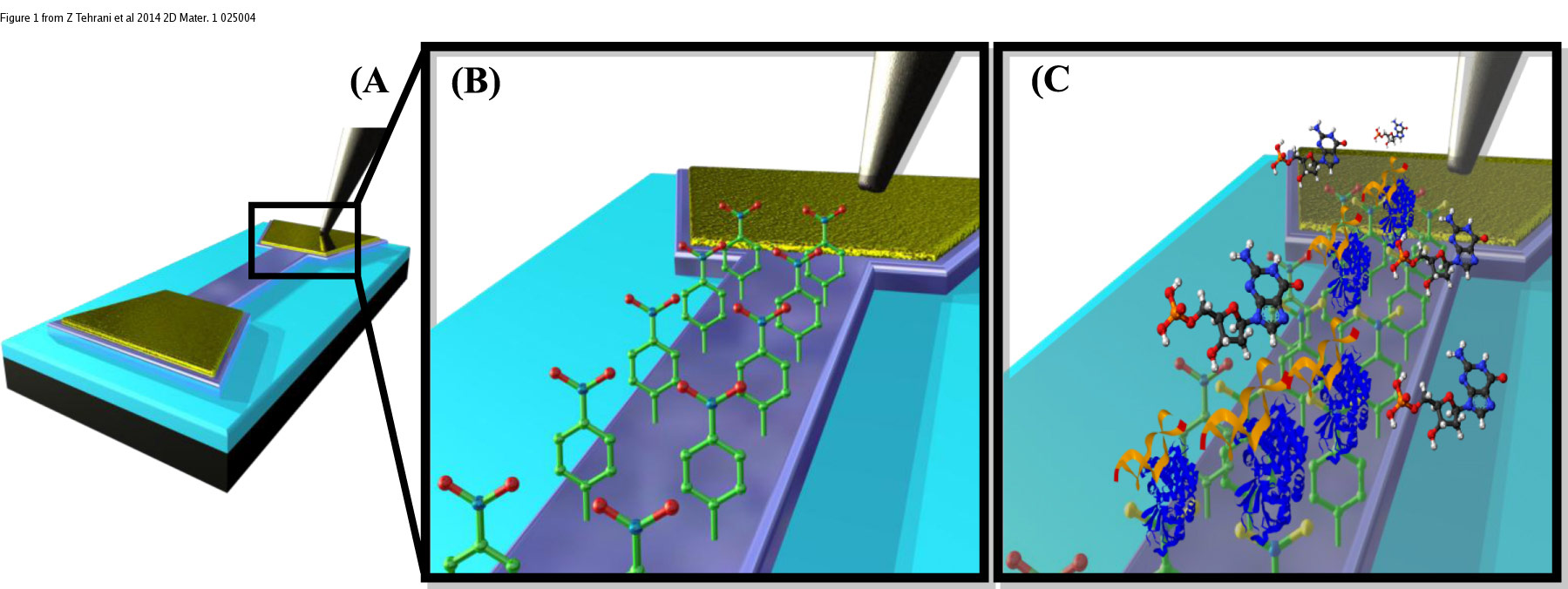
    Illustration of an epitaxial graphene channel biosensor for detection of targeted 8-hydroxydeoxyguanosine (8-OHdG) biomarker. (A) Schematic of MLEG device. (B) Thin film of covalently attached nitro phenyl (PhNO2) groups on the MLEG channel. (C) Attachment of the ‘bioreceptor’ antibody anti-8-OHdG to the amine terminated MLEG channel and subsequent detection of 8-OHdG. Credit: Z Tehrani et al 2014 2D Mater. 1 025004; doi:10.1088/2053-1583/1/2/025004

    Scientists from the University of Swansea have developed an ultrasensitive graphene biosensor that can detect molecules that indicate an increased risk of developing cancer.

    The biosensor has been shown to be more than five times more sensitive than bioassay tests currently in use, and was able to provide results in a matter of minutes, opening up the possibility of a rapid, point-of-care diagnostic tool for patients. The biosensor has been presented today, 19 September, in IOP Publishing’s journal 2D Materials.

    To develop a viable biosensor, the researchers, from the University of Swansea, had to create patterned graphene devices using a large substrate area, which was not possible using the traditional exfoliation technique where layers of graphene are stripped from graphite.

    Instead, they grew graphene onto a silicon carbide substrate under extremely high temperatures and low pressure to form the basis of the biosensor. The researchers then patterned graphene devices, using semiconductor processing techniques, before attaching a number of bioreceptor molecules to the graphene devices. These receptors were able to bind to, or target, a specific molecule present in blood, saliva or urine.

    The molecule, 8-hydroxydeoxyguanosine (8-OHdG), is produced when DNA is damaged and, in elevated levels, has been linked to an increased risk of developing several cancers. However, 8-OHdG is typically present at very low concentrations in urine, so is very difficult to detect using conventional detection assays, known as enzyme-linked immunosorbent assays (ELISAs).

    In their study, the researchers used X-ray photoelectron spectroscopy and Raman spectroscopy to confirm that the bioreceptor molecules had attached to the graphene biosensor once fabricated, and then exposed the biosensor to a range of concentrations of 8-OHdG.

    When 8-OHdG attached to the bioreceptor molecules on the sensor, there was a notable difference in the graphene channel resistance, which the researchers were able to record.

    Results showed that the graphene sensor was capable of detecting 8-OHdG concentrations as low as 0.1 ng mL-1, which is almost five times more sensitive compared with ELISAs. The graphene biosensor was also considerably faster at detecting the target molecules, completing the analysis in a matter of minutes.

    Moving forward, the researchers highlight the potential of the biosensor to diagnose and monitor a whole range of diseases, since it is quite simple to substitute the specific receptor molecules on the graphene surface.

    Co-author of the study Dr Owen Guy said: “Graphene has superb electronic transport properties and has an intrinsically high surface-to-volume ratio, which make it an ideal material for fabricating biosensors.

    “Now that we’ve created the first proof-of-concept biosensor using epitaxial graphene, we will look to investigate a range of different biomarkers associated with different diseases and conditions, as well as detecting a number of different biomarkers on the same chip.”

    Reference: “Generic epitaxial graphene biosensors for ultrasensitive detection of cancer risk biomarker” by DZ Tehrani, G Burwell, M A Mohd Azmi, A Castaing, R Rickman, J Almarashi, P Dunstan, A Miran Beigi, S H Doak and O J Guy, 19 September 2014, 2D Materials.
    DOI: 10.1088/2053-1583/1/2/025004


    Never miss a breakthrough: Join the SciTechDaily newsletter.
    Follow us on Google and Google News.

    Biosensor Graphene Institute of Physics Nanoscience Nanotechnology
    Share. Facebook Twitter Pinterest LinkedIn Email Reddit

    Related Articles

    Organic Semiconductor Breakthrough Could Literally Reshape Solar Cells

    Researchers Successfully Synthesize 2D Material Germanene

    Experimental Evidence Shows New Boron Nanomaterial is Possible

    Researchers Develop Peptoid Nanosheets that Mimic Natural Antibodies

    Flexible Sensors May Lead to “Artificial Skin” That Senses Touch, Humidity and Temperature

    Triangular Layers of Tungsten Disulfide May Have Applications in Optical Technology

    RNA Delivering Nanoparticles Shrink Tumors in Mice

    “Closed-Edge Graphene Nanoribbons”

    Carbon Nanotubes Increase the Speed of Biological Sensors

    Leave A Reply Cancel Reply

    • Facebook
    • Twitter
    • Pinterest
    • YouTube

    Don't Miss a Discovery

    Subscribe for the Latest in Science & Tech!

    Trending News

    Monster Storms on Jupiter Unleash Lightning Beyond Anything on Earth

    Scientists Create “Liquid Gears” That Spin Without Touching

    The Simple Habit That Could Help Prevent Cancer

    Millions Take These IBS Drugs, But a New Study Finds Serious Risks

    Scientists Unlock Hidden Secrets of 2,300-Year-Old Mummies Using Cutting-Edge CT Scanner

    Bread Might Be Making You Gain Weight Even Without Eating More Calories

    Scientists Discover Massive Magma Reservoir Beneath Tuscany

    Europe’s Most Active Volcano Just Got Stranger – Here’s Why Scientists Are Rethinking It

    Follow SciTechDaily
    • Facebook
    • Twitter
    • YouTube
    • Pinterest
    • Newsletter
    • RSS
    SciTech News
    • Biology News
    • Chemistry News
    • Earth News
    • Health News
    • Physics News
    • Science News
    • Space News
    • Technology News
    Recent Posts
    • 25-Year Study Uncovers Hidden Paths and Early Warning Signs of Blood Cancer
    • Not Just Snoring – New Research Reveals Sleep Apnea May Be Damaging Your Muscles
    • Scientists Discover a Surprising Reason Intermittent Fasting Extends Life
    • Scientists Discover a New Meteor Shower From a Mysterious Crumbling Asteroid
    • This Simple Fruit Wash Could Make Produce Safer and Last Days Longer
    Copyright © 1998 - 2026 SciTechDaily. All Rights Reserved.
    • Science News
    • About
    • Contact
    • Editorial Board
    • Privacy Policy
    • Terms of Use

    Type above and press Enter to search. Press Esc to cancel.