
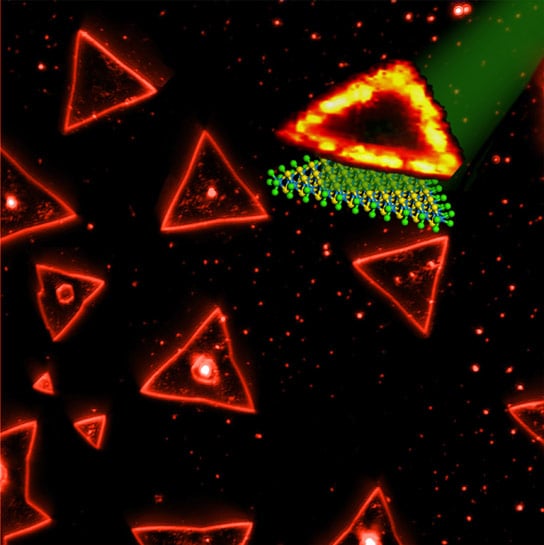
Researchers at Penn State have created triangular single layers of tungsten disulfide that exhibit unusual photoluminescent properties and may have potential applications in optical technology.
For the first time, scientists have created single layers of a naturally occurring rare mineral called tungstenite, or WS2. The resulting sheet of stacked sulfur and tungsten atoms forms a honeycomb pattern of triangles that have been shown to have unusual light-emitting, or photoluminescent, properties. According to team leader Mauricio Terrones, a professor of physics and of materials science and engineering at Penn State, the triangular structures have potential applications in optical technology; for example, for use in light detectors and lasers. The results of the research are published online in the journal Nano Letters.
Terrones explained that creating monolayers — single, one-atom-thick layers — is of special interest to scientists because the chemical properties of minerals and other substances are known to change depending on their atomic thickness, opening the door to potentially useful applications of multi-layered materials of various thicknesses. In previous research, scientists had accomplished the feat of making a monolayer of graphene — a substance similar to the graphite found in pencil leads. “The technique these researchers used was tedious, but it worked,” Terrones said. “They basically removed, or exfoliated, the graphene, layer by layer, with Scotch tape, until they got down to a single atom of thickness.”
Now, for the first time, Terrones and his team have used a controlled thermal reduction-sulfurization method — or chemical vapor deposition — to accomplish the same feat with a rare mineral called tungstenite. The scientists began by depositing tiny crystals of tungsten oxide, which are less than one nanometer in height, and they then passed the crystals through sulfur vapor at 850 degrees Celsius (1,600 degrees Fahrenheit). This process led to individual layers — or sheets — composed of one atom in thickness. The resulting structure — called tungsten disulfide — is a honeycomb pattern of triangles consisting of tungsten atoms bonded with sulfur atoms.
“One of the most exciting properties of the tungsten disulfide monolayer is its photoluminescence,” Terrones said. Terrones explained that photoluminescence occurs when a substance absorbs light at one wavelength and re-emits that light at a different wavelength. The property of photoluminescence also occurs in certain bioluminescenent animals such as angler fish and fireflies. “One interesting discovery from our work is the fact that we see the strongest photoluminescence at the edges of the triangles, right where the chemistry of the atoms changes, with much less photoluminescence occurring in the center of the triangles,” Terrones said. “We also have found that these new monolayers luminesce at room temperature. So no special temperature requirements are needed for the material to exhibit this property.”
Co-author Vincent H. Crespi, Distinguished Professor of Physics, Chemistry, and Materials Science and Engineering at Penn State, added, “The images of the photoluminescence are beautiful; the triangles light up all around their edges like little holiday ornaments — holiday ornaments with potentially transformative, long-term applications in nano-optics.”
The research has many potential applications in the fields of optical light detection, the production of light-emitting diodes, and even laser technology. The researchers also plan to try the chemical-vapor-deposition technology to grow innovative monolayers using other layered materials with potentially useful applications.
Reference: “Extraordinary Room-Temperature Photoluminescence in Triangular WS2 Monolayers” by Humberto R. Gutiérrez, Nestor Perea-López, Ana Laura Elías, Ayse Berkdemir, Bei Wang, Ruitao Lv, Florentino López-Urías, Vincent H. Crespi, Humberto Terrones and Mauricio Terrones, 29 November 2013, Nano Letters.
DOI: 10.1021/nl3026357
In addition to Terrones and Crespi, other researchers who contributed to this study include Humberto R. Gutiérrez, an assistant professor at the University of Louisville; Nestor Perea-López and Ana Laura Elías, research associates at Penn State; Ayse Berkdemir and Ruitao Lv, postdoctoral fellows at Penn State; Bei Wang and Yuanxi Wang, graduate students at Penn State; and Florentino López-Urías and Humberto Terrones, visiting professors at Penn State.
Support for this research comes primarily from the U.S. Army Research Office and, in part, from the Penn State Center for Nanoscale Science.
Never miss a breakthrough: Join the SciTechDaily newsletter.
Follow us on Google and Google News.