
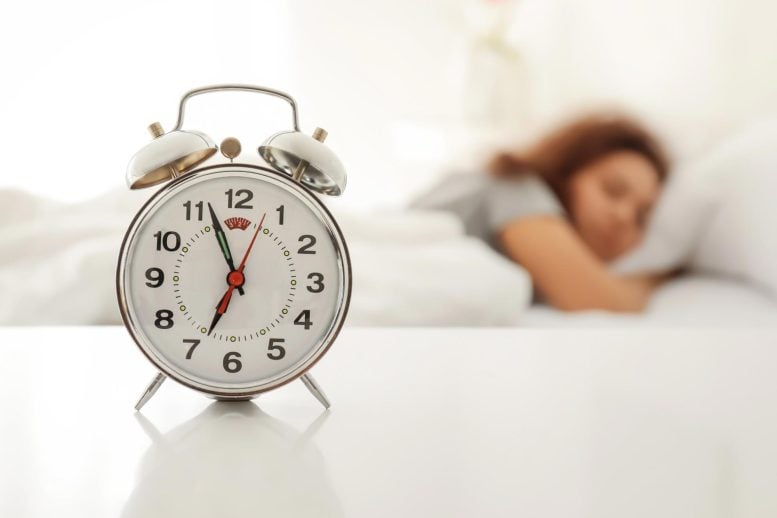
Researchers from the University of Cambridge and Fudan University say seven hours is the ideal amount of sleep for people in their middle age and upwards, with too little or too much sleep associated with poorer cognitive performance and mental health.
Everyone knows that getting a good night’s sleep is important, but how much sleep is best? Is it possible to get too much sleep?
An old adage states that we should get 8 hours of sleep each night, and many people think that too much sleep is not generally a problem. However, researchers analyzed data from nearly half a million adults and found that both inadequate and excessive sleep duration were linked with impaired cognitive performance, increased anxiety and depression, and worse overall well-being.
According to the scientists, 7 hours of sleep was optimal for adults, with greater differences from this amount being linked with increased changes in the structure of brain regions involved in cognitive processing and memory.
Sleep and Its Role in Cognitive Function and Brain Health
Sleep plays an important role in enabling cognitive function and maintaining good psychological health. It also helps keep the brain healthy by removing waste products. As we get older, we often see alterations in our sleep patterns, including difficulty falling asleep and staying asleep, and decreased quantity and quality of sleep. It is thought that these sleep disturbances may contribute to cognitive decline and psychiatric disorders in the aging population.
“Getting a good night’s sleep is important at all stages of life, but particularly as we age.” Barbara Sahakian
In research published on April 28, 2022, in the scientific journal Nature Aging, scientists from the UK and China examined data from nearly 500,000 adults aged 38-73 years from the UK Biobank. Participants were asked about their sleeping patterns, mental health, and well-being, and took part in a series of cognitive tests. Brain imaging and genetic data were available for almost 40,000 of the study participants.
By analyzing the data, the team found that both insufficient and excessive sleep duration were associated with impaired cognitive performance, such as processing speed, visual attention, memory, and problem-solving skills. Seven hours of sleep per night was the optimal amount of sleep for cognitive performance, but also for good mental health, with people experiencing more symptoms of anxiety and depression and worse overall wellbeing if they reported sleeping for longer or shorter durations.
Links Between Sleep Duration, Memory, and Dementia Risk
The researchers say one possible reason for the association between insufficient sleep and cognitive decline may be due to the disruption of slow-wave – ‘deep’ – sleep. Disruption to this type of sleep has been shown to have a close link with memory consolidation as well as the build-up of amyloid – a key protein which, when it misfolds, can cause ‘tangles’ in the brain characteristic of some forms of dementia. Additionally, lack of sleep may hamper the brain’s ability to rid itself of toxins.
The team also found a link between the amount of sleep and differences in the structure of brain regions involved in cognitive processing and memory, again with greater changes associated with greater than or less than seven hours of sleep.
Having a consistent seven hours’ sleep each night, without too much fluctuation in duration, was also important to cognitive performance and good mental health and well-being. Previous studies have also shown that interrupted sleep patterns are associated with increased inflammation, indicating a susceptibility to age-related diseases in older people.
Professor Jianfeng Feng from Fudan University in China said: “While we can’t say conclusively that too little or too much sleep causes cognitive problems, our analysis looking at individuals over a longer period of time appears to support this idea. But the reasons why older people have poorer sleep appear to be complex, influenced by a combination of our genetic makeup and the structure of our brains.”
Sleep Duration as a Risk Factor for Cognitive Decline
The researchers say the findings suggest that insufficient or excessive sleep duration may be a risk factor for cognitive decline in aging. This is supported by previous studies that have reported a link between sleep duration and the risk of developing Alzheimer’s disease and dementia, in which cognitive decline is a hallmark symptom.
Professor Barbara Sahakian from the Department of Psychiatry at the University of Cambridge, one of the study’s authors, said: “Getting a good night’s sleep is important at all stages of life, but particularly as we age. Finding ways to improve sleep for older people could be crucial to helping them maintain good mental health and wellbeing and avoiding cognitive decline, particularly for patients with psychiatric disorders and dementias.”
Reference: “The brain structure and genetic mechanisms underlying the nonlinear association between sleep duration, cognition and mental health” by Yuzhu Li, Barbara J. Sahakian, Jujiao Kang, Christelle Langley, Wei Zhang, Chao Xie, Shitong Xiang, Jintai Yu, Wei Cheng and Jianfeng Feng, 28 April 2022, Nature Aging.
DOI: 10.1038/s43587-022-00210-2
The research was supported by the National Key R&D Program of China, the Shanghai Municipal Science and Technology Major Project, the Shanghai Center for Brain Science and Brain-Inspired Technology, the 111 Project, the National Natural Sciences Foundation of China and the Shanghai Rising Star Program.
Never miss a breakthrough: Join the SciTechDaily newsletter.
Follow us on Google and Google News.
72 Comments
Not enough information really to gague on this study. Some looke strictly at brain function, while others properly look at overall body chemistry and micro-organism balance. We can’t be sure of anything when looking at pixels while ignoring the whole picture.
ASLEEP @ THE WHEEL…
NOT TO MENTION 5G.
So I won’t…
Think MAYBE I’ll SLEEP on IT…
🤭 YAWN!
😴
Not to mention 5G…
So I won’t.
Think I’ll SLEEP on IT.
🤭YAWN…
😴
Quite dissapointed in the article. Very click bait and avoids giving any real detail or breakdown but merely suggesta 7 hours sleep is all you need.
Where is the age differential, or nutritional facts.
Also too many ads for no real content.
Ads? I have never seen an ad here. Grab an ad blocker 😉
it oks… When die.. sleep firever is betttter.
.
.BizMuLLaGh pbuh pwe SWaT pwa blyat kkk ngk kgb kjv niv ssd ddt rip etc etc.
What qualifies you to commen? what degree’s do you have? Or is this just millennial bulls*** where you feel that others give a d*** about your opinion?
The article ended abruptly and I literally got no information at all. I was expecting pertinent information but got more from the title than the article.
I only sleep 5 to 6 hours a day and feel great after i am up and if sleep more than 6 i don’t feel good that day
Waste of my time reading this. Is study is bs and didn’t happen. Who do you pay to publish this crap?
Scitech daily i bid you farewell.
7 hours, for anyone like me who didn’t want to read through everything
So how many hours of sleep??
I wish I could stay sleep past 8 hours I wanna dream longer my dreams is the only way I explore other worlds
An inferior article, as it does not provide any resolution/solution or most beneficial times to sleep. Elderly people often have urination issues during the night and never get a full night’s sleep, rather they get 7 or 8 hours of interrupted sleep. Since no real data or information or detailed explanation is offered, I have to ask why even bother with this as a “science” article, it’s pure empty fluff.
There is no solution. The right amount of sleep is the amount you need.
They may well be confusing cause and effect here. People with these various brain disorders may have abnormal sleep patterns as a result of these conditions and trying to always have 7 hours of optimal sleep isn’t going to prevent or cure them.
How do we know if it’s not paid by big corporations to justify long working hours? Seems suspicious… I’ll wait until it is more widely studied, to be sure.
Tells me I sleep too much. Will cut an hour to 7 thanks. I watched my mum with Alzheimers and I want to prevent it if I can.
I think the amount of sleep you need is peripheral. I agree 7 hours is enough sleep if you feel rested the next day. I found out my dreams were generated by suggestions during the day. I doctor at a sleep clinic in London said he’s a Dream Weaver. He can plot your dreams on an EEG using infrared. I get no sleep while I’m dreaming I’m under they’re control.
🙈🙉🙊🍌 🚩🚩🚩
Nature Aging, yet they strive to cover humans nonetheless. Health bands may strive to help us laugh off rough nights until there’s something to do, but trying hard enough for 7 H is that until they do. Hope to try my library’s Nature Unlimited subscription and see more to it. Go on, ‘in my dreams’ me.
While the results are more anecdotal than anything else, it gives people an idea of the whys and wherefores of the studies into sleep. Researchers are now getting away from quality to quantity number in hours according to the results stated above. Let’s hope that I someday can have a better night sleep sooner rather than later from this.
Brains are similar but differents, I doubt this study applies for every brain?!
There is no right amount of sleep hours that fits everyone. If you are more active during the day and have a more physical job you will sleep more and differently than someone who doesn’t.
Its not quantity of sleep its quality of sleep! LOL I must be cranky
Do some research on “our natural sleep cycle”, and you will find that a period of wakefulness in the middle of the night plus a daily nap is the key to good rest.
They repeatedly say that too little or too much sleep causes this and that. But when they go into details they only say when you don’t get enough sleep this happens … when you don’t get enough sleep that happens. They never specifically mention when you get lots of sleep…. Every bad thing they mention is due to not getting enough sleep???
You wrote an entire article with no information to what the title suggested. What waste of time. Very click bate driven.
100 % bull. They don’t even mention REM sleep. I took biological psychology and I can tell you this study is weak ! They holding back the real technology. Just read a David Icke book that you may know the truth.
Buy a google nest!
It will track your sleep cycles and watch you while you sleep!!
Great! Well that was 3 minutes wasted reading this ridiculous,click-bait article that I can never recoup!
Okkk, I’m 61 and have always had sleep issues, for some reason I only get two and a half hour to 3 and I still fell refreshed and have no cognitive problem.
6 hr sleep + 1/2 hr yoga nidra keeps me fresh all day..
These scientists need to research Chinese Medicine. Its well know in TCM that sleep decline due to age is linked to a drop in blood volume. I’m in my 50s and without blood building herbs I would have constant insomnia. I need also an average of 9 hours sleep every night and that works well for me. I feel embarrassed for the scientists publishing an article like this as it doesn’t factor in menopause and this nonsense about 7 hours for everyone doesn’t take into account all the variables associated with good cognitive functioning associated with sleep.
There’s 7min. of my life I’ll never get back. I never did see a number in hours.
Did anyone else ?
PS: The reason aged humans have trouble staying asleep for long periods of time is likely due to body aches and pains/inability remain in one position through the night. It is anxiety that keeps the younger of the species up at night.
To die, to sleep—
No more—and by a sleep to say we end
The heartache, and the thousand natural shocks
That flesh is heir to. ’tis a consummation
Devoutly to be wish’d. To die, to sleep—
To sleep—perchance to dream. Ay, there’s the rub!
For in that sleep of death what dreams may come,
The real experiment is the comments left by the readers to see how people react to a garbage article.
(¬_¬)
I go to sleep when I’m tired, and I get up when I’m not. Too much overthinking, like everything else in our failing civilization!
Totally agree,we focus to much on sleep which creates sleep anxiety,this leading to no sleep or very little sleep
If you need scientific studies to believe in the paramount importance of sleep in ALL aspects of health, both physical and psychological, then you need to get better sleep, so you can think clearly.
BS. I’ve slept 9 to 10 hours all my life. I won full scholarships to high school, and I’m 90 years old now. My only health problem is COPD which I got because I smoked all my life. Otherwise I’m in good shape. Eg most of my WORDLE games are 3/6. And the “scientists” mentioned here forgot about muscular aches interfering with sleep.
This article is trash. I, myself, at almost 73 have consistently only required 6 hours of sleep nightly for over 50 years. Even as a child I required 2 or 3 hours less sleep than the average child. Trying to pigeon hole people is unscientific, moronic, and a waste of time.
Reads like so much BS. No diff between ages?
Older people have to get up more at night to go pee — thus interrupting their sleep. Duh.
I sleep until I’m rested or cant go back to sleep
. That’s how it’s always been unless I had little kids and babies to raise or worked at night.
There’s a ton of studies and a ton of results. What I want to know is what do you do for someone like me who can’t sleep despite everything that has been tried. I’m middle-aged plus, 55 to be exact. And I have had insomnia since I was 7 years old. I have been in therapy, spent over 19 years in therapy. Tried every prescription medication on the market and I mean every single one, including xyrem which was a battle to get and didn’t do anything. I’ve done acupuncture, massage, hypnotherapy, exercise of course, eft, yoga, deep breathing, relaxation techniques, and the list goes on. I’ve also exhausted every supplement and combination of supplements there are available. I have been enrolled in three different sleep studies and was discharged all three times because I could not fall asleep. You cannot study what doesn’t happen. For the past 30 years I sleep an average of 3 hours a night or less and it is never longer than 15 minutes at a time. I can fall asleep no problem and 15 minutes later I wake up covered in sweat with horrific nightmares related to some even worse real life nightmares that happened as a child. There’s nothing left to try. There are no more specialists there are no more medications there are no more techniques there are no more procedures short of hitting myself on the head with a mallet every night nothing is going to keep me asleep. So you can tell me all day long how not sleeping is screwing me up. That doesn’t help me sleep. How about more data on that. To help people like myself who have been suffering with insomnia for decade after decade to get even 1 hour of straight sleep would make me so incredibly happy. Even 30 minutes would bring me tears of joy
Not to mention pickles. Which are have the same carcinogenic risk as 5G. No more pickles i guess.
Not the greatest article, and it provides an implication that it wasn’t the greatest study. Many of the issues stated here to be caused by too much sleep are known to cause you to sleep more. Depression for example causes increase in sleep time, but this states that sleeping longer causes depression. Poor science, assuming which way the association goes.
I drink alot of water at night so my sleep is interrupted with going to the restroom. Also pain keeps me from sleeping. Where’s the information on dealing with pain at night. Oh and what about noises in the neighborhood or from your neighbors, theses things wake me up in the night. Car alarms, the leaf blowers in the morning ect. It’s hard to sleep with so much going on. And surfing the internet. Worrying about the 1 percent destroying the world,and religion, inflation, oh and hunger keeps you from sleeping, love some pancakes at 2am.lol
Title was misleading. It led me to believe and implied, that 8 hours of sleep was unnecessary in later years and that less sleep would be optional. This article was nothing more than sensationalism and taught me nothing.
Not to mention 5G…
So I won’t.
Think I’ll SLEEP on IT.
🤭YAWN…
😴
I love the fact that this research had nothing to do with the headline. Lol
This article was very vague. Also I think sleep should depend more on the individual, health and lifestyle not so much on age. And yes I was disappointed and misled by the information given.
This is bad science. I do best on 10 hours of sleep. Ahh…sweet sleep. Maybe I’m a dog in a man’s body. Oh, wait, my dog sleeps 14 hours/day.
The amount of sleep that you need is the amount of sleep that YOU need.
HUngry eat tired sleep.
I need a nap..
4 paragraphs of blabber to say we need 7 hours of sleep. Pretty vapid article
Get a CPAP machine and breathe.
This is old news! Where’s the advice about waking too early/not being able to stay asleep???
I am 67. I work on a golf course, mostly mowing greens and fairways. Being in the fresh air and sun all day whipes me out. I usually go to bed before sundown and am up before dawn.
Or….. maybe, just maybe some of the 40,000 people were predisposed to losing it later in life and sleep had zero effect.
I worked for a major electrical utility for 41 years..8 hours of sleep never existed….called to work at all hours of the night. …16 or 24 hour shifts. …16 hour days for weeks…now at age 75 I rarely have a sound night but I’ll put my brain up against any one….it functions perfectly. …
I love the comments, mist are just rationalizing there own sleep patterns. Go ahead, keep discounting science. Welcome to the new middle ages.
I’ve been taking Essence of life minerals they keep me from having any cramps,I sleep throughout the night, I am 73 years.
Why don’t u tell the actual cause of Alzhiemer’s which is statin drugs. Instead insinuating it mb sleep.. Memory Loss is on the label for statins.
I’m lucky if I get 3, since my kids were born I’m unable to sleep longer.
I always sleep 7 hours per day not per night. Usually 5 hours in the night and 2 hours in the afternoon.Which is better 7 hours per day or per night?
Stopped reading as soon as I saw the word “toxins.” At that moment I knew this article would have no worthwhile information.
For me at 67, it doesn’t matter how long or short my sleep is in terms of hours at night so long as I wake up in the morning refresh and satisfied then I call it a good night sleep.
Unreadable. Learn editing. 4/10
Association does not prove causation. Too few/much sleep can be caused by dementia. Saying sleep disturbance causes dementia does not follow from the data.
Do you believe in science?