
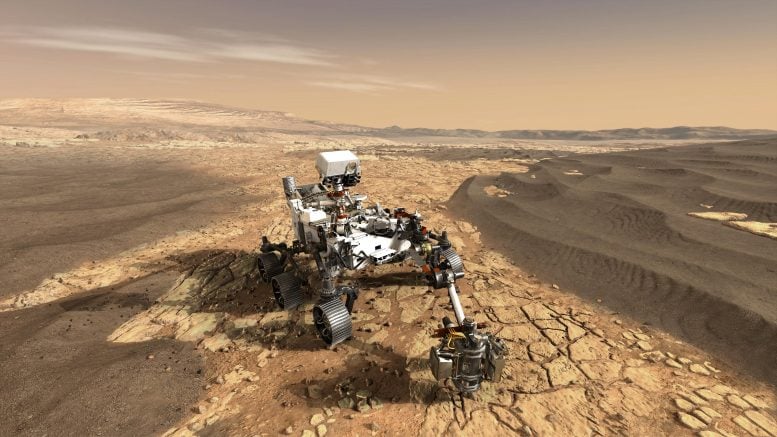
Perseverance rover’s Delta Front Campaign explores Mars’ Jezero Crater, aiming to collect core samples and study ancient sedimentary layers for potential signs of past life.
Recently on Mars, NASA’s Perseverance rover officially began the “Delta Front Campaign.” This second campaign of the mission commenced on April 18th, 2022, the 415th sol since landing. Each campaign represents a sub-portion of the Mars 2020 mission and is dedicated to exploring a distinct region, drilling designated sets of cores for possible future return to Earth, and taking numerous in situ science observations with onboard instruments to study the geologic and environmental features that characterize that region of the planet.
Sol is a solar day on Mars, i.e. a Mars-day. At approximately 24 hours, 39 minutes, 35 seconds long, a sol is slightly longer than an Earth day.
Achievements of the Crater Floor Campaign
During the Crater Floor Campaign, Perseverance spent over 400 sols roving across the floor of Jezero crater, starting at the Octavia E. Butler landing site, driving south to explore the best exposures of the crater floor rocks, then turning back to the north around Séítah, and approaching the edge of the delta.
During this traverse, Perseverance drilled and collected 8 rock cores, one atmospheric sample, and sealed one witness tube. The rover characterized igneous lithologies (or rock types) that make up the crater floor, studied Martian atmospheric phenomenon and dust cycling, supported the Ingenuity helicopter’s 27 flights (thus far!) and so much more. Perseverance also used cameras and remote sensing instruments to start observing the delta from afar in preparation for the Delta Front Campaign. Here you can view an interactive map showing everywhere Perseverance has explored to date!
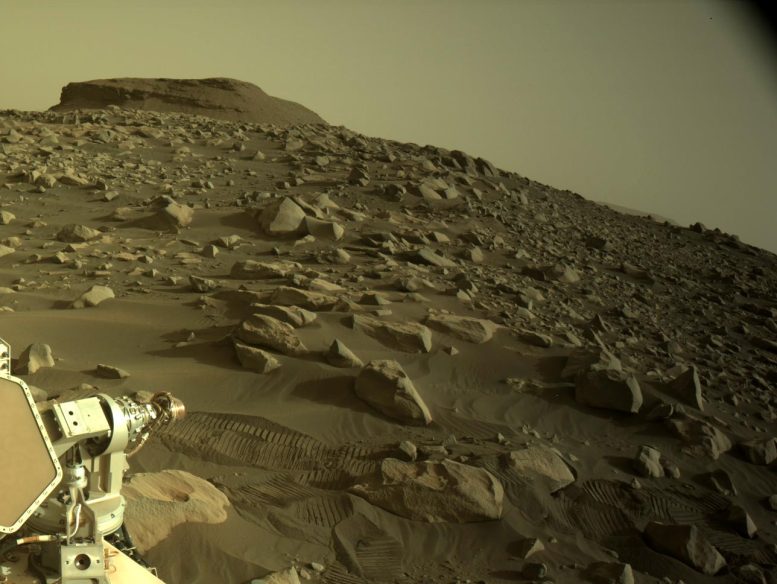
The Delta Front Campaign will take about half of an Earth year: Perseverance will rove 130 feet (40 meters) up and over the delta, drill cores along the way, and characterize the layered sedimentary rocks that make up the delta. These sediments were deposited billions of years ago, when water flowed across the surface of Mars and a river drained into the ancient crater below.
Searching for Signs of Ancient Life
If Mars did host life during this time, remnants or signatures of those organisms could be preserved in some of these ancient rocks. By characterizing the delta’s structure, mineralogy, and organic chemistry, scientists hope to better understand Jezero’s past environment and select cores that could be astrobiologically interesting for return to Earth!
Perseverance will spend the first few sols of the Delta Front Campaign traversing across an area called Cannery Passage, which is the transitional region between the edge of the crater floor and the delta. Next, the science team will have a big decision to make- which direction will Perseverance take to get up the delta?
Over the past few months, the science team’s Campaign Planning Science Group worked to map out potential paths and decided on two options: Cape Nukshak and Hawksbill Gap. Once Perseverance is closer to this divergence point, images and other data gathered by rover instruments will give the scientists and engineers a better idea of which area may be more interesting and provide better opportunities to conduct scientific measurements. After selecting a path, Perseverance will rove up the delta layers, stopping to analyze the sediments and gather cores along the way.
When the climb is complete, the Delta Front Campaign will conclude and Perseverance will begin campaign #3: the Delta Top.
Written by Denise Buckner, Student Collaborator at the University of Florida.
Never miss a breakthrough: Join the SciTechDaily newsletter.
Follow us on Google and Google News.
1 Comment
Along with 11 million close friends, my name is on Perseverance along with my wife. Now and then we check up on what’s happening on Mars. Of the dozens of updates we’ve read, this one by Student Collaborator Denise Buckner is very well-written due to its straight-forward purpose and being full of clarifying explanations. Thank you.