
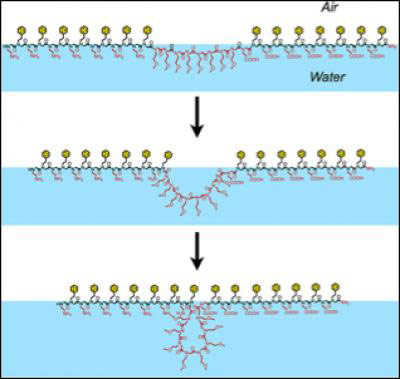
A team of researchers from the Berkeley Lab have developed peptoid nanosheets that mimic the way natural antibodies recognize viruses and toxins.
Taking inspiration from the human immune system, researchers at the U.S. Department of Energy’s Lawrence Berkeley National Laboratory (Berkeley Lab) have created a new material that can be programmed to identify an endless variety of molecules. The new material resembles tiny sheets of Velcro, each just one hundred nanometers across. But instead of securing your sneakers, this molecular Velcro mimics the way natural antibodies recognize viruses and toxins, and could lead to a new class of biosensors.
“Antibodies have a really effective architectural design: a structural scaffold that pretty much stays the same, whether it’s for snake venom or the common cold, and endlessly variable functional loops that bind foreign invaders,” says Ron Zuckermann, a senior scientist at Berkeley Lab’s Molecular Foundry. “We’ve mimicked that here, with a two-dimensional nanosheet scaffold covered with little functional loops like Velcro.”
Zuckermann, Director of the Molecular Foundry’s Biological Nanostructures Facility, is the corresponding author on a paper reporting these results in ACS Nano, titled “Antibody-Mimetic Peptoid Nanosheets for Molecular Recognition.” Coauthoring the paper are Gloria K. Olivier, Andrew Cho, Babak Sanii, Michael D. Connolly, and Helen Tran.
Zuckermann’s nanosheet scaffolds are self-assembled from peptoids – synthetic, bio-inspired polymers capable of folding into protein-like architectures. Like beads on a string, each peptoid molecule is a long chain of small molecular units arranged in a specific pattern. In earlier work, Zuckermann showed how certain simple peptoids can fold themselves into nanosheets just a few nanometers thick but up to one-hundred micrometers across – dimensions equivalent to a one-millimeter-thick plastic sheet the size of a football field.

“The reason that nanosheets form is because there’s a code for it programmed directly into the peptoids,” says Zuckermann. “In this case it’s admittedly a pretty rudimentary program, but it shows how if you bring in just a little bit of sequence information: Boom! You can make a nanosheet.”
To create functional loops on the nanosheets, the researchers insert short molecular segments into nanosheet-forming peptoid polymers. As the peptoids knit themselves together into sheets, the inserted segments are excluded from the fold, pushed out instead into loops upon the nanosheet surface. The functional loops can be programmed to selectively bind certain enzymes or inorganic materials, which makes the new material promising for chemical sensing and catalysis.
“The advantage here is that we’re able to make these materials in very high yield,” says Gloria Olivier, a postdoctoral researcher and lead author on the paper. “We’re borrowing this idea of stringing together a particular sequence of monomers, which Nature uses to build 3D protein structures, and applying it to the world of non-natural materials, to create a really useful material that can assemble itself.”
The researchers demonstrated the flexibility of their method by creating nanosheets with loops of varying composition, length, and density; they made nanosheets that can pick specific enzymes out of a solution, causing chemical changes that can be detected with standard techniques, and others that bind selectively to gold metal, seeding the growth of gold nanoparticles and films.
“Peptoids can withstand much harsher conditions than peptides, their counterpart in nature,” says Olivier. “So if you wanted to build a diagnostic device that can be taken outside of a laboratory, or a device that can screen for biomarkers in the presence of a mixture of proteins like proteases, peptoids are an excellent choice.”
Looking beyond the exciting applications, Zuckermann points out that this work represents an important step toward extending the rules of protein folding to the world of synthetic materials.
Says Zuckermann, “That’s kind of what my whole research program here is about: learning from the richness of chemical sequence information found in biology to create new types of advanced synthetic materials. We’re really just starting to scratch the surface.”
This research was funded by the DOE Office of Science and the Defense Threat Reduction Agency. The work was conducted at the Molecular Foundry with support from the Advanced Light Source, and at the Advanced Photon Source at Argonne National Laboratory.
Reference: “Antibody-Mimetic Peptoid Nanosheets for Molecular Recognition” by Gloria K. Olivier, Andrew Cho, Babak Sanii, Michael D. Connolly, Helen Tran and Ronald N. Zuckermann, 18 September 2013, .
DOI: 10.1021/nn403899y
Never miss a breakthrough: Join the SciTechDaily newsletter.
Follow us on Google and Google News.