
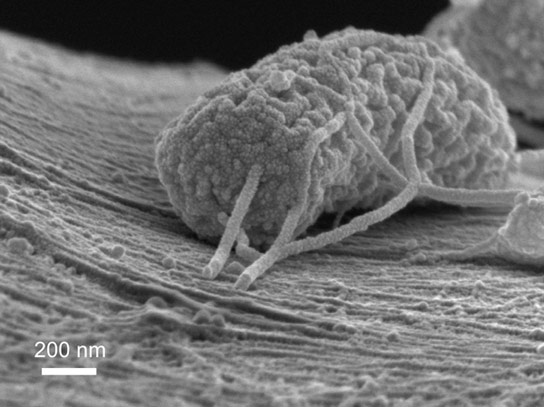
Scientists at Stanford University have developed a “microbial battery” driven by naturally occurring bacteria that have evolved to produce electricity as they digest organic material.
Engineers at Stanford have devised a new way to generate electricity from sewage, using naturally occurring “wired microbes” as mini power plants, producing electricity as they digest plant and animal waste.
In a paper published today in the Proceedings of the National Academy of Sciences, co-authors Yi Cui, a materials scientist, Craig Criddle, an environmental engineer, and Xing Xie, an interdisciplinary researcher, call their invention a microbial battery.
They hope it will be used in places such as sewage treatment plants, or to break down organic pollutants in the “dead zones” of lakes and coastal waters where fertilizer runoff and other organic waste can deplete oxygen levels and suffocate marine life.
At the moment, however, their laboratory prototype is about the size of a D-cell battery and looks like a chemistry experiment, with two electrodes, one positive, the other negative, plunged into a bottle of wastewater.
Inside that murky vial, attached to the negative electrode like barnacles to a ship’s hull, an unusual type of bacteria feast on particles of organic waste and produce electricity that is captured by the battery’s positive electrode.
“We call it fishing for electrons,” said Criddle, a professor in the Department of Civil and Environmental Engineering.
Scientists have long known of the existence of what they call exoelectrogenic microbes – organisms that evolved in airless environments and developed the ability to react with oxide minerals rather than breathe oxygen as we do, to convert organic nutrients into biological fuel.
Over the last dozen years or so, several research groups have tried various ways to use these microbes as bio-generators, but tapping this energy efficiently has proven challenging.
What is new about the microbial battery is a simple yet efficient design that puts these exoelectrogenic bacteria to work.
At the battery’s negative electrode, colonies of wired microbes cling to carbon filaments that serve as efficient electrical conductors. Using a scanning electron microscope, the Stanford team captured images of these microbes attaching milky tendrils to the carbon filaments.
“You can see that the microbes make nanowires to dump off their excess electrons,” Criddle said. To put the images into perspective, about 100 of these microbes could fit, side by side, in the width of a human hair.
As these microbes ingest organic matter and convert it into biological fuel, their excess electrons flow into the carbon filaments, and across to the positive electrode, which is made of silver oxide, a material that attracts electrons.
The electrons flowing to the positive node gradually reduce the silver oxide to silver, storing the spare electrons in the process. According to Xie, after a day or so the positive electrode has absorbed a full load of electrons and has largely been converted into silver.
At that point it is removed from the battery and re-oxidized back to silver oxide, releasing the stored electrons.
The Stanford engineers estimate that the microbial battery can extract about 30 percent of the potential energy locked up in wastewater. That is roughly the same efficiency at which the best commercially available solar cells convert sunlight into electricity.
Of course, there is far less energy potential in wastewater. Even so, the inventors say the microbial battery is worth pursuing because it could offset some of the electricity now used to treat wastewater. That use currently accounts for about 3 percent of the total electrical load in developed nations. Most of this electricity goes toward pumping air into wastewater at conventional treatment plants where ordinary bacteria use oxygen in the course of digestion, just like humans and other animals.
Looking ahead, the Stanford engineers say their biggest challenge will be finding a cheap but efficient material for the positive node.
“We demonstrated the principle using silver oxide, but silver is too expensive for use at large scale,” said Cui, an associate professor of materials science and engineering.
“Though the search is underway for a more practical material, finding a substitute will take time.”
Reference: “Microbial battery for efficient energy recovery” by Xing Xie, Meng Ye, Po-Chun Hsu, Nian Liu, Craig S. Criddle and Yi Cui, 16 September 2013, Proceedings of the National Academy of Sciences.
DOI: 10.1073/pnas.1307327110
Never miss a breakthrough: Join the SciTechDaily newsletter.
Follow us on Google and Google News.