
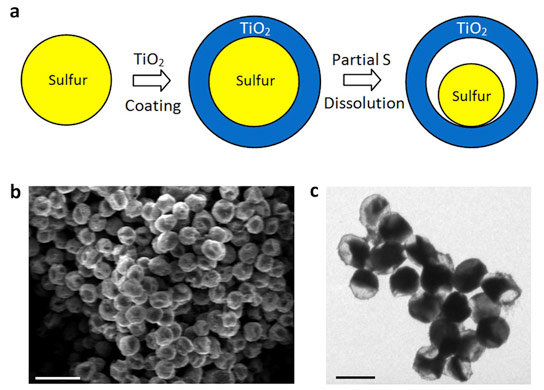
Using a sulfur cathode made of nanoparticles where each tiny sulfur nugget is surrounded by a hard shell of porous titanium dioxide, researchers at Stanford University designed a cathode that can store five times more energy than today’s commercial technology and set a world record for energy storage along the way.
SLAC and Stanford scientists have set a world record for energy storage, using a clever “yolk-shell” design to store five times more energy in the sulfur cathode of a rechargeable lithium-ion battery than is possible with today’s commercial technology. The cathode also maintained a high level of performance after 1,000 charge/discharge cycles, paving the way for new generations of lighter, longer-lasting batteries for use in portable electronics and electric vehicles.
The research was led by Yi Cui, a Stanford associate professor of materials science and engineering and a member of the Stanford Institute for Materials and Energy Sciences, a SLAC/Stanford joint institute. The team reported its results in Nature Communications.
Lithium-ion batteries work by moving lithium ions back and forth between two electrodes, the cathode, and anode. Charging the battery forces the ions and electrons into the anode, creating an electrical potential that can power a wide range of devices. Discharging the battery – using it to do work – moves the ions and electrons to the cathode.
Today’s lithium-ion batteries typically retain about 80 percent of their initial capacity after 500 charge/discharge cycles.
For some 20 years, researchers have known that sulfur could theoretically store more lithium ions, and thus much more energy, than today’s cathode materials. But two critical disadvantages prevented its commercial use: When lithium ions enter a sulfur cathode during discharging, they bond with sulfur atoms to create an intermediate compound that’s important for the cathode’s performance; but this compound kept dissolving, limiting the cathode’s energy-storage capacity. At the same time, the influx of ions caused the cathode to expand by about 80 percent. When scientists applied protective coatings to keep the intermediate compound from dissolving, the cathode would expand and crack the coating, rendering it useless.
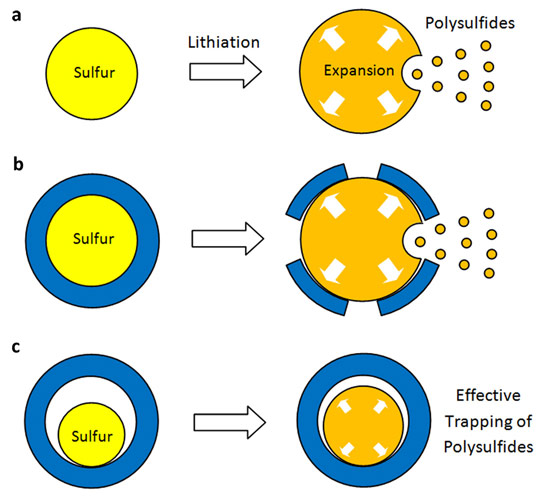
Cui’s innovation is a cathode made of nanoparticles, each a tiny sulfur nugget surrounded by a hard shell of porous titanium dioxide, like an egg yolk in an eggshell. Between the yolk and shell, where the egg white would be, is an empty space into which the sulfur can expand. During discharging, lithium ions pass through the shell and bind to the sulfur, which expands to fill the void but not so much as to break the shell. The shell, meanwhile, protects the sulfur-lithium intermediate compound from electrolyte solvent that would dissolve it.
Each cathode particle is only 800 nanometers (billionths of a meter) in diameter, about one-hundredth the diameter of a human hair.
“It basically worked the first time we tried it,” Cui said. “The sulfur cathode stored up to five times more energy per sulfur weight than today’s commercial materials.
“After 1,000 charge/discharge cycles, our yolk-shell sulfur cathode had retained about 70 percent of its energy-storage capacity. This is the highest performing sulfur cathode in the world, as far as we know,” he said. “Even without optimizing the design, this cathode cycle life is already on par with commercial performance. This is a very important achievement for the future of rechargeable batteries.”
Funding for the project came from the DOE Office of Basic Energy Sciences through SLAC’s Laboratory Directed Research and Development Program, which directs a percentage of the lab’s funding to high-risk, high-payoff research that, if successful, can lead to future program opportunities.
Over the past seven years, Cui’s group has demonstrated a succession of increasingly capable anodes that use silicon rather than carbon because it can store up to 10 times more charge per weight. Their most recent anode also has a yolk-shell design that retains its energy-storage capacity over 1,000 charge/discharge cycles.
The group’s next step is to combine the yolk-shell sulfur cathode with a yolk-shell silicon anode to see if together they produce a high-energy, long-lasting battery.
Reference: “Sulphur–TiO2 yolk–shell nanoarchitecture with internal void space for long-cycle lithium–sulphur batteries” by Zhi Wei Seh, Weiyang Li, Judy J. Cha, Guangyuan Zheng, Yuan Yang, Matthew T. McDowell, Po-Chun Hsu and Yi Cui, 8 January 2013, Nature Communications.
DOI: 10.1038/ncomms2327
Never miss a breakthrough: Join the SciTechDaily newsletter.
Follow us on Google and Google News.