
Close Menu
    Facebook X (Twitter) Instagram
    SciTechDaily
    • Biology
    • Chemistry
    • Earth
    • Health
    • Physics
    • Science
    • Space
    • Technology
    Facebook X (Twitter) Pinterest YouTube RSS
    SciTechDaily
    Home»Technology»Silicon Nanoparticles Clustered Like Pomegranate Seeds Solve Problems for Lithium-Ion Batteries
    Technology

    Silicon Nanoparticles Clustered Like Pomegranate Seeds Solve Problems for Lithium-Ion Batteries

    By SLAC National Accelerator LaboratoryFebruary 17, 2014No Comments5 Mins Read
    Facebook Twitter Pinterest Telegram LinkedIn WhatsApp Email Reddit
    Share
    Facebook Twitter LinkedIn Pinterest Telegram Email Reddit
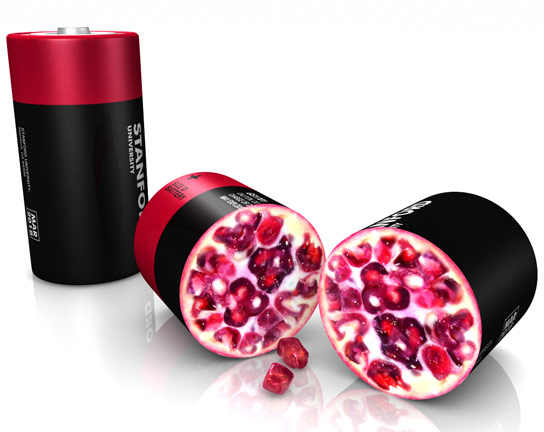
    Pomegranate Design Solves Problems for Lithium Ion Batteries
    A novel battery electrode features silicon nanoparticles clustered like pomegranate seeds in a tough carbon rind. Credit: Greg Stewart/SLAC)

    Using a microemulsion technique, researchers at the SLAC National Accelerator Laboratory have developed a new lithium-ion battery design that uses silicon nanoparticles clustered like pomegranate seeds.

    Menlo Park, California — An electrode designed like a pomegranate – with silicon nanoparticles clustered like seeds in a tough carbon rind – overcomes several remaining obstacles to using silicon for a new generation of lithium-ion batteries, say its inventors at Stanford University and the Department of Energy’s SLAC National Accelerator Laboratory.

    “While a couple of challenges remain, this design brings us closer to using silicon anodes in smaller, lighter, and more powerful batteries for products like cell phones, tablets and electric cars,” said Yi Cui, an associate professor at Stanford and SLAC who led the research, reported today in Nature Nanotechnology.

    “Experiments showed our pomegranate-inspired anode operates at 97 percent capacity even after 1,000 cycles of charging and discharging, which puts it well within the desired range for commercial operation.”
    Silicon Nanoparticles for a New Generation o fLithium Ion Batteries
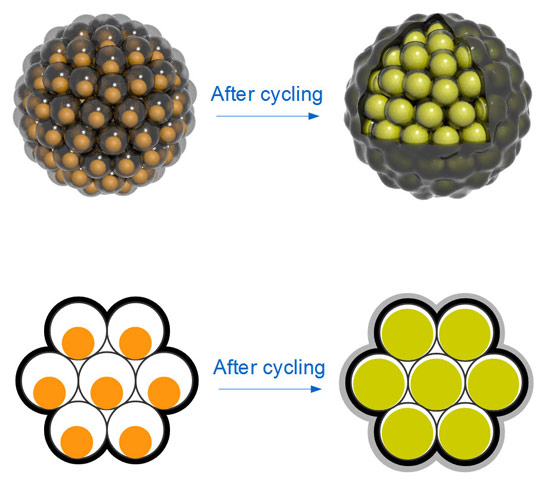
    Top: Silicon nanoparticles are encased in carbon “yolk shells” and clustered like seeds in a pomegranate. Each cluster has a carbon rind that holds it together, conducts electricity, and minimizes reactions with the battery’s electrolyte that can degrade performance. Bottom: Silicon nanoparticles swell during battery charging to completely fill their yolk shells; no space is wasted, and the shells stay intact. Credit: Nian Liu, Zhenda Lu, and Yi Cui/Stanford

    The anode, or negative electrode, is where energy is stored when a battery charges. Silicon anodes could store 10 times more charge than the graphite anodes in today’s rechargeable lithium-ion batteries, but they also have major drawbacks: The brittle silicon swells and falls apart during battery charging, and it reacts with the battery’s electrolyte to form gunk that coats the anode and degrades its performance.

    Over the past eight years, Cui’s team has tackled the breakage problem by using silicon nanowires or nanoparticles that are too small to break into even smaller bits and encasing the nanoparticles in carbon “yolk shells” that give them room to swell and shrink during charging.

    The new study builds on that work. Graduate student Nian Liu and postdoctoral researcher Zhenda Lu used a microemulsion technique common in the oil, paint, and cosmetic industries to gather silicon yolk shells into clusters, and coated each cluster with a second, thicker layer of carbon. These carbon rinds hold the pomegranate clusters together and provide a sturdy highway for electrical currents.

    And since each pomegranate cluster has just one-tenth the surface area of the individual particles inside it, a much smaller area is exposed to the electrolyte, thereby reducing the amount of gunk that forms to a manageable level.
    Silicon Battery Anodes
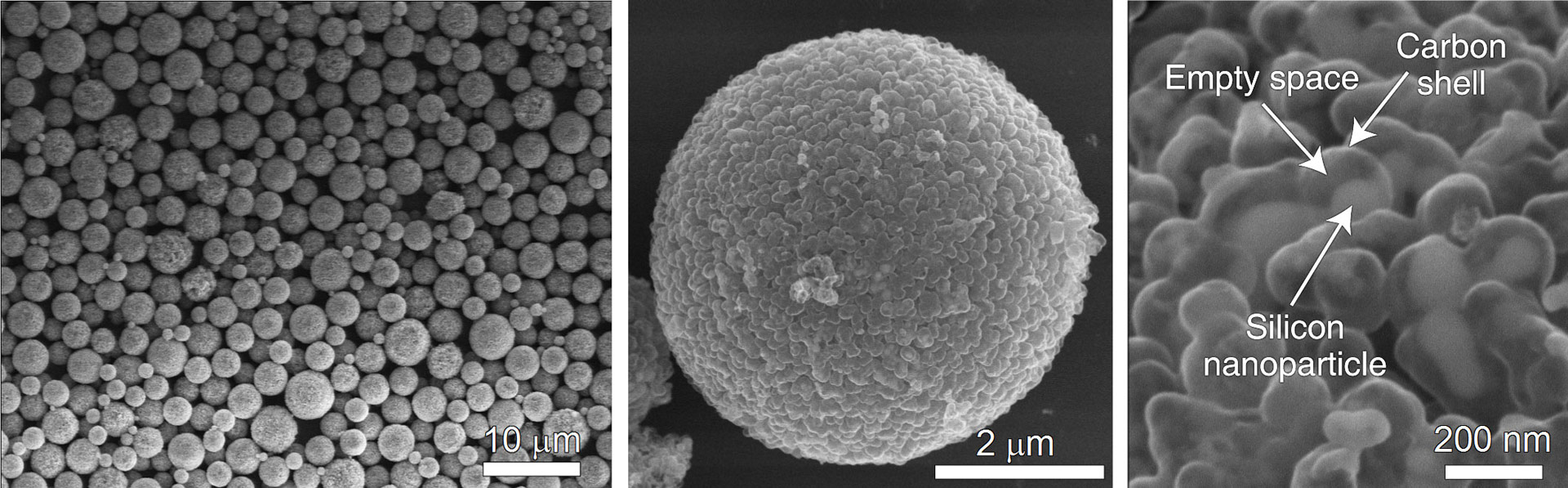
    By precisely controlling the process used to make them, Stanford and SLAC researchers can produce pomegranate clusters of a specific size for silicon battery anodes. Left: Microscopic clusters form a fine black powder that can be coated on foil to create an anode. Middle: A single cluster. Right: In this close-up of a cluster, a silicon nanoparticle can be seen inside its yolk shell, with space to swell during battery charging. Credit: Nian Liu, Zhenda Lu, and Yi Cui/Stanford

    Although the clusters are too small to see individually, together they form a fine black powder that can be used to coat a piece of foil and form an anode. Lab tests showed that pomegranate anodes worked well when made in the thickness required for commercial battery performance.

    While these experiments show the technique works, Cui said, the team will have to solve two more problems to make it viable on a commercial scale: They need to simplify the process and find a cheaper source of silicon nanoparticles. One possible source is rice husks: They’re unfit for human food, produced by millions of tons and 20 percent silicon dioxide by weight. According to Liu, they could be transformed into pure silicon nanoparticles relatively easily, as his team recently described in Scientific Reports.

    “To me, it’s very exciting to see how much progress we’ve made in the last seven or eight years,” Cui said, “and how we have solved the problems one by one.”

    The research team also included Jie Zhao, Matthew T. McDowell, Hyun-Wook Lee, and Wenting Zhao of Stanford. Cui is a member of the Stanford Institute for Materials and Energy Sciences, a joint SLAC/Stanford institute. The research was funded by the DOE Office of Energy Efficiency and Renewable Energy.

    SLAC is a multi-program laboratory exploring frontier questions in photon science, astrophysics, particle physics, and accelerator research. Located in Menlo Park, California, SLAC is operated by Stanford University for the U.S. Department of Energy Office of Science.

    Reference: “A pomegranate-inspired nanoscale design for large-volume-change lithium battery anodes” by Nian Liu, Zhenda Lu, Jie Zhao, Matthew T. McDowell, Hyun-Wook Lee, Wenting Zhao and Yi Cui, 16 February 2014, Nature Nanotechnology.
    DOI: 10.1038/nnano.2014.6

    Never miss a breakthrough: Join the SciTechDaily newsletter.
    Follow us on Google and Google News.

    Battery Technology Materials Science Nanoparticles Nanotechnology SLAC National Accelerator Laboratory
    Share. Facebook Twitter Pinterest LinkedIn Email Reddit

    Related Articles

    Aluminum “Yolk-and-Shell” Nanoparticle Boosts Capacity and Power of Lithium-ion Batteries

    Researchers Produce Uniform Antimony Nanocrystals for the First Time

    Scientists Develop Self-Healing Battery Electrode

    Sulfur Cathodes Set a World Record for Energy Storage

    Repeating Patterns Dictate Optical Properties of Nanoparticle Arrays

    Spray Paint Battery Can be Painted on Virtually Any Surface

    Double-Walled Silicon Nanotube Battery Shows Promise

    Nanowires Covered in Nanoparticles Boost Performance

    Researchers Uncover Why Lithium Iron Phosphate Works So Well

    Leave A Reply Cancel Reply

    • Facebook
    • Twitter
    • Pinterest
    • YouTube

    Don't Miss a Discovery

    Subscribe for the Latest in Science & Tech!

    Trending News

    Largest-Ever Study Finds Medicinal Cannabis Ineffective for Anxiety, Depression, PTSD

    250-Million-Year-Old Egg Solves One of Evolution’s Biggest Mysteries

    Living With Roommates Might Be Changing Your Gut Microbiome Without You Knowing

    Century-Old Cleaning Chemical Linked to 500% Increased Risk of Parkinson’s Disease

    What if Your Memories Never Happened? Physicists Take a New Look at the Boltzmann Brain Paradox

    One of the Universe’s Largest Stars May Be Getting Ready To Explode

    Scientists Discover Enzyme That Could Supercharge Ozempic-Like Weight Loss Drugs

    Popular Sweetener Linked to DNA Damage – “It’s Something You Should Not Be Eating”

    Follow SciTechDaily
    • Facebook
    • Twitter
    • YouTube
    • Pinterest
    • Newsletter
    • RSS
    SciTech News
    • Biology News
    • Chemistry News
    • Earth News
    • Health News
    • Physics News
    • Science News
    • Space News
    • Technology News
    Recent Posts
    • What Did Prehistoric Europeans Eat? Scientists Uncover Surprising Answers
    • Scientists Say This Overlooked Organ Could Hold the Key to Longer Life
    • Want Less Stress? Landmark Study Points to a Simple Habit
    • Scientists Reveal Eating Fruits and Vegetables May Increase Your Risk of Lung Cancer
    • AI Reveals Explosive Growth of Floating Algae Across the World’s Oceans
    Copyright © 1998 - 2026 SciTechDaily. All Rights Reserved.
    • Science News
    • About
    • Contact
    • Editorial Board
    • Privacy Policy
    • Terms of Use

    Type above and press Enter to search. Press Esc to cancel.