

A newly published study from scientists at Rice University found patterns in the way that surface plasmons influence each other in chains of gold nanoparticles.
New research at Rice University that seeks to establish points of reference between plasmonic particles and polymers might lead to smaller computer chips, better antennae and improvements in optical computing.
Materials scientists take advantage of strong interactions between chemicals to form polymers that self-assemble into patterns and are the basis of things people use every day. Anything made of plastic is a good example.
Now, Rice scientists have detailed similar patterns in the way that surface plasmons – charged “quasiparticles” that flow within metallic particles when excited by light – influence each other in chains of gold nanoparticles.
The results of work by the Rice lab of Stephan Link, an assistant professor of chemistry and electrical and computer engineering, appear online in the American Chemical Society journal Nano Letters.
Interactions between small things have been very much in the news lately with the discovery of signs of the Higgs boson and extensive discussion about how the most elemental particles interact to give the universe its form. The Rice team studies nanoparticles that are orders of magnitude larger – though still so small that they can only be seen with an electron microscope – with the goal of understanding how the more elemental electromagnetic particles within behave.
This is important to electronics engineers perpetually looking for ways to shrink the size of computer chips and other devices through ever-smaller components like waveguides. The ability of nanoparticles to pass waves that can be interpreted as signals may open the door to new methods for optical computing. The work may also contribute to more finely tuned antennae and sensors.
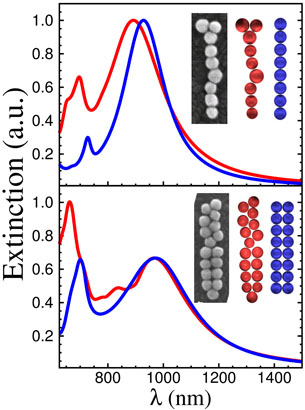
Specifically, the researchers looked for the ways plasmons influence each other across tiny gaps – as small as one nanometer – between gold nanoparticles. Lead author Liane Slaughter, a Rice graduate student, and her colleagues engineered chains of 50-nanometer particles in single and double rows that mimicked the repeating molecular patterns of polymers. They then looked into the standing super-radiant and subradiant signals collectively sustained by the individual assemblies of nanoparticles. The composition of the chain in terms of nanoparticle sizes, shapes and positions determines the frequencies of light they can characteristically interact with.
“In plasmonics, we use individual nanoparticles as building blocks to make higher-order structures,” Link said. “Here, we’re taking concepts known to polymer scientists to analyze the structures of longer chains of nanoparticles that we think resemble polymers.”
“The fundamental definition of a polymer is that it’s a long molecule whose properties depend on the repeat unit,” Slaughter said. “If you change the atoms that repeat in the chain, then you change the properties of the polymer.”
“What we changed in our assembly structures was the repeat unit – a single particle row versus a dimer (in the double row) – and we found that this fit the analogy with chemical polymers because that change very clearly alters the interactions along the chain,” Link added.

This basic structure change from a single row to a double row led to pronounced differences demonstrated by additional subradiant modes and a lower energy super-radiant mode.
Two additional interesting effects seemed to be universal among the team’s plasmonic polymers. One was that the energy of the super-radiant mode, which results from the interaction over the most repeat units, would characteristically decrease with the addition of nanoparticles along the length, up to about 10 particles, and then level off. “Once you have 10 repeat units, you basically see an optical spectrum that will not change very much if you make a chain with 20 or 50 repeat units,” Link said.
The other was that disorder among the repeat units – the nanoparticles – only seems to matter at the small scale. “With chemically prepared nanoparticles, there’s always a distribution of sizes and perhaps shapes,” Link said. “As you bring them close together, they couple really strongly, and that’s a big advantage. But at the same time, we can never make structures that are perfect.
“So we wanted to understand the effect of disorder, and what we found was pretty amazing: As the system grows in size, the effect of disorder is less and less important on the optical properties. That also has a strong analogy in polymers, in which disorder can be seen as chemical defects,” he said.
“If the plasmonic interactions over the chain tolerate disorder, it gives promise to designing functional structures more economically and maybe with higher throughput,” Slaughter said. “With a whole bunch of small building blocks, even if they’re not all perfectly alike, you can make a great variety of shapes and structures with broad tunability.”
Reference: “Toward Plasmonic Polymers” Liane S. Slaughter, Britain A. Willingham, Wei-Shun Chang, Maximilian H. Chester, Nathan Ogden and Stephan Link, 27 June 2012, Nano Letters.
DOI: 10.1021/nl3011512
Co-authors of the paper are graduate student Britain Willingham, Rice postdoctoral fellow Wei-Shung Chang and undergraduates Maximilian Chester and Nathan Ogden.
The Robert A. Welch Foundation, the Office of Naval Research, the National Science Foundation, the American Chemical Society Petroleum Research Fund and a 3M Nontenured Faculty Grant supported the research.
Never miss a breakthrough: Join the SciTechDaily newsletter.
Follow us on Google and Google News.