
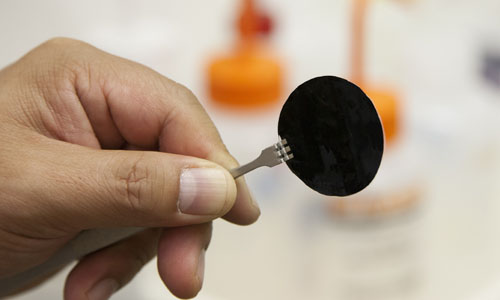
Scientists are working to develop a nanotube-based fabric that repels chemical and biological agents, switching reversibly from a highly breathable state to a protective one in response to the presence of the environmental threat without the need for an external control system.
Military uniforms of the future may offer a new layer of critical protection to wearers thanks to research by teams at the University of Massachusetts Amherst and several other institutions who are developing a nanotube-based fabric that repels chemical and biological agents.
UMass Amherst polymer scientists Kenneth Carter and James Watkins, collaborating with team leader Francesco Fornasiero of Lawrence Livermore National Laboratory (LLNL), recently received a five-year $1.8 million grant to design ways to manufacture the new material as part of a $13 million project funded by the U.S. Defense Threat Reduction Agency. It’s estimated that the new uniforms could be deployed in the field in less than 10 years.
The researchers say the fabric will be able to switch reversibly from a highly breathable state to a protective one in response to the presence of the environmental threat without the need for an external control system. In the protective state, the uniform material will block the chemical threat while maintaining a good breathability level. “The uniform will be like a smart second skin that responds to the environment,” says Fornasiero.
UMass Amherst polymer scientists bring expertise in additive-driven assembly processes that bring polymers and nanoparticles together to produce hybrid functional materials to the project. Membrane and layer fabrication will take place in part through the university’s Roll-to-Roll Nanofabrication Laboratory.
The new fabric’s reversibility is due to highly breathable membranes with pores made of a few-nanometer-wide, vertically-aligned carbon nanotubes modified with a functional surface layer designed to respond to the presence of a chemical warfare agent, says Watkins at UMass Amherst. The threat response would be triggered by direct chemical warfare agent attack. The fabric would switch to a protective state by closing the pore entrance or by shedding the contaminated surface layer.
For wearer comfort and safety, high breathability is a critical requirement for protective clothing to prevent heat stress when military personnel are engaged in missions in contaminated environments. To provide high breathability, the new composite material will take advantage of the unique transport properties of carbon nanotube pores, which offer gas transport rates two orders of magnitude faster than any other pore of similar size.
The polymer scientists point out that biological agents such as bacteria and viruses are close to 10 nanometers in size. Because the membrane pores on the uniform are only a few nanometers wide, these membranes will block such agents.
However, chemical agents such as mustard gas and nerve gas can be much smaller and require the membrane pores to be able to react to block that threat. To create a multifunctional membrane, the research team plans to modify the surface of the original prototype carbon nanotube membranes with chemical threat responsive functional groups. These functional groups sense and block the threat like gatekeepers on entrance.
The scientists also plan to develop a second, “shedding” response scheme in which the fabric exfoliates upon reaction with a chemical agent. In this way, the fabric will be able to block chemical agents such as sulfur mustard (blister agent), GD and VX nerve agents, toxins such as staphylococcal enterotoxin and biological spores such as anthrax.
Carter at UMass Amherst says, “Mimicking the way real skin responds to threats by exfoliation and shedding of contaminated areas will allow for a dynamic responsive garment, all achieved through controlled chemical reactions in this new advanced fabric.”
Tracee Harris, science and technology manager for the Dynamic Multifunctional Material for a Second Skin Program, says, “Development of chemical threat responsive carbon nanotube membranes is a great example of a novel material’s potential to provide innovative solutions for the Department of Defense CB needs. This futuristic uniform would allow our military forces to operate safely for extended time periods and successfully complete their missions in environments contaminated with chemical and biological warfare agents.”
In addition to Carter, Watkins, Jeffrey Morse and YuYing Tang at UMass Amherst, with Fornasiero, Sangil Kim and Kuang Jen Wu at LLNL, the team includes Heidi Schreuder-Gibson at U.S. Army Natick Soldier Research Development and Engineering Center, Timothy Swager at Massachusetts Institute of Technology, Jerry Shan at Rutgers University, and Robert Praino at Chasm Technologies, Inc. of Canton, Mass.
Never miss a breakthrough: Join the SciTechDaily newsletter.
Follow us on Google and Google News.