
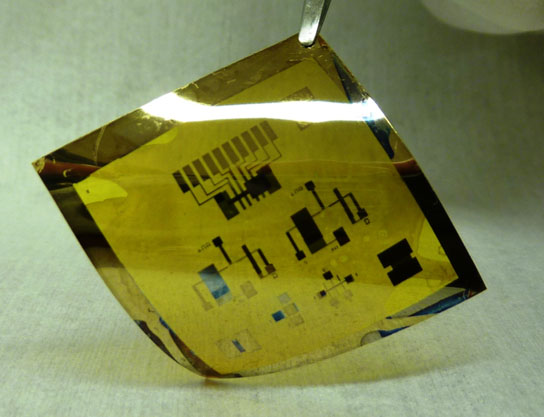
Scientists at the University of Pennsylvania have shown that nanoscale particles can be “printed” on flexible plastics to form high-performance electronics.
Electronic circuits are typically integrated in rigid silicon wafers, but flexibility opens up a wide range of applications. In a world where electronics are becoming more pervasive, flexibility is a highly desirable trait, but finding materials with the right mix of performance and manufacturing cost remains a challenge.
Now a team of researchers from the University of Pennsylvania has shown that nanoscale particles, or nanocrystals, of the semiconductor cadmium selenide can be “printed” or “coated” on flexible plastics to form high-performance electronics.
The research was led by David Kim, a doctoral student in the Department of Materials Science and Engineering in Penn’s School of Engineering and Applied Science; Yuming Lai, a doctoral student in the Engineering School’s Department of Electrical and Systems Engineering; and professor Cherie Kagan, who has appointments in both departments as well as in the School of Arts and Sciences’ Department of Chemistry. Benjamin Diroll, a doctoral student in chemistry, and Penn Integrates Knowledge Professor Christopher Murray of Materials Science and of Chemistry also collaborated on the research.
Their work was published in the journal Nature Communications.
“We have a performance benchmark in amorphous silicon, which is the material that runs the display in your laptop, among other devices,” Kagan said. “Here, we show that these cadmium selenide nanocrystal devices can move electrons 22 times faster than in amorphous silicon.”
Besides speed, another advantage cadmium selenide nanocrystals have over amorphous silicon is the temperature at which they are deposited. Whereas amorphous silicon uses a process that operates at several hundred degrees, cadmium selenide nanocrystals can be deposited at room temperature and annealed at mild temperatures, opening up the possibility of using more flexible plastic foundations.
Another innovation that allowed the researchers to use flexible plastic was their choice of ligands, the chemical chains that extend from the nanocrystals’ surfaces and helps facilitate conductivity as they are packed together into a film.
“There have been a lot of electron transport studies on cadmium selenide, but until recently we haven’t been able to get good performance out of them,” Kim said. “The new aspect of our research was that we used ligands that we can translate very easily onto the flexible plastic; other ligands are so caustic that the plastic actually melts.”
Because the nanocrystals are dispersed in an ink-like liquid, multiple types of deposition techniques can be used to make circuits. In their study, the researchers used spincoating, where centrifugal force pulls a thin layer of the solution over a surface, but the nanocrystals could be applied through dipping, spraying or ink-jet printing as well.
On a flexible plastic sheet a bottom layer of electrodes was patterned using a shadow mask — essentially a stencil — to mark off one level of the circuit. The researchers then used the stencil to define small regions of conducting gold to make the electrical connections to upper levels that would form the circuit. An insulating aluminum oxide layer was introduced and a 30-nanometer layer of nanocrystals was coated from solution. Finally, electrodes on the top level were deposited through shadow masks to ultimately form the circuits.
“The more complex circuits are like buildings with multiple floors,” Kagan said. “The gold acts like staircases that the electrons can use to travel between those floors.”
Using this process, the researchers built three kinds of circuits to test the nanocrystals performance for circuit applications: an inverter, an amplifier and a ring oscillator.
“An inverter is the fundamental building block for more complex circuits,” Lai said. “We can also show amplifiers, which amplify the signal amplitude in analog circuits, and ring oscillators, where ‘on’ and ‘off’ signals are properly propagating over multiple stages in digital circuits.”
“And all of these circuits operate with a couple of volts,” Kagan said. “If you want electronics for portable devices that are going to work with batteries, they have to operate at low voltage or they won’t be useful.”
With the combination of flexibility, relatively simple fabrication processes, and low power requirements, these cadmium selenide nanocrystal circuits could pave the way for new kinds of devices and pervasive sensors, which could have biomedical or security applications.
“This research also opens up the possibility of using other kinds of nanocrystals, as we’ve shown the materials aspect is not a limitation anymore,” Kim said.
Reference: “Flexible and low-voltage integrated circuits constructed from high-performance nanocrystal transistors” by David K. Kim, Yuming Lai, Benjamin T. Diroll, Christopher B. Murray and Cherie R. Kagan,20 November 2012, Nature Communications.
DOI: 10.1038/ncomms2218
The research was supported by the U.S. Department of Energy and the National Science Foundation.
Never miss a breakthrough: Join the SciTechDaily newsletter.
Follow us on Google and Google News.