

Close Menu
    Facebook X (Twitter) Instagram
    SciTechDaily
    • Biology
    • Chemistry
    • Earth
    • Health
    • Physics
    • Science
    • Space
    • Technology
    Facebook X (Twitter) Pinterest YouTube RSS
    SciTechDaily
    Home»Technology»Double-Walled Silicon Nanotube Battery Shows Promise
    Technology

    Double-Walled Silicon Nanotube Battery Shows Promise

    By Mike Ross, SLAC National Accelerator LaboratoryMay 11, 2012No Comments4 Mins Read
    Facebook Twitter Pinterest Telegram LinkedIn WhatsApp Email Reddit
    Share
    Facebook Twitter LinkedIn Pinterest Telegram Email Reddit
    Advanced Battery Artist Concept
    The new double-walled silicon nanotube battery can last for over 6,000 cycles with 85% capacity remaining.

    New silicon battery technology is a major step forward in creating smaller, lighter and longer-lasting batteries. The new design contains a double-walled silicon nanotube coated with a thin layer of silicon oxide and can operate for more than 6,000 cycles with 85 percent capacity remaining.

    For more than a decade, scientists have tried to improve lithium-based batteries by replacing the graphite in one terminal with silicon, which can store 10 times more charge. But after just a few charge/discharge cycles, the silicon structure would crack and crumble, rendering the battery useless.

    Now a team led by materials scientist Yi Cui of Stanford and SLAC has found a solution: a cleverly designed double-walled nanostructure that lasts more than 6,000 cycles, far more than needed by electric vehicles or mobile electronics.

    “This is a very exciting development toward our goal of creating smaller, lighter and longer-lasting batteries than are available today,” Cui said. The results were published March 25 in the journal Nature Nanotechnology.
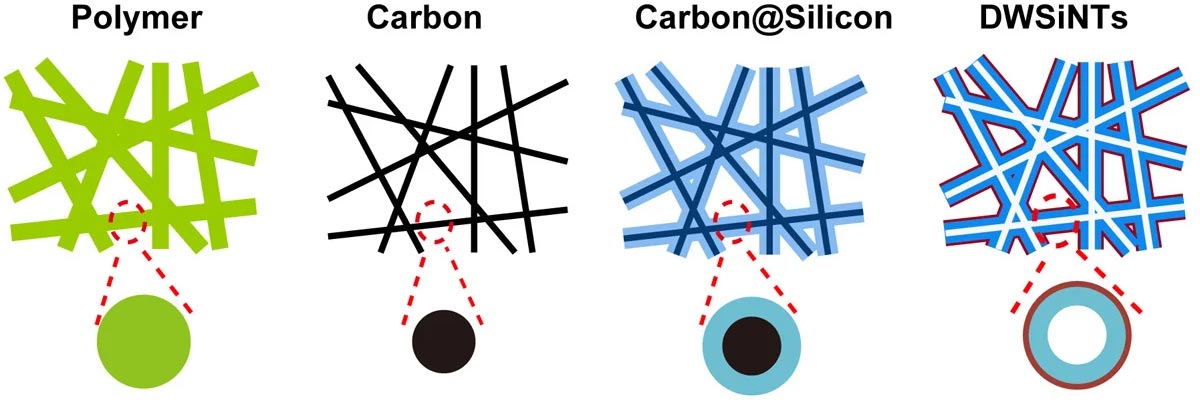
    Double-Walled Silicon Nanotube Battery
    The new double-walled silicon nanotube anode is made by a clever four-step process: Polymer nanofibers (green) are made, then heated (with, and then without, air) until they are reduced to carbon (black). Silicon (light blue) is coated over the outside of the carbon fibers. Finally, heating in air drives off the carbon and creates the tube as well as the clamping oxide layer (red). Credit: Image courtesy Hui Wu, Stanford, and Yi Cui

    Lithium-ion batteries are widely used to power devices from electric vehicles to portable electronics because they can store a relatively large amount of energy in a relatively lightweight package. The battery works by controlling the flow of lithium ions through a fluid electrolyte between its two terminals, called the anode and cathode.

    The promise – and peril – of using silicon as the anode in these batteries comes from the way the lithium ions bond with the anode during the charging cycle. Up to four lithium ions bind to each of the atoms in a silicon anode – compared to just one for every six carbon atoms in today’s graphite anode – which allows it to store much more charge.

    However, it also swells the anode to as much as four times its initial volume. What’s more, some of the electrolyte reacts with the silicon, coating it and inhibiting further charging. When lithium flows out of the anode during discharge, the anode shrinks back to its original size and the coating cracks, exposing fresh silicon to the electrolyte.

    Within just a few cycles, the strain of expansion and contraction, combined with the electrolyte attack, destroys the anode through a process called “decrepitation.”

    Over the past five years, Cui’s group has progressively improved the durability of silicon anodes by making them out of nanowires and then hollow silicon nanoparticles. His latest design consists of a double-walled silicon nanotube coated with a thin layer of silicon oxide, a very tough ceramic material.

    This strong outer layer keeps the outside wall of the nanotube from expanding, so it stays intact. Instead, the silicon swells harmlessly into the hollow interior, which is also too small for electrolyte molecules to enter. After the first charging cycle, it operates for more than 6,000 cycles with 85 percent capacity remaining.

    Cui said future research is aimed at simplifying the process for making the double-wall silicon nanotubes. Others in his group are developing new high-performance cathodes to combine with the new anode to form a battery with five times the performance of today’s lithium-ion technology.

    In 2008, Cui founded a company, Amprius, which licensed rights to Stanford’s patents for his silicon nanowire anode technology. Its near-term goal is to produce a battery with double the energy density of today’s lithium-ion batteries.

    Reference: “Stable cycling of double-walled silicon nanotube battery anodes through solid–electrolyte interphase control” by Hui Wu, Gerentt Chan, Jang Wook Choi, Ill Ryu, Yan Yao, Matthew T. McDowell, Seok Woo Lee, Ariel Jackson, Yuan Yang, Liangbing Hu and Yi Cui, 25 March 2012, Nature Nanotechnology.
    DOI: 10.1038/nnano.2012.35

    Never miss a breakthrough: Join the SciTechDaily newsletter.
    Follow us on Google and Google News.

    Battery Technology Nanostructures Nanotechnology Nanotubes Nanowires Popular SLAC National Accelerator Laboratory
    Share. Facebook Twitter Pinterest LinkedIn Email Reddit

    Related Articles

    New Battery Could Overcome Key Drawbacks of Lithium-Air Batteries

    MIT Researchers Create Perfect Nanoscrolls from Graphene Oxide

    Scientists Use ‘Smart Window’ to Observe Lithium-Ion Battery Operation

    Silicon Nanoparticles Clustered Like Pomegranate Seeds Solve Problems for Lithium-Ion Batteries

    Scientists Develop Self-Healing Battery Electrode

    Tin Nanocrystals Enable More Power to be Stored in Lithium Ion Batteries

    Sulfur Cathodes Set a World Record for Energy Storage

    Spray Paint Battery Can be Painted on Virtually Any Surface

    Multi-Walled Carbon Nanotubes May Eventually Replace Expensive Platinum Catalysts

    Leave A Reply Cancel Reply

    • Facebook
    • Twitter
    • Pinterest
    • YouTube

    Don't Miss a Discovery

    Subscribe for the Latest in Science & Tech!

    Trending News

    Your Blood Pressure Reading Could Be Wrong Because of One Simple Mistake

    Astronomers Stunned by Ancient Galaxy With No Spin

    Physicists May Be on the Verge of Discovering “New Physics” at CERN

    Scientists Solve 320-Million-Year Mystery of Reptile Skin Armor

    Scientists Say This Daily Walking Habit May Be the Secret to Keeping Weight Off After Dieting

    New Therapy Rewires the Brain To Restore Joy in Depression Patients

    Giant Squid Detected off Western Australia in Stunning Deep-Sea Discovery

    Popular Sugar-Free Sweetener Linked to Liver Disease, Study Warns

    Follow SciTechDaily
    • Facebook
    • Twitter
    • YouTube
    • Pinterest
    • Newsletter
    • RSS
    SciTech News
    • Biology News
    • Chemistry News
    • Earth News
    • Health News
    • Physics News
    • Science News
    • Space News
    • Technology News
    Recent Posts
    • Scientists Revive Ancient Chemistry Trick To Engineer Next-Generation Glass
    • Scientists Use AI To Supercharge Ultrafast Laser Simulations by More Than 250x
    • Scientists Just Found a Surprising Way To Destroy “Forever Chemicals”
    • Popular Supplement Ingredient Linked to Shorter Lifespan in Men
    • Scientists May Have Found a Way To Repair Nerve Damage in Multiple Sclerosis
    Copyright © 1998 - 2026 SciTechDaily. All Rights Reserved.
    • Science News
    • About
    • Contact
    • Editorial Board
    • Privacy Policy
    • Terms of Use

    Type above and press Enter to search. Press Esc to cancel.