
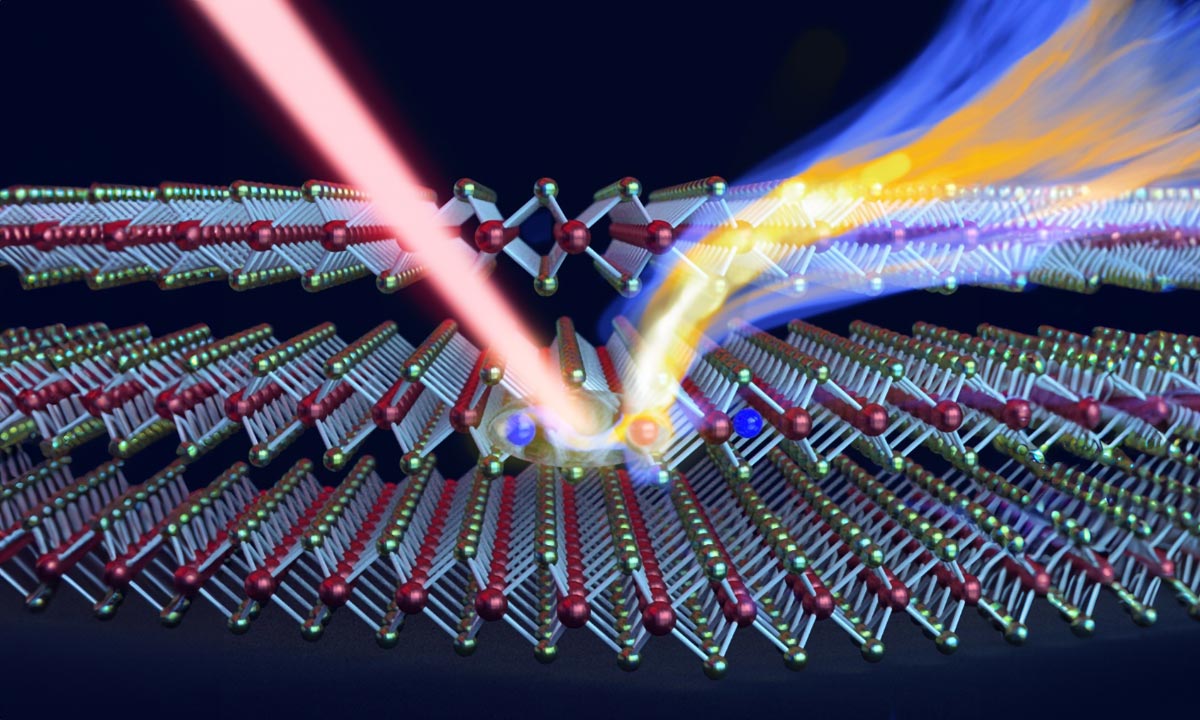
A new semiconductor device using tungsten di-selenide demonstrates unprecedented capabilities in altering light’s properties to process information more efficiently.
This technology promises to enhance telecommunications by processing signals directly in optical fibers without converting them to electrical signals, thereby speeding up data transmission and reducing energy consumption.
Excitons in Semiconductor Technology
When light shines on a semiconductor, it excites the electrons into higher energy states. This leaves behind the absence of an electron, which is equivalent to a positively charged space called a “hole.” The electron and the hole attract each other through the electrostatic force and form a bound pair called an exciton.
Excitons can then interact with other unpaired charges. This interaction alters the typical way in which a beam of light that propagates in a material shifts that material’s positive and negative charges. This response is called nonlinear, and it can make the beam change its shape, direction, and/or frequency. This change allows for optical processing of information.
Researchers have now demonstrated that the nonlinear optical response is unprecedently strong in a two-dimensional device made of three atomic layers of the semiconductor tungsten di-selenide (WSe2). The researchers also showed that the giant nonlinear response can be tuned.
Revolutionizing Telecommunications With Optical Processing
Currently, optical fibers manage all long-distance internet communications. However, at any point where a data signal changes fibers to get to its destination, the signal is converted from light to electricity. This is done so the signal can be processed and routed. Electrical processing uses extra power, which generates heat and introduces delays.
This study introduces a groundbreaking alternative system in which only a small number of photons of light can process information. This could improve the speed and energy efficiency of telecommunications and computing platforms. In addition, highly efficient and tunable photons can be used for secure quantum communication, which offers strong protection against cyberattacks.
The Role of Nonlinear Optics in Data Transmission
Optical transmission of information can only be achieved in materials that exhibit a property called nonlinear optical response. This is because nonlinear optics enables the processing of information carried by a light beam by changing the shape, direction, and frequency of the beam. Two-dimensional materials like WSe2 have gained attention because their reduced dimensionality causes strong electrostatic interactions, which result in the formation of tightly bound excitons. Because the excitons are so strongly connected, they are stable at room temperature and enable devices that do not need cooling.
Breakthroughs in Two-Dimensional Material Research
In this research, scientists leveraged the behavior of excitons in a device made of three atomically thin layers of WSe2. They demonstrated a giant nonlinear optical response with unprecedented efficiency, using only tens to hundreds of photons. The team found that the optical nonlinearity is only observed when the material is electrostatically doped with free charges by applying a voltage bias. Moreover, the response can be readily tuned by changing the voltage. To build the device, the researchers used the Quantum Material Press (QPress) at the Center for Functional Nanomaterials, a Department of Energy Office of Science user facility at Brookhaven National Laboratory. The QPress is an automated system that allows precise stacking of 2D quantum materials as thin as a single atom.
For more on this breakthrough, see Photon-Powered Breakthrough: Speedy, Secure, and Sustainable Telecom for the Future.
Reference: “Giant optical nonlinearity of Fermi polarons in atomically thin semiconductors” by Liuxin Gu, Lifu Zhang, Ruihao Ni, Ming Xie, Dominik S. Wild, Suji Park, Houk Jang, Takashi Taniguchi, Kenji Watanabe, Mohammad Hafezi and You Zhou, 14 May 2024, Nature Photonics.
DOI: 10.1038/s41566-024-01434-x
This research was primarily supported by the Department of Energy (DOE) Office of Science, Office of Basic Energy Sciences Early Career Research Program. Sample fabrication was supported by the National Science Foundation CAREER Award. This research used Quantum Material Press (QPress) of the Center for Functional Nanomaterials, a DOE Office of Science User Facility at Brookhaven National Laboratory. Additional support was provided by the JSPS KAKENHI and World Premier International Research Center Initiative, MEXT, Japan for hBN synthesis.
Never miss a breakthrough: Join the SciTechDaily newsletter.
Follow us on Google and Google News.