
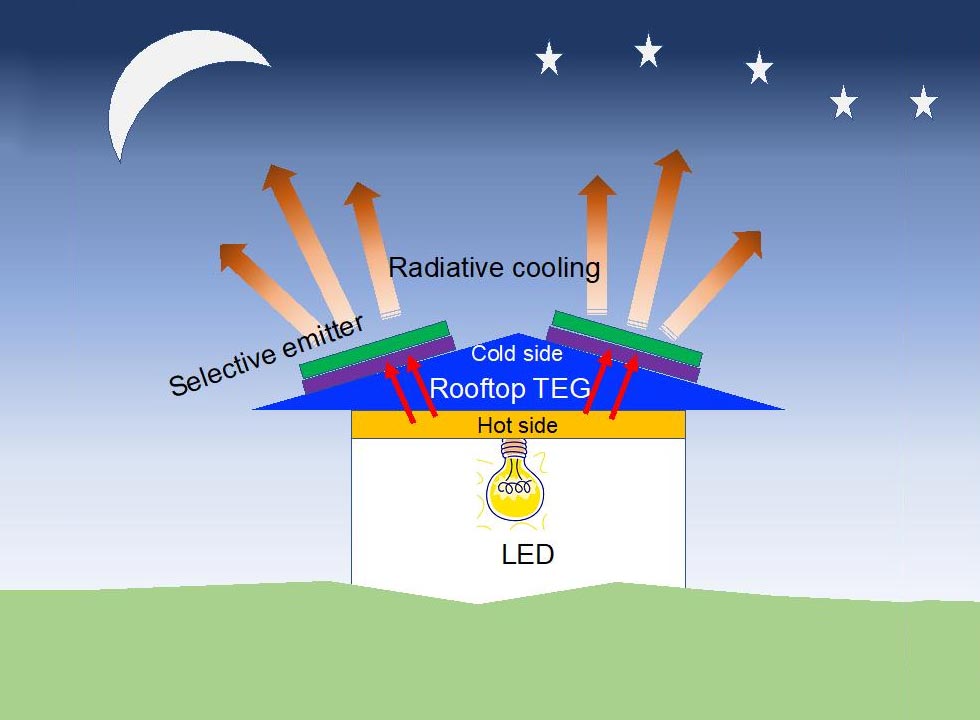
Rooftop radiative cooling system could provide lighting power when solar energy is unavailable.
Researchers have designed an off-grid, low-cost modular energy source that can efficiently produce power at night. The system uses commercially available technology and could eventually help meet the need for nighttime lighting in urban areas or provide lighting in developing countries.
Although solar power brings many benefits, its use depends heavily on the distribution of sunlight, which can be limited in many locations and is completely unavailable at night. Systems that store energy produced during the day are typically expensive, thus driving up the cost of using solar power.
To find a less-expensive alternative, researchers led by Shanhui Fan from Stanford University looked to radiative cooling. This approach uses the temperature difference resulting from heat absorbed from the surrounding air and the radiant cooling effect of cold space to generate electricity.
In The Optical Society (OSA) journal Optics Express, the researchers theoretically demonstrate an optimized radiative cooling approach that can generate 2.2 Watts per square meter with a rooftop device that doesn’t require a battery or any external energy. This is about 120 times the amount of energy that has been experimentally demonstrated and enough to power modular sensors such as ones used in security or environmental applications.
“We are working to develop high-performance, sustainable lighting generation that can provide everyone – including those in developing and rural areas – access to reliable and sustainable low cost lighting energy sources,” said Lingling Fan, first author of the paper. “A modular energy source could also power off-grid sensors used in a variety of applications and be used to convert waste heat from automobiles into usable power.”
Maximizing power generation
One of the most efficient ways to generate electricity using radiative cooling is to use a thermoelectric power generator. These devices use thermoelectric materials to generate power by converting the temperature differences between a heat source and the device’s cool side, or radiative cooler, into an electric voltage.
In the new work, the researchers optimized each step of thermoelectric power generation to maximize nighttime power generation from a device that would be used on a rooftop. They improved the energy harvesting so that more heat flows into the system from the surrounding air and incorporate new commercially available thermoelectric materials that enhance how well that energy is used by the device. They also calculated that a thermoelectric power generator covering one square meter of a rooftop could achieve the best trade-off between heat loss and thermoelectric conversion.
“One of the most important innovations was designing a selective emitter that is attached to the cool side of the device,” said Wei Li, a member of the research team. “This optimizes the radiative cooling process so that the power generator can more efficiently get rid of excessive heat.”
The researchers demonstrated the new approach by using computer modeling to simulate a system with realistic physical parameters. The models reproduced previous experimental results faithfully and revealed that the optimized system designed by the researchers could come close to what has been calculated as the maximum efficiency using thermoelectric conversion.
In addition to carrying out experiments, the researchers are also examining optimal designs for operating the system during the day, in addition to nighttime, which could expand the practical applications of the system.
Reference: “Maximal nighttime electrical power generation via optimal radiative cooling” by Lingling Fan, Wei Li, Weiliang Jin, Meir Orenstein and Shanhui Fan, 13 August 2020, Optics Express.
DOI: 10.1364/OE.397714
This work is supported by the U.S. Department of Energy under Grant No. DE-FG02-07ER46426.
Never miss a breakthrough: Join the SciTechDaily newsletter.
Follow us on Google and Google News.
3 Comments
I find all of this new technological breakthru very fascinating and interesting and I would like to ask your opinion or research if there any about new insulating products for cement roof tops exposed to 35*C> heat,plus if there are any new inovative products to reduce heat and also maintain the ability to “walk on” the roof tops.
I would be much obliged for your answer since I have tried almost every new insulation method and have had no satisfying results.
Thank you .
Because radiative cooling is such a new concept for most readers it would be good to compare the energy production to 1 sq. m. of solar PV; to say a bit about whether it works on cloudy or rainy nights or just clear nights; what impact, if any, roof angle has on performance; and what impact ambient outside and indoor temperature has on performance.
My mother, nee Mary Karney, was your dad’s sister. I think the last time we saw each other I was five. The last time Mom mentioned cousin Bruce was your graduation from Harvey Mudd. I figure seven decades is plenty of time to be left alone, so I thought I’d reach out just to say Hi.