
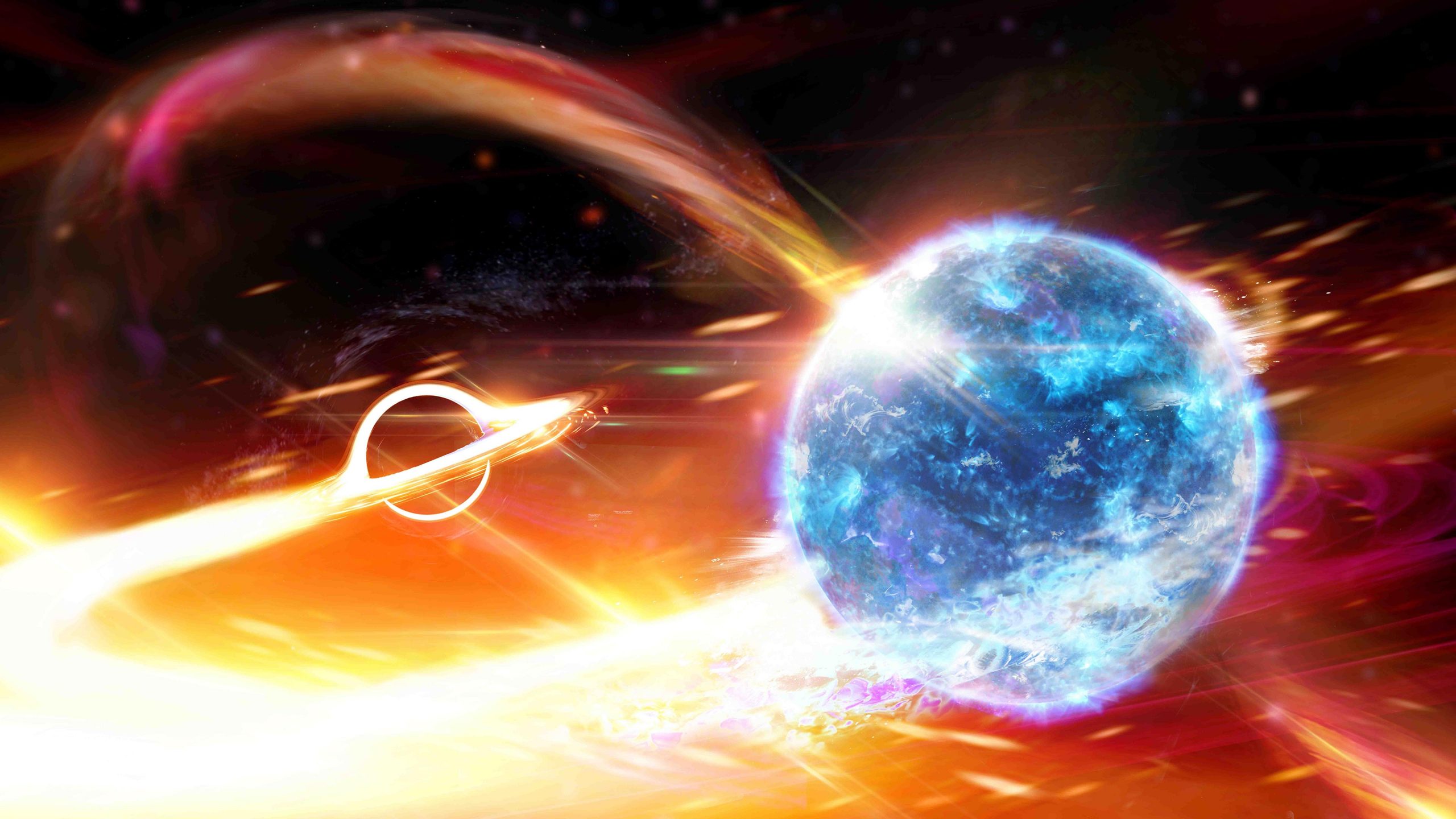
A new study makes a compelling case for the development of “NEMO”—a new observatory in Australia that could deliver on some of the most exciting gravitational-wave science next-generation detectors have to offer, but at a fraction of the cost.
The study, co-authored by the ARC Center of Excellence for Gravitational Wave Discovery (OzGrav), coincides with an Astronomy Decadal Plan mid-term review by Australian Academy of Sciences where “NEMO” is identified as a priority goal.
“Gravitational-wave astronomy is reshaping our understanding of the Universe,” said one of the study’s lead authors OzGrav Chief Investigator Paul Lasky, from Monash University.
“Neutron stars are an end state of stellar evolution,” he said. “They consist of the densest observable matter in the Universe, and are believed to consist of a superfluid, superconducting core of matter at supranuclear densities. Such conditions are impossible to produce in the laboratory, and theoretical modeling of the matter requires extrapolation by many orders of magnitude beyond the point where nuclear physics is well understood.”
The study presents the design concept and science case for a Neutron Star Extreme Matter Observatory (NEMO): a gravitational-wave interferometer optimized to study nuclear physics with merging neutron stars.
The concept uses high circulating laser power, quantum squeezing and a detector topology specially designed to achieve the high frequency sensitivity necessary to probe nuclear matter using gravitational waves.
The study acknowledges that third-generation observatories require substantial, global financial investment and significant technological development over many years.
According to Monash Ph.D. candidate Francisco Hernandez Vivanco, who also worked on the study, the recent transformational discoveries were only the tip of the iceberg of what the new field of gravitational-wave astronomy could potentially achieve.
“To reach its full potential, new detectors with greater sensitivity are required,” Francisco said.
“The global community of gravitational-wave scientists is currently designing the so called ‘third-generation gravitational-wave detectors (we are currently in the second generation of detectors; the first generation were the prototypes that got us where we are today).”
Third-generation detectors will increase the sensitivity achieved by a factor of 10, detecting every black hole merger throughout the Universe, and most of the neutron star collisions.
But they have a hefty price tag. At about $1B, they require truly global investment, and are not anticipated to start detecting ripples of gravity until 2035 at the earliest.
In contrast, NEMO would require a budget only under $100M, a considerably shorter timescale for development, and it would provide a test-bed facility for technology development for third-generation instruments.
The paper concludes that further design studies are required detailing specifics of the instrument, as well as a possible scoping study to find an appropriate location for the observatory, a project known as “Finding NEMO.”
Never miss a breakthrough: Join the SciTechDaily newsletter.
Follow us on Google and Google News.
5 Comments
And another $100M gets gobbled up by black holes, lol. I suspect that if just 10% of that was diverted to researching better explanations to observed cosmic phenomena than the “black holes” in space gravy train, there’d suddenly be much better, more compelling explanations.
Oh please….. So many problems on EARTH, and you’re spending a 100 mil on this???? How will it benefit humankind? My mind does not comprehend this…
How depressing to read such comments above. Gravitational wave research is one of the most important fields of science, but lay people just don’t seem to grasp it. Welcome to the age of the bogan.
Have zero problem with funds being used for cosmic research, am just objecting to yet more funds being channeled from other legitimate investigative paths always into black holes and other imagined forces and undetectable whatevers. So please state your case on gravitational wave research being one of the most important fields in science, which is a very big claim.
No sign up required,easy to play and create the best high score in this game play hearts online free this is site is best then now search this game.