
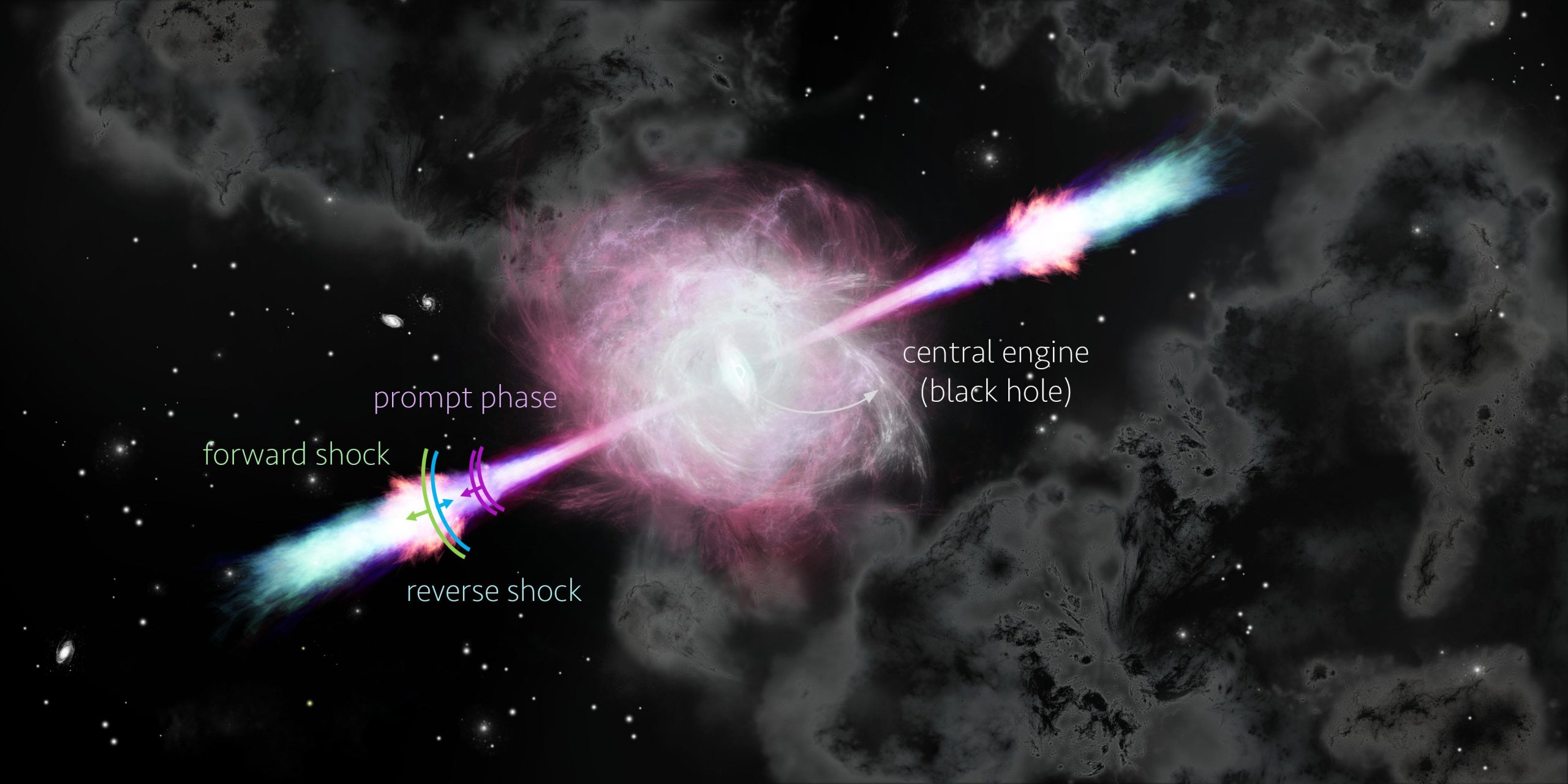
Astrophysicists from the University of Bath in the UK find the magnetic field in gamma-ray bursts is scrambled after the ejected material crashes into, and shocks, the surrounding medium.
An international team of scientists, led by astrophysicists from the University of Bath, has measured the magnetic field in a far-off Gamma-Ray Burst, confirming for the first time a decades-long theoretical prediction – that the magnetic field in these blast waves becomes scrambled after the ejected material crashes into, and shocks, the surrounding medium.
Black holes are formed when massive stars (at least 40 times larger than our Sun) die in a catastrophic explosion that powers a blast wave. These extremely energetic events drive out material at velocities close to the speed of light, and power bright, short-lived gamma-ray flashes that can be detected by satellites orbiting the Earth – hence their name, Gamma-Ray Bursts (GRBs).
Magnetic fields may be threaded through the ejected material and, as the spinning black hole forms, these magnetic fields twist into corkscrew shapes that are thought to focus and accelerate the ejected material.
The magnetic fields can’t be seen directly, but their signature is encoded in the light produced by charged particles (electrons) that whiz around the magnetic field lines. Earth-bound telescopes capture this light, which has traveled for millions of years across the Universe.
Professor Carole Mundell, Head of Astrophysics at Bath and gamma-ray expert, said: “We measured a special property of the light – polarization – to directly probe the physical properties of the magnetic field powering the explosion. This is a great result and solves a long-standing puzzle of these extreme cosmic blasts – a puzzle I’ve been studying for a long time.”
Capturing the Light Early
The challenge is to capture the light as soon as possible after a burst and decode the physics of the blast, the prediction being that any primordial magnetic fields will ultimately be destroyed as the expanding shock front collides with the surrounding stellar debris.
This model predicts light with high levels of polarization (>10%) soon after the burst when the large-scale primordial field is still intact and driving the outflow. Later, the light should be mostly unpolarised as the field is scrambled in the collision.
Mundell’s team was the first to discover highly polarised light minutes after the burst that confirmed the presence of primordial fields with large-scale structures. However, the picture for expanding forward shocks has proved more controversial.
Teams who observed GRBs in slower time – hours to a day after a burst – found low polarization and concluded the fields had long since been destroyed, but could not say when or how. In contrast, a team of Japanese astronomers announced an intriguing detection of 10% polarised light in a GRB, which they interpreted as a polarised forward shock with long-lasting ordered magnetic fields.
Lead author of the new study, Bath PhD student Nuria Jordana-Mitjans, said: “These rare observations were difficult to compare, as they probed very different timescales and physics. There was no way to reconcile them in the standard model.”
The mystery remained unsolved for over a decade, until the Bath team’s analysis of GRB 141220A.
In the new paper, published recently in the Monthly Notices of the Royal Astronomical Society, Professor Mundell’s team reports the discovery of very low polarization in forward-shock light detected just 90 seconds after the blast of GRB 141220A. The super-speedy observations were made possible by the team’s intelligent software on the fully autonomous robotic Liverpool Telescope and the novel RINGO3 polarimeter – the instrument that logged the GRB’s color, brightness, polarization, and rate of fade. Putting together this data, the team was able to prove that:
- The light originated in the forward shock.
- The magnetic field length scales were much smaller than the Japanese team inferred.
- The blast was likely powered by the collapse of ordered magnetic fields in the first moments of the formation of a new black hole.
- The mysterious detection of polarization by the Japanese team could be explained by a contribution of polarized light from the primordial magnetic field before it was destroyed in the shock.
Ms. Jordana-Mitjans said: “This new study builds on our research that has shown the most powerful GRBs can be powered by large-scale ordered magnetic fields, but only the fastest telescopes will catch a glimpse of their characteristic polarization signal before they are lost to the blast.”
Professor Mundell added: “We now need to push the frontiers of technology to probe the earliest moments of these blasts, capture statistically significant numbers of bursts for polarization studies, and put our research into the wider context of real-time multimessenger follow-up of the extreme Universe.”
Reference: “Coherence scale of magnetic fields generated in early-time forward shocks of GRBs” by N Jordana-Mitjans, C G Mundell, R J Smith, C Guidorzi, M Marongiu, S Kobayashi, A Gomboc, M Shrestha and I A Steele, 10 April 2021, Monthly Notices of the Royal Astronomical Society.
DOI: 10.1093/mnras/stab1003
Never miss a breakthrough: Join the SciTechDaily newsletter.
Follow us on Google and Google News.
7 Comments
There are 3 types of stable dark matter:
1) string – is in the center of our universe;
2) quark – located in the centers of galaxies;
3) nucleon – is in the stars under the crown.
There are 3 types of auroras:
1) planetary;
2) stellar;
3) centers of galaxies (quasars)
In the figure, we see a gamma burst of nucleon matter, which is stopped and scattered by a quark magnetic field from the parent quark black hole, which enters the poles of this star.
Where do cranks like this get their ideas? You know making stuff up doesn’t make you an astrophysicist, don’t you? Don’t you?
It’s like the post was fashioned by an AI badly pretending to be a scientist. Quarks don’t form dark matter because they have electric charge so they interact with light (we’re made of them), string theory is not related to dark matter, there is no “center” to the Universe, there’s no “nucleon” dark matter, no idea what “crown” means with respect to cosmology, and an aurora is an atmospheric phenomenon not a cosmic one. We don’t “see” a burst of dark matter because you can’t see dark matter: that’s why it’s called dark matter. The magnetic field is not solely created by quarks (they even mentioned electrons in the article, which are leptons), the black hole is not “quark” related unless you mean it’s baryonic matter rather than dark matter (but you just said quarks are a kind of dark matter earlier), a black hole isn’t a star strictly speaking but a stellar remnant, and the magnetic field doesn’t come from the poles of the black hole exactly but rather from the baryonic material outside the black hole’s event horizon as it is subjected to extreme forces.
Watch my video – there is a translation.
Your counter-arguments are outdated 100 years ago.
https://www.youtube.com/watch?v=tFUM3vAlaGc
Why would anyone watch a self promoted pseudoscience video?
And why would anyone pose “counter-arguments” when you provide no quantitative, peer reviewed published science to argue over? Science is not a philosophical debate.
My “pseudoscience” explained the nature of gravity (it is the reactive thrust of electromagnetic waves), proved the existence of the Center of Our Universe, around which all galaxies revolve, calculated the diameter of Our Universe = 2 * 10 ^ 28 light years, proved the gradual transformation in the reactions of the Great Synthesis of Dark Matter (strings, quarks and nucleons) in the atoms visible to us, proved the existence of 3 types of dark matter that exists in each atom …
And your reviewer will stand still for 100 years and dance around the non-existent Big Bang.
There can be no experts in new theories. The expert may suggest that you are not designing the required diameter of the piston for the antediluvian engine.
For that logical thinking also exists not to fly to the Center of the Universe and not to measure it with a roulette))
Could it be? That somewhere in the helix of an unimaginably powerful magnetic field generated by a spinning black hole like steel rope holding a worm hole in it’s center, the field created distorts light why not time and space?
So… if
1) What we refer to as a (spacelike) singularity is a patch of spacetime with a density greater the Planck density which satisfies the spacetime conditions SPACE = 1 TIME = 0
2) The speed of light in a vacuum is the escape velocity of our universe and satisfies the spacetime conditions SPACE = 0.5 TIME = 0.5
3) A timelike singularity would satisfy spacetime conditions SPACE = 0 TIME = 1 and would presumably represent a patch of spacetime with a density lower than the inverse Planck density
… would you like some toast Dave?