
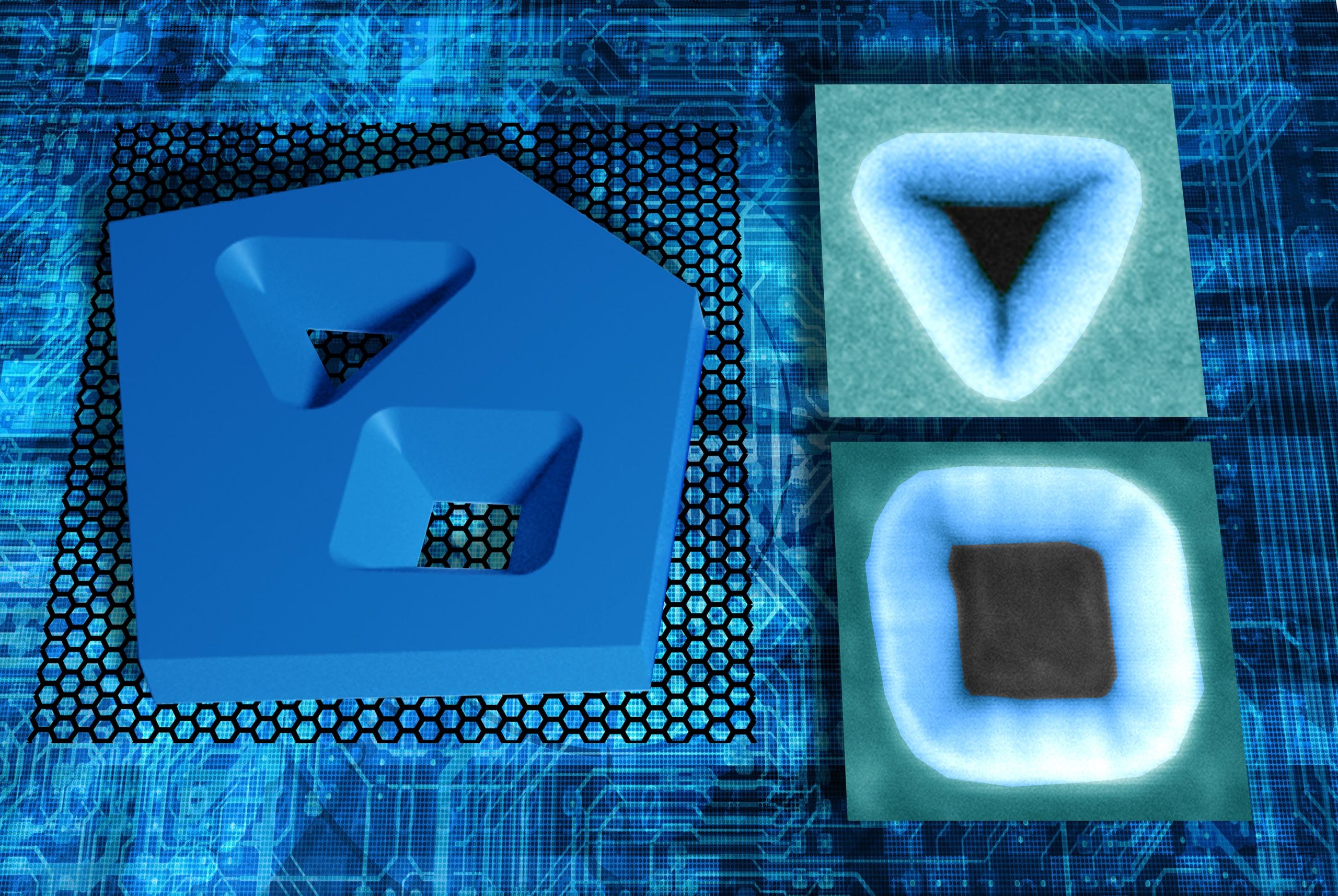
A new method designs nanomaterials with less than 10-nanometer precision. It could pave the way for faster, more energy-efficient electronics.
DTU and Graphene Flagship researchers have taken the art of patterning nanomaterials to the next level. Precise patterning of 2D materials is a route to computation and storage using 2D materials, which can deliver better performance and much lower power consumption than today’s technology.
One of the most significant recent discoveries within physics and material technology is two-dimensional materials such as graphene. Graphene is stronger, smoother, lighter, and better at conducting heat and electricity than any other known material.
Their most unique feature is perhaps their programmability. By creating delicate patterns in these materials, we can change their properties dramatically and possibly make precisely what we need.
At DTU, scientists have worked on improving state of the art for more than a decade in patterning 2D materials, using sophisticated lithography machines in the 1500 m2 cleanroom facility. Their work is based in DTU’s Center for Nanostructured Graphene, supported by the Danish National Research Foundation and a part of The Graphene Flagship.
The electron beam lithography system in DTU Nanolab can write details down to 10 nanometers. Computer calculations can predict exactly the shape and size of patterns in the graphene to create new types of electronics. They can exploit the charge of the electron and quantum properties such as spin or valley degrees of freedom, leading to high-speed calculations with far less power consumption. These calculations, however, ask for higher resolution than even the best lithography systems can deliver: atomic resolution.
“If we really want to unlock the treasure chest for future quantum electronics, we need to go below 10 nanometers and approach the atomic scale,” says professor and group leader at DTU Physics, Peter Bøggild.
And that is excactly what the researchers have succeeded in doing.
“We showed in 2019 that circular holes placed with just 12-nanometer spacing turn the semimetallic graphene into a semiconductor. Now we know how to create circular holes and other shapes such as triangles, with nanometer sharp corners. Such patterns can sort electrons based on their spin and create essential components for spintronics or valleytronics. The technique also works on other 2D materials. With these supersmall structures, we may create very compact and electrically tunable metalenses to be used in high-speed communication and biotechnology,” explains Peter Bøggild.
Razor-Sharp Triangle
The research was led by postdoc Lene Gammelgaard, an engineering graduate of DTU in 2013 who has since played a vital role in the experimental exploration of 2D materials at DTU:
“The trick is to place the nanomaterial hexagonal boron-nitride on top of the material you want to pattern. Then you drill holes with a particular etching recipe,” says Lene Gammelgaard, and continues:
“The etching process we developed over the past years down-size patterns below our electron beam lithography systems’ otherwise unbreakable limit of approximately 10 nanometers. Suppose we make a circular hole with a diameter of 20 nanometers; the hole in the graphene can then be downsized to 10 nanometers. While if we make a triangular hole, with the round holes coming from the lithography system, the downsizing will make a smaller triangle with self-sharpened corners. Usually, patterns get more imperfect when you make them smaller. This is the opposite, and this allows us to recreate the structures the theoretical predictions tell us are optimal.”
One can e.g. produce flat electronic meta-lenses — a kind of super-compact optical lens that can be controlled electrically at very high frequencies, and which according to Lene Gammelgaard can become essential components for the communication technology and biotechnology of the future.
Pushing the Limits
The other key person is a young student, Dorte Danielsen. She got interested in nanophysics after a 9th-grade internship in 2012, won a spot in the final of a national science competition for high school students in 2014, and pursued studies in Physics and Nanotechnology under DTU’s honors program for elite students.
She explains that the mechanism behind the “super-resolution” structures is still not well understood:
“We have several possible explanations for this unexpected etching behavior, but there is still much we don’t understand. Still, it is an exciting and highly useful technique for us. At the same time, it is good news for the thousands of researchers around the world pushing the limits for 2D nanoelectronics and nanophotonics.”
Supported by the Independent Research Fund Denmark, within the METATUNE project, Dorte Danielsen will continue her work on extremely sharp nanostructures. Here, the technology she helped develop, will be used to create and explore optical metalenses that can be tuned electrically.
Reference: “Super-Resolution Nanolithography of Two-Dimensional Materials by Anisotropic Etching” by Dorte R. Danielsen, Anton Lyksborg-Andersen, Kirstine E. S. Nielsen, Bjarke S. Jessen, Timothy J. Booth, Manh-Ha Doan, Yingqiu Zhou, Peter Bøggild and Lene Gammelgaard, 25 August 2021, ACS Applied Materials & Interfaces.
DOI: 10.1021/acsami.1c09923
Never miss a breakthrough: Join the SciTechDaily newsletter.
Follow us on Google and Google News.