

Rice University Study Leverages Chiral Phonons for Transformative Quantum Effect
Quantum materials hold the key to a future of lightning-speed, energy-efficient information systems. The problem with tapping their transformative potential is that, in solids, the vast number of atoms often drowns out the exotic quantum properties electrons carry.
Chiral Phonons and Magnetism
Rice University researchers in the lab of quantum materials scientist Hanyu Zhu found that when they move in circles, atoms can also work wonders: When the atomic lattice in a rare-earth crystal becomes animated with a corkscrew-shaped vibration known as a chiral phonon, the crystal is transformed into a magnet.
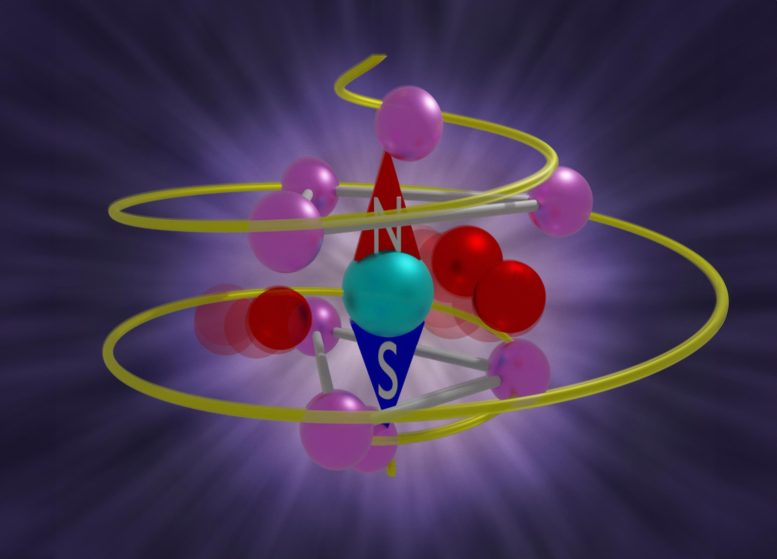
According to a study published recently in the journal Science, exposing cerium fluoride to ultrafast pulses of light sends its atoms into a dance that momentarily enlists the spins of electrons, causing them to align with the atomic rotation. This alignment would otherwise require a powerful magnetic field to activate, since cerium fluoride is naturally paramagnetic with randomly oriented spins even at zero temperature.
Electron Spins and Chiral Movement
“Each electron possesses a magnetic spin that acts like a tiny compass needle embedded in the material, reacting to the local magnetic field,” said Rice materials scientist and co-author Boris Yakobson. “Chirality ⎯ also called handedness because of the way in which left and right hands mirror each other without being superimposable ⎯ should not affect the energies of the electrons’ spin. But in this instance, the chiral movement of the atomic lattice polarizes the spins inside the material as if a large magnetic field were applied.”

Though short-lived, the force that aligns the spins outlasts the duration of the light pulse by a significant margin. Since atoms only rotate in particular frequencies and move for a longer time at lower temperatures, additional frequency- and temperature-dependent measurements further confirm that magnetization occurs as a result of the atoms’ collective chiral dance.

The Surprising Influence of Atomic Motion
“The effect of atomic motion on electrons is surprising because electrons are so much lighter and faster than atoms,” said Zhu, Rice’s William Marsh Rice Chair and an assistant professor of materials science and nanoengineering. “Electrons can usually adapt to a new atomic position immediately, forgetting their prior trajectory. Material properties would remain unchanged if atoms went clockwise or counterclockwise, i.e., traveled forward or backward in time ⎯ a phenomenon that physicists refer to as time-reversal symmetry.”
The idea that the collective motion of atoms breaks time-reversal symmetry is relatively recent. Chiral phonons have now been experimentally demonstrated in a few different materials, but exactly how they impact material properties is not well understood.
Exploring Spin-Phonon Coupling
“We wanted to quantitatively measure the effect of chiral phonons on a material’s electrical, optical and magnetic properties,” Zhu said. “Because spin refers to electrons’ rotation while phonons describe atomic rotation, there is a naive expectation that the two might talk with each other. So we decided to focus on a fascinating phenomenon called spin-phonon coupling.”
Spin-phonon coupling plays an important part in real-world applications like writing data on a hard disk. Earlier this year, Zhu’s group demonstrated a new instance of spin-phonon coupling in single molecular layers with atoms moving linearly and shaking spins.

In their new experiments, Zhu and the team members had to find a way to drive a lattice of atoms to move in a chiral fashion. This required both that they pick the right material and that they create light at the right frequency to send its atomic lattice aswirl with the help of theoretical computation from the collaborators.
Innovative Experimental Techniques
“There is no off-the-shelf light source for our phonon frequencies at about 10 terahertz,” explained Jiaming Luo, an applied physics graduate student and the lead author of the study. “We created our light pulses by mixing intense infrared lights and twisting the electric field to ‘talk’ to the chiral phonons. Furthermore, we took another two infrared light pulses to monitor the spin and atomic motion, respectively.”
Future Research Implications
In addition to the insights into spin-phonon coupling derived from the research findings, the experimental design and setup will help inform future research on magnetic and quantum materials.
“We hope that quantitatively measuring the magnetic field from chiral phonons can help us develop experiment protocols to study novel physics in dynamic materials,” Zhu said. “Our goal is to engineer materials that do not exist in nature through external fields ⎯ such as light or quantum fluctuations.”

Reference: “Large effective magnetic fields from chiral phonons in rare-earth halides” by Jiaming Luo, Tong Lin, Junjie Zhang, Xiaotong Chen, Elizabeth R. Blackert, Rui Xu, Boris I. Yakobson and Hanyu Zhu, 9 November 2023, Science.
DOI: 10.1126/science.adi9601
The research was supported by the National Science Foundation (2005096, 1842494, 2240106), the Welch Foundation (C-2128) and the Army Research Office (W911NF-16-1-0255).
Never miss a breakthrough: Join the SciTechDaily newsletter.
Follow us on Google and Google News.