
Close Menu
    Facebook X (Twitter) Instagram
    SciTechDaily
    • Biology
    • Chemistry
    • Earth
    • Health
    • Physics
    • Science
    • Space
    • Technology
    Facebook X (Twitter) Pinterest YouTube RSS
    SciTechDaily
    Home»Earth»How and When Was Carbon Distributed in the Earth? New Experiment Raises Questions
    Earth

    How and When Was Carbon Distributed in the Earth? New Experiment Raises Questions

    By Ehime UniversityOctober 7, 2019No Comments2 Mins Read
    Facebook Twitter Pinterest Telegram LinkedIn WhatsApp Email Reddit
    Share
    Facebook Twitter LinkedIn Pinterest Telegram Email Reddit
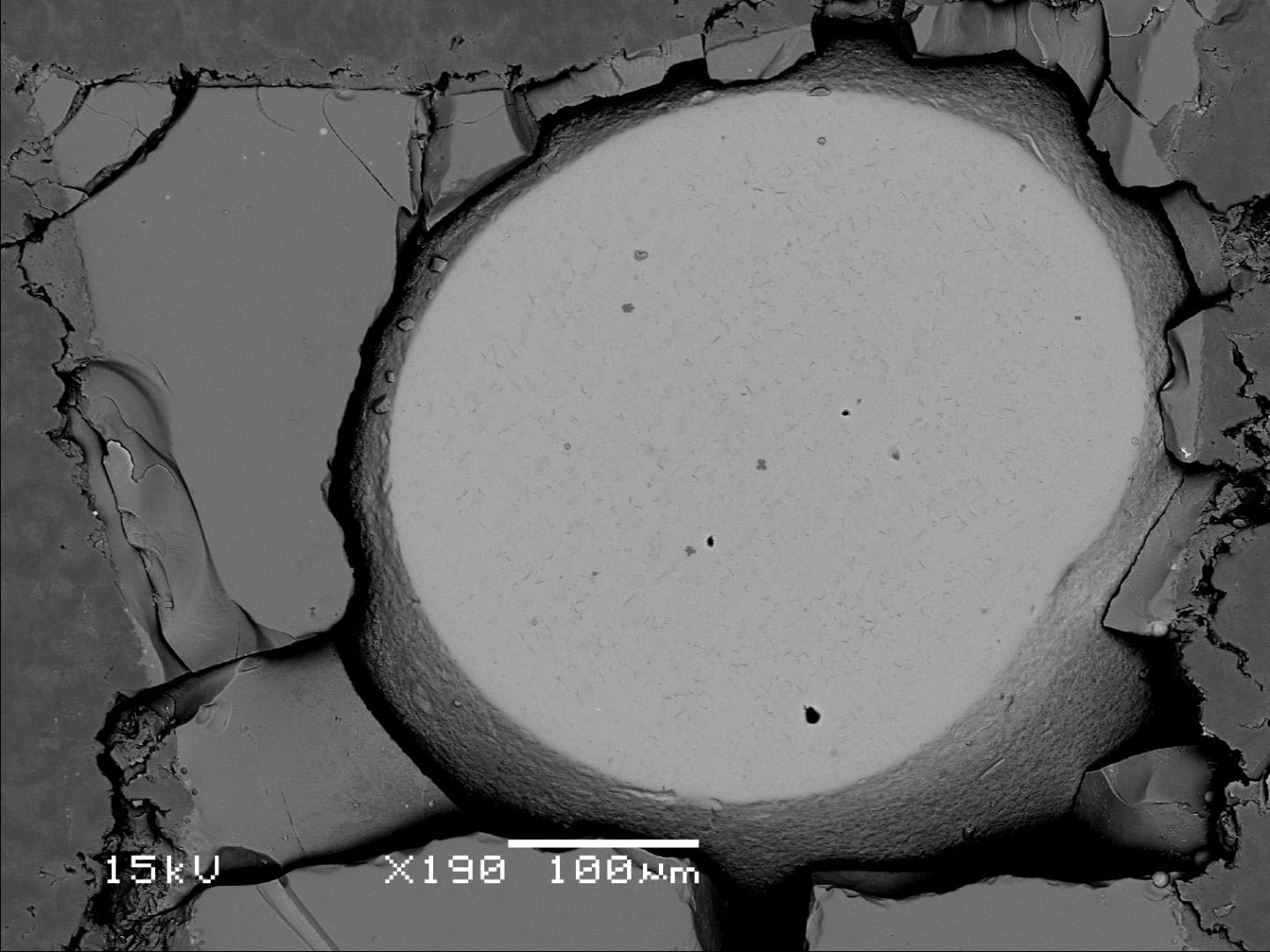
    Electron Micrograph of the Recovered Sample
    A large metallic iron ball was formed during heating and was surrounded by quenched silicate melts Credit: Ehime University

    It is generally accepted that planetary surfaces were covered with molten silicate, a “magma ocean,” during the formation of terrestrial planets. In a deep magma ocean, iron would separate from silicate, sink, and eventually form a metallic core. In this stage, elemental partitioning between a metallic core and a magma ocean would have occurred and siderophile elements would be removed from the magma ocean. Such a chemically differentiated magma ocean formed the present-day Earth’s mantle. Previous studies have experimentally investigated carbon partitioning between iron liquid and silicate melt under high-pressure conditions and found that a terrestrial magma ocean should be more depleted in carbon than in the present day. Thus, how and when the carbon abundance in the Earth’s mantle was established is still poorly understood.

    All previous studies have used a graphite capsule, and therefore, the sample was saturated with carbon. However, the bulk of Earth is unlikely to be saturated with carbon given the carbon abundance in chondrites which are believed to be the building blocks of the Earth. Moreover, it is known that the partition coefficient varies with the bulk concentration of the element of interest even if experimental conditions are identical. In order to investigate the effect of bulk carbon concentration on its liquid metal-silicate partitioning behavior, researchers at Ehime University, Kyoto University, and JAMSTEC have conducted new carbon partitioning experiments at carbon-undersaturated conditions using a boron nitride capsule.

    The new experimental result shows that the partition coefficient of carbon between iron liquid and silicate melt at carbon-undersaturated conditions is several times lower than the previous studies using a graphite capsule. This suggests that carbon in a magma ocean may not have been as depleted as previously thought and requires re-investigation of the core-mantle partitioning of carbon.

    Reference: “The Effects of Carbon Concentration and Silicate Composition on the Metal‐Silicate Partitioning of Carbon in a Shallow Magma Ocean” by H. Kuwahara, S. Itoh, R. Nakada and T. Irifune, 8 August 2019, Geophysical Research Letters.
    DOI: 10.1029/2019GL084254

    Never miss a breakthrough: Join the SciTechDaily newsletter.
    Follow us on Google and Google News.

    Carbon Ehime University
    Share. Facebook Twitter Pinterest LinkedIn Email Reddit

    Related Articles

    Ancient Carbon Is Flooding Arctic Rivers As Permafrost Melts Faster

    Cosmic Hide-and-Seek: Scientists Solve a 4.6-Billion-Year-Old Nitrogen Mystery

    Quantum Simulations Uncover Unexpected Weakening in Planetary Mantles

    Ancient Ocean Slowdown Warns of Future Climate Chaos

    Scientists Discover Gigantic Global Reserve of Soil Carbon Underground

    Boreal Forests at Risk: Lightning-Induced Wildfires Threaten Crucial Carbon Storage

    A Significant Surge: How Tropical Cyclones Increase the Cost of Carbon

    Increased Lightning Fires Threaten Boreal Forest Carbon Storage

    From Core to Crust: The Significance of Magma’s Oxidation in Earth’s Formation

    Leave A Reply Cancel Reply

    • Facebook
    • Twitter
    • Pinterest
    • YouTube

    Don't Miss a Discovery

    Subscribe for the Latest in Science & Tech!

    Trending News

    Massive Study Warns Marijuana Use in Teens Is Linked to Serious Mental Illness

    Scientists Discover a Completely Unexpected Way T Cells Kill Cancer

    Scientists Just Found the Solar System’s Original “Planet Factory”

    Study Warns Widely Used Food Preservatives Linked to High Blood Pressure and Heart Disease

    New Treatment Could Reverse Osteoarthritis Within Weeks

    Physicists Have Measured “Negative Time” in Bizarre Quantum Experiment

    The Deadly Tapeworm Spreading Across America Has Reached the Pacific Northwest

    Could Low Vitamin D Be Making Your Pain Worse?

    Follow SciTechDaily
    • Facebook
    • Twitter
    • YouTube
    • Pinterest
    • Newsletter
    • RSS
    SciTech News
    • Biology News
    • Chemistry News
    • Earth News
    • Health News
    • Physics News
    • Science News
    • Space News
    • Technology News
    Recent Posts
    • Scientists Discover Mysterious Creature Living in the Great Salt Lake – and It Exists Nowhere Else on Earth
    • It’s Alive? Surprising Discovery Changes What We Know About Fog
    • Simple Family Routines May Be the Secret to a Smoother Start at School
    • Brain Study Overturns Long-Held Beliefs About How Humans Learn Speech
    • Ancient Goose Fossil Challenges Long-Held Theories About New Zealand Birds
    Copyright © 1998 - 2026 SciTechDaily. All Rights Reserved.
    • Science News
    • About
    • Contact
    • Editorial Board
    • Privacy Policy
    • Terms of Use

    Type above and press Enter to search. Press Esc to cancel.