
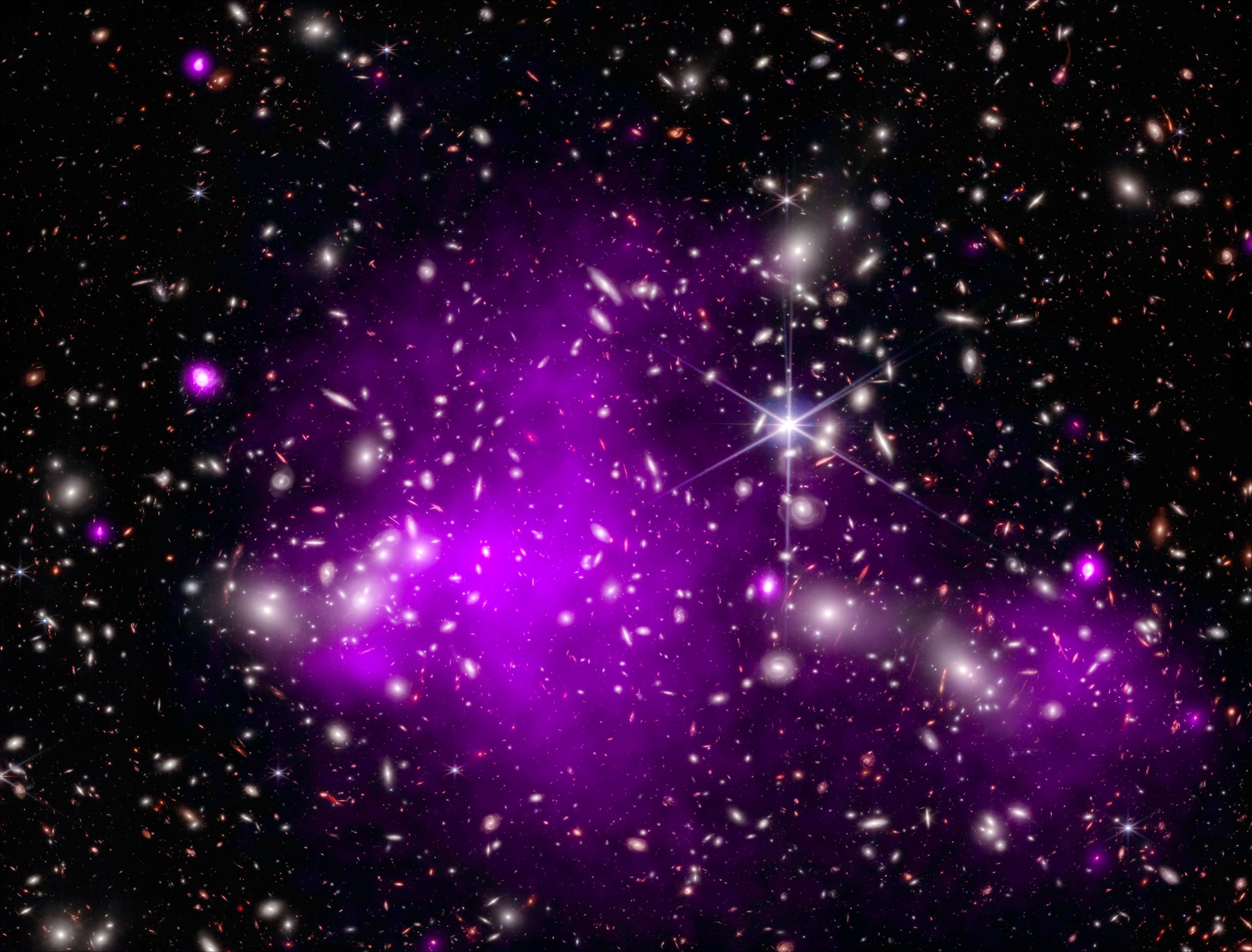
Astronomers have found the most distant X-ray black hole, challenging our understanding of supermassive black hole formation in the early universe.
Astronomers using NASA telescopes have discovered the most distant black hole observed in X-rays to date. The black hole is at an early stage of growth that had never been witnessed before, where its mass is similar to that of its host galaxy.
This result may explain how some of the first supermassive black holes in the universe formed.
Combining Chandra and Webb Data
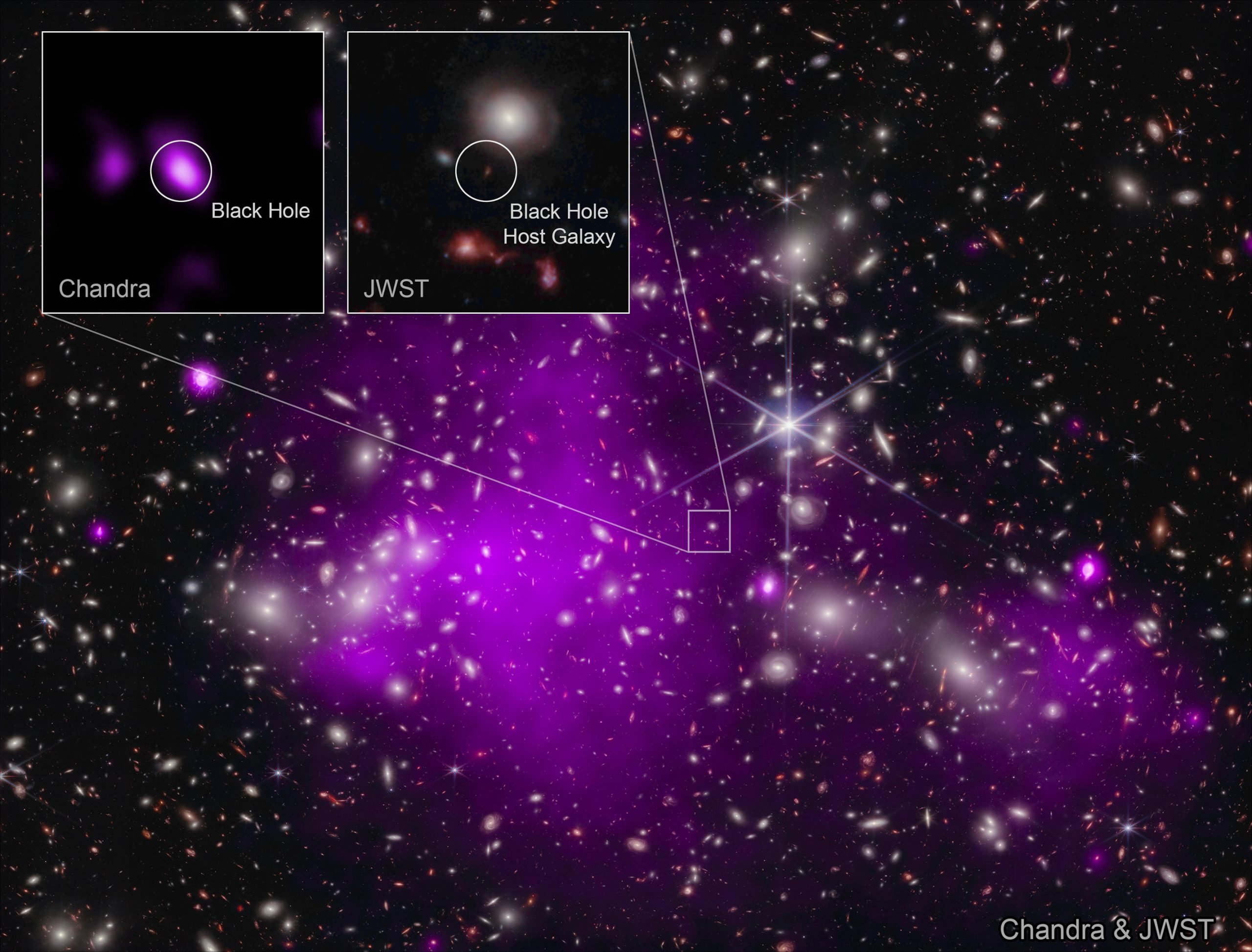
By combining data from NASA’s Chandra X-ray Observatory and NASA’s James Webb Space Telescope, a team of researchers was able to find the telltale signature of a growing black hole just 470 million years after the Big Bang.
“We needed Webb to find this remarkably distant galaxy and Chandra to find its supermassive black hole,” said Akos Bogdan of the Center for Astrophysics | Harvard & Smithsonian (CfA) who leads a new paper in the journal Nature Astronomy describing these results. “We also took advantage of a cosmic magnifying glass that boosted the amount of light we detected.” This magnifying effect is known as gravitational lensing.
Distance Measurements and Lensing Effects
Bogdan and his team found the black hole in a galaxy named UHZ1 in the direction of the galaxy cluster Abell 2744, located 3.5 billion light-years from Earth. Webb data, however, has revealed the galaxy is much more distant than the cluster, at 13.2 billion light-years from Earth, when the universe was only 3% of its current age.
Then over two weeks of observations with Chandra showed the presence of intense, superheated, X-ray emitting gas in this galaxy — a trademark for a growing supermassive black hole. The light from the galaxy and the X-rays from gas around its supermassive black hole are magnified by about a factor of four by intervening matter in Abell 2744 (due to gravitational lensing), enhancing the infrared signal detected by Webb and allowing Chandra to detect the faint X-ray source.
Implications for Black Hole Formation
This discovery is important for understanding how some supermassive black holes can reach colossal masses soon after the Big Bang. Do they form directly from the collapse of massive clouds of gas, creating black holes weighing between about 10,000 and 100,000 Suns? Or do they come from explosions of the first stars that create black holes weighing only between about 10 and 100 Suns?
“There are physical limits on how quickly black holes can grow once they’ve formed, but ones that are born more massive have a head start. It’s like planting a sapling, which takes less time to grow into a full-size tree than if you started with only a seed,” said Andy Goulding of Princeton University. Goulding is a co-author of the Nature Astronomy paper and lead author of a new paper in The Astrophysical Journal Letters that reports the galaxy’s distance and mass using a spectrum from Webb.

Evidence of a ‘Born Massive’ Black Hole
Bogdan’s team has found compelling evidence that the newly discovered black hole was born massive. Its mass is estimated to fall between 10 and 100 million Suns, based on the brightness and energy of the X-rays. This mass range is similar to that of all the stars in the galaxy where it lives, which is in stark contrast to black holes in the centers of galaxies in the nearby universe that usually contain only about a tenth of a percent of the mass of their host galaxy’s stars.
The large mass of the black hole at a young age, plus the amount of X-rays it produces and the brightness of the galaxy detected by Webb, all agree with theoretical predictions in 2017 by co-author Priyamvada Natarajan of Yale University for an “Outsize Black Hole” that directly formed from the collapse of a huge cloud of gas.
“We think that this is the first detection of an ‘Outsize Black Hole’ and the best evidence yet obtained that some black holes form from massive clouds of gas,” said Natarajan. “For the first time we are seeing a brief stage where a supermassive black hole weighs about as much as the stars in its galaxy, before it falls behind.”
Future Research and Collaborative Efforts
The researchers plan to use this and other results pouring in from Webb and those combining data from other telescopes to fill out a larger picture of the early universe.
NASA’s Hubble Space Telescope previously showed that light from distant galaxies is highly magnified by matter in the intervening galaxy cluster, providing part of the motivation for the Webb and Chandra observations described here.
References:
“Evidence for heavy-seed origin of early supermassive black holes from a z ≈ 10 X-ray quasar” by Ákos Bogdán, Andy D. Goulding, Priyamvada Natarajan, Orsolya E. Kovács, Grant R. Tremblay, Urmila Chadayammuri, Marta Volonteri, Ralph P. Kraft, William R. Forman, Christine Jones, Eugene Churazov and Irina Zhuravleva, 6 November 2023, Nature Astronomy.
DOI: 10.1038/s41550-023-02111-9
“UNCOVER: The Growth of the First Massive Black Holes from JWST/NIRSpec—Spectroscopic Redshift Confirmation of an X-Ray Luminous AGN at z = 10.1” by Andy D. Goulding, Jenny E. Greene, David J. Setton, Ivo Labbe, Rachel Bezanson, Tim B. Miller, Hakim Atek, Ákos Bogdán, Gabriel Brammer, Iryna Chemerynska, Sam E. Cutler, Pratika Dayal, Yoshinobu Fudamoto, Seiji Fujimoto, Lukas J. Furtak, Vasily Kokorev, Gourav Khullar, Joel Leja, Danilo Marchesini, Priyamvada Natarajan, Erica Nelson, Pascal A. Oesch, Richard Pan, Casey Papovich, Sedona H. Price, Pieter van Dokkum, Bingjie Wang, 冰洁 王, John R. Weaver, Katherine E. Whitaker and Adi Zitrin, 22 September 2023, The Astrophysical Journal Letters.
DOI: 10.3847/2041-8213/acf7c5
The paper describing the results by Bogdan’s team appears in Nature Astronomy. In addition to those listed above, the authors include Orsolya Kovacs (Masaryk University, Czech Republic), Grant Tremblay (CfA), Urmila Chadayammuri (CfA), Marta Volonteri (Institut d’Astrophysique de Paris, France), Ralph Kraft (CfA), William Forman (CfA), Christine Jones (CfA), Eugene Churazov (Max Planck Institute for Astrophysics, Germany), and Irina Zhuravleva (University of Chicago).
The Webb data used in both papers is part of a survey called the Ultradeep Nirspec and nirCam ObserVations before the Epoch of Reionization (UNCOVER). The paper led by UNCOVER team member Andy Goulding appears in the Astrophysical Journal Letters. The co-authors include other UNCOVER team members, plus Bogdan and Natarajan. A detailed interpretation paper that compares observed properties of UHZ1 with theoretical models for Outsize Black Hole Galaxies is forthcoming.
NASA’s Marshall Space Flight Center manages the Chandra program. The Smithsonian Astrophysical Observatory’s Chandra X-ray Center controls science operations from Cambridge, Massachusetts, and flight operations from Burlington, Massachusetts.
The James Webb Space Telescope is the world’s premier space science observatory. Webb is solving mysteries in our solar system, looking beyond to distant worlds around other stars, and probing the mysterious structures and origins of our universe and our place in it. Webb is an international program led by NASA with its partners, ESA (European Space Agency) and the Canadian Space Agency.
Never miss a breakthrough: Join the SciTechDaily newsletter.
Follow us on Google and Google News.