
- Astronomers may have discovered the most distant jet emitting X-rays.
- The source of this jet is a rapidly growing supermassive black hole, or quasar, located about 12.7 billion light-years away from Earth.
- Chandra data revealed this jet extends for about 160,000 light-years, or longer than the entire span of the Milky Way.
- This result may help explain how the biggest black holes formed so quickly.
Astronomers may have found the most distant supermassive black hole with a jet detected in X-rays using NASA’s Chandra X-ray Observatory. The source of this jet is a quasar — a rapidly growing supermassive black hole — named PSO J352.4034-15.3373 (PJ352-15 for short), which sits at the center of a young galaxy located about 12.7 billion light-years from Earth. This result may help explain how the biggest black holes formed at a very early time in the Universe’s history.
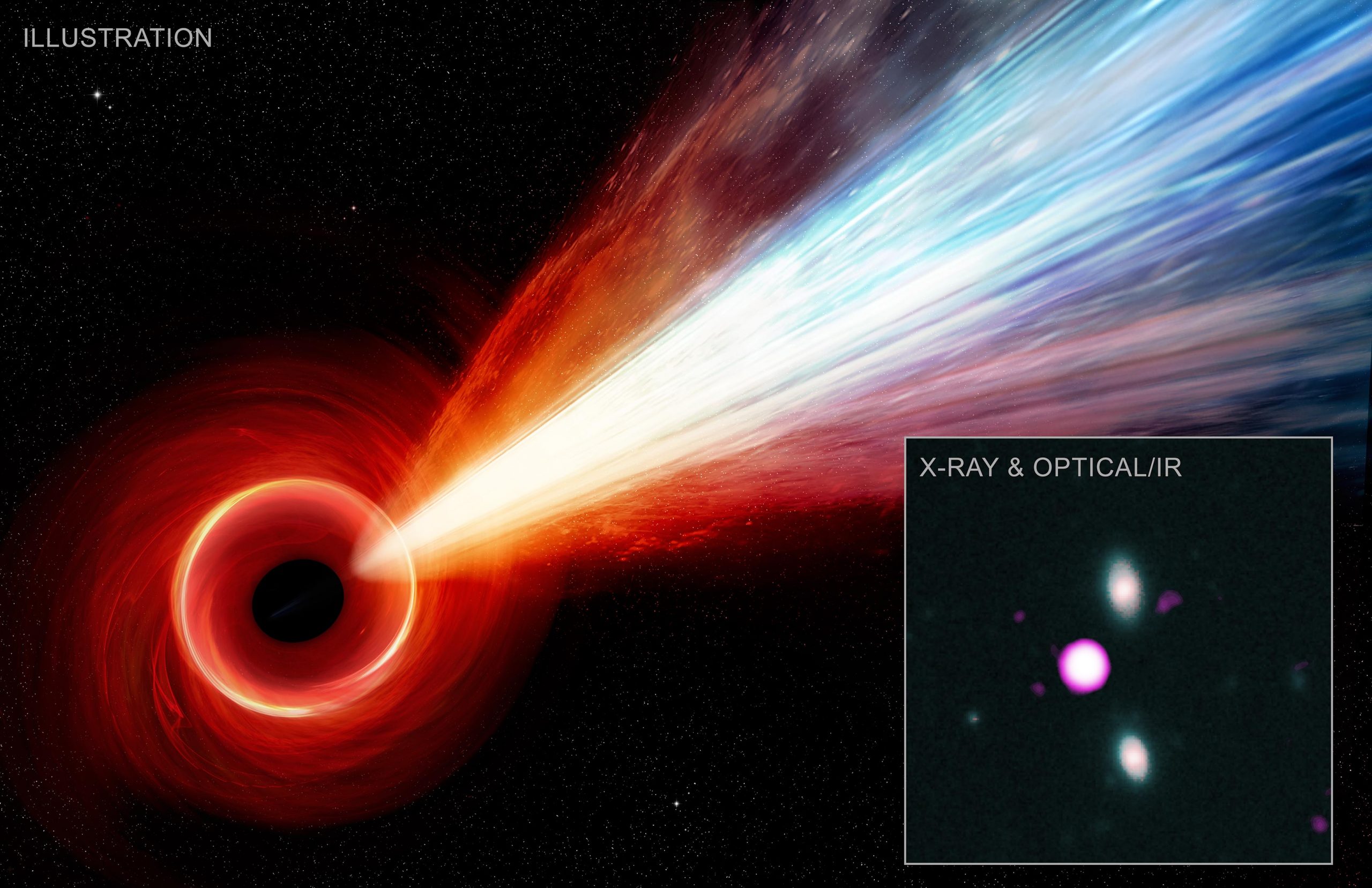
The main panel of the graphic on the top of this article is an artist’s illustration of a close-up view of a quasar and its jet, like the one in PJ352-52. To the lower left, material is orbiting around a supermassive black hole in a disk. Once it loses enough speed and energy, the material can fall farther inwards to cross the so-called event horizon, the point of no return, shown as the black disk. Meanwhile, some of this material is redirected away from the black hole in the form of a narrow beam, or jet, which is seen on the right side of the illustrations. These high-speed jets of energetic particles are powered by magnetic fields, which can cause a braking effect on the disk as energy is removed from the system. This is one key way for material in the disk to lose energy and, therefore, enhance the rate of growth of black holes.
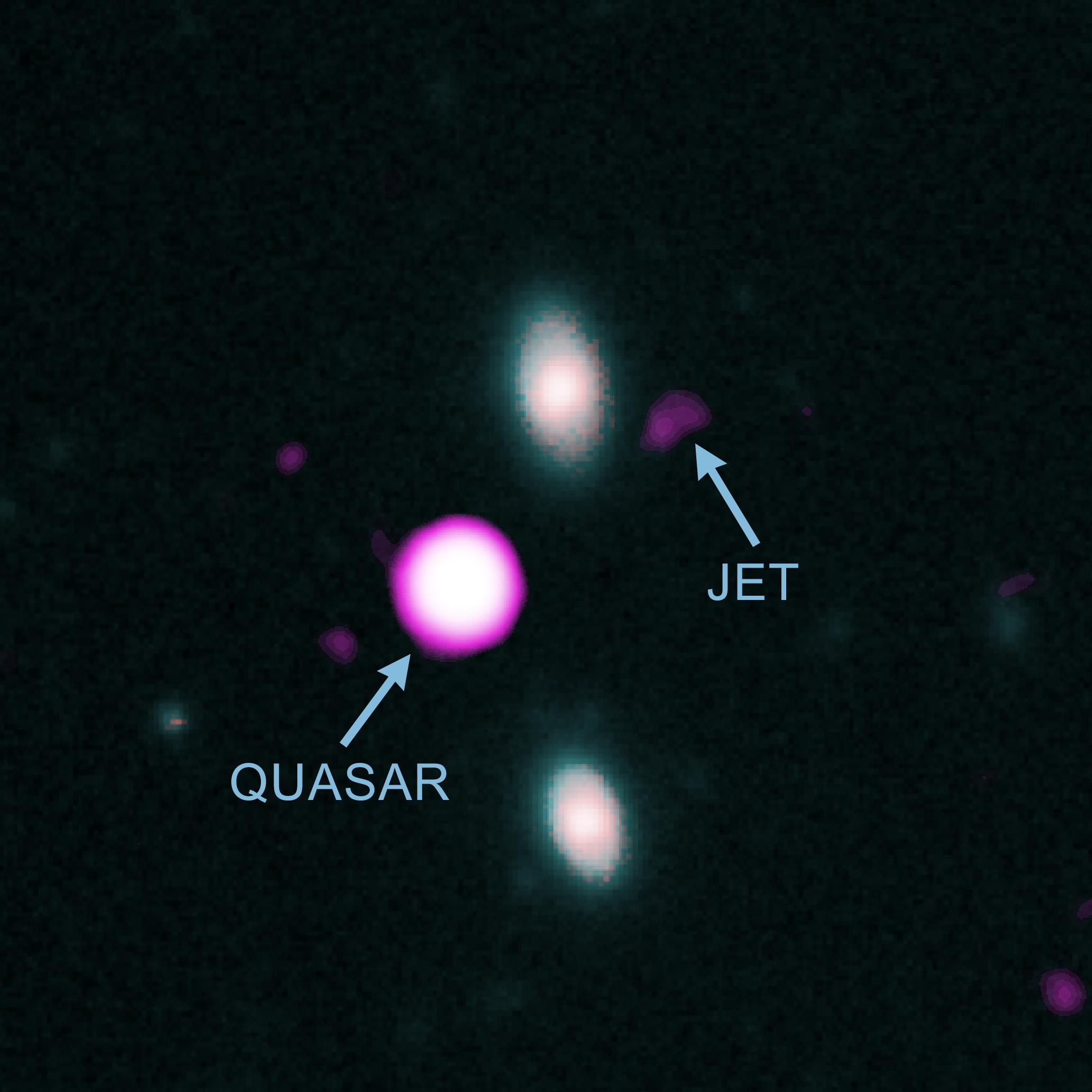
The inset of that graphic (and shown above in full) contains X-ray data from Chandra of PJ352-15 (purple) that has been combined with optical and infrared data from the Gemini-North telescope and the Keck-I telescope respectively. Astronomers observed PJ352-15 for a total of three days using the sharp vision of Chandra to detect evidence for the X-ray jet. Chandra revealed X-ray emission about 160,000 light-years away from the quasar along the same direction as much shorter jets seen in radio waves. By comparison, the entire Milky Way spans about 100,000 light-years. The jet does not appear continuous in the Chandra data, likely because only the brightest part of the jet is detectable with the observation time used.
The X-rays detected from the jet in PJ352-15 were emitted when the Universe was only 0.98 billion years old, which corresponds to less than a tenth of its present age. At this point, the intensity of the cosmic microwave background radiation (CMB) left over from the Big Bang was much greater than it is today. As the electrons in the jet fly away from the black hole at close to the speed of light, they move through and collide with photons making up the CMB radiation, boosting the energy of the photons up into the X-ray range to be detected by Chandra. In this scenario, the X-rays are significantly boosted in brightness compared to radio waves. This agrees with the observation that the large X-ray jet feature has no associated radio emission.
Prior to this latest study on PJ352-15, the longest jet astronomers had observed from the first billion years after the Big Bang was only about 5,000 light-years in length, corresponding to the radio observations of PJ352-15. PJ352-15 is also about 300 million light-years farther away than the most distant X-ray jet recorded before it.
A paper describing these results has been accepted for publication in The Astrophysical Journal. The authors of the paper are Thomas Connor (NASA’s Jet Propulsion Laboratory, Pasadena, CA), Eduardo Bañados (Max Planck Institute for Astronomy, Heidelberg, German), Daniel Stern (JPL) Chris Carilli (NRAO, Socorro, New Mexico); Andrew Fabian (University of Cambridge, UK); Emmanuel Momjian (NRAO); Sofía Rojas-Ruiz (MPIA); Roberto Decarli (INAF, Bologna, Italy); Emanuele Paolo Farina (Max Planck Institute for Astrophysics, Garching, Germany); Chiara Mazzucchelli (ESO, Chile); Hannah P. Earnshaw (Caltech, Pasadena, California).
Reference: “Enhanced X-ray Emission from the Most Radio-Powerful Quasar in the Universe’s First Billion Years” by Thomas Connor, Eduardo Bañados, Daniel Stern, Chris Carilli, Andrew Fabian, Emmanuel Momjian, Sofía Rojas-Ruiz, Roberto Decarli, Emanuele Paolo Farina, Chiara Mazzucchelli and Hannah P. Earnshaw, Accepted, The Astrophysical Journal.
DOI: 10.3847/1538-4357/abe710
arXiv: 2103.03879
NASA’s Marshall Space Flight Center manages the Chandra program. The Smithsonian Astrophysical Observatory’s Chandra X-ray Center controls science from Cambridge Massachusetts and flight operations from Burlington, Massachusetts.
Never miss a breakthrough: Join the SciTechDaily newsletter.
Follow us on Google and Google News.
2 Comments
First we must differentiate radio wave from oþher parts galaxy from the X-ray jet, a distinct source of emission due to central part,an inavoìdable manifestation of the Supermassive black hole as òrigino the final feature of formation during the evolution.So the same is magnetic in nature.Thè concerned picture of the Quasar is of early period of 5he evolution of the Universe when galaxies were growing very rapidly and in steady form is There is being specifyin here.
First we must differentiate radio waves from the other parts of
the galaxy from the X-ray jet, a distinct source of emission due to central part,an inavoìdable manifestation of the Supermassive black hole as òrigino the final feature of formation during the evolution.So the same is magnetic in nature.Thè concerned picture of the Quasar is of early period of 5he evolution of the Universe when galaxies were growing very rapidly and in steady form is There is being specifyin here.