

Photosynthetic bacteria adapt to environment by using quantum mechanics to steer energy.
Photosynthetic organisms harvest light from the sun to produce the energy they need to survive. A new paper published by University of Chicago researchers reveals their secret: exploiting quantum mechanics.
“Before this study, the scientific community saw quantum signatures generated in biological systems and asked the question, were these results just a consequence of biology being built from molecules, or did they have a purpose?” said Greg Engel, Professor of Chemistry and senior author on the study. “This is the first time we are seeing biology actively exploiting quantum effects.”

The scientists studied a type of microorganism called green sulfur bacteria. These bacteria need light to survive, but even small amounts of oxygen can damage their delicate photosynthetic equipment. So they must develop ways to minimize the damage when the bacterium does encounter oxygen.
To study this process, researchers tracked the movement of energy through a photosynthetic protein under different conditions–with oxygen around, and without.
Vibronic Mixing: A Quantum Navigation Tool
They found that the bacterium uses a quantum mechanical effect called vibronic mixing to move energy between two different pathways, depending on whether or not there’s oxygen around. Vibronic mixing involves vibrational and electronic characteristics in molecules coupling to one another. In essence, the vibrations mix so completely with the electronic states that their identities become inseparable. This bacterium uses this phenomenon to guide energy where it needs it to go.

If there’s no oxygen around and the bacterium is safe, the bacterium uses vibronic mixing by matching the energy difference between two electronic states in an assembly of molecules and proteins called the FMO complex, with the energy of the vibration of a bacteriochlorophyll molecule. This encourages the energy to flow through the “normal” pathway toward the photosynthetic reaction center, which is packed full of chlorophyll.
But if there is oxygen around, the organism has evolved to steer the energy through a less direct path where it can be quenched. (Quenching energy is similar to putting a palm on a vibrating guitar string to dissipate energy.) This way, the bacterium loses some energy but saves the entire system.
A Quantum-Triggered Defense Mechanism
To achieve this effect, a pair of cysteine residues in the photosynthetic complex acts as a trigger: They each react with the oxygen in the environment by losing a proton, which disrupts the vibronic mixing. This means that energy now preferentially moves through the alternative pathway, where it can be safely quenched. This principle is a bit like blocking two lanes on a superhighway and diverting some traffic to local roads where there are many more exits.
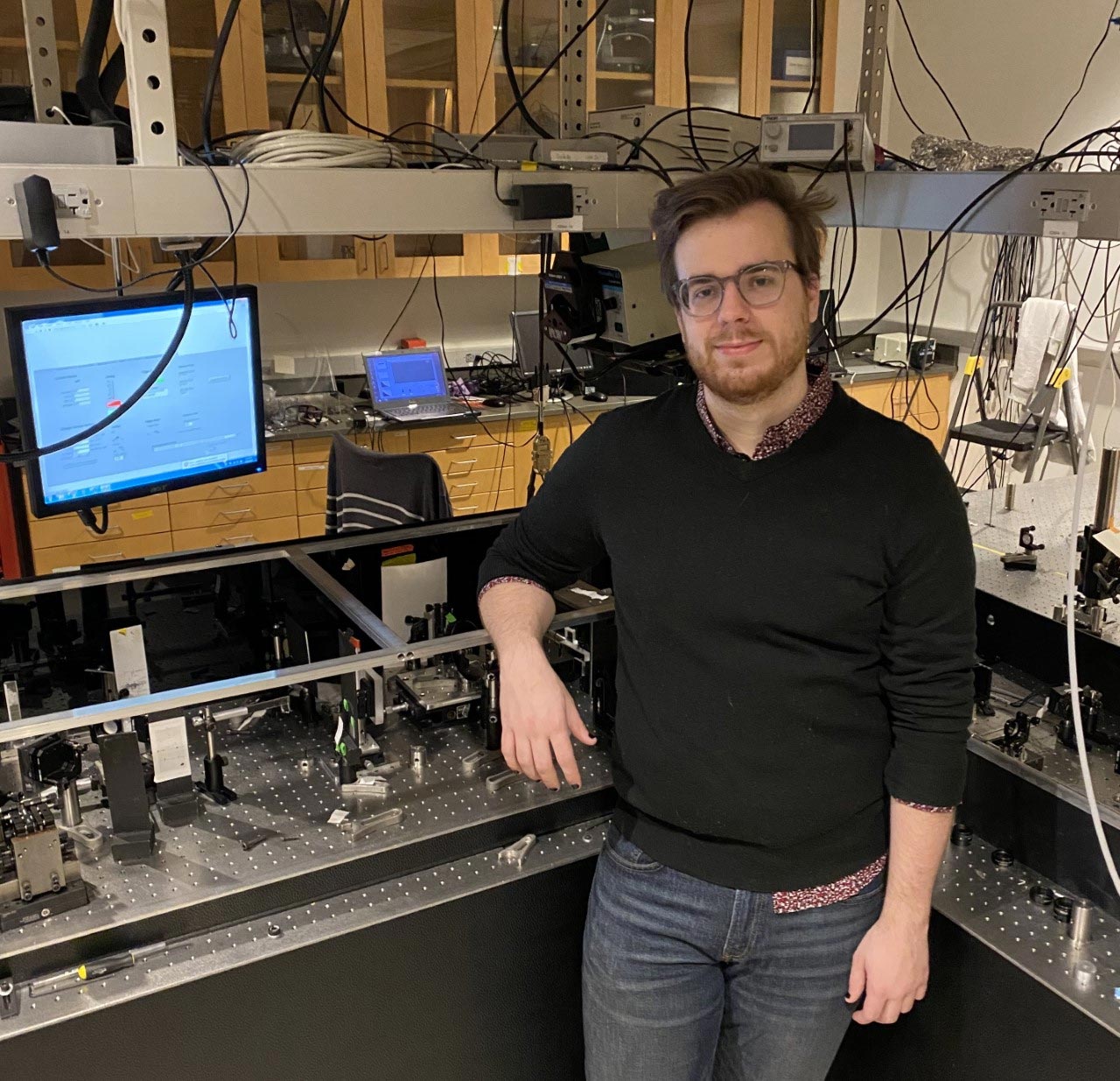
“What’s interesting about this result is that we are seeing the protein turn the vibronic coupling on and off in response to environmental changes in the cell,” said Jake Higgins, a graduate student in the Department of Chemistry and the lead author of the paper. “The protein uses the quantum effect to protect the organism from oxidative damage.”
These findings bring about an exciting new revelation about biology; using an explicitly quantum mechanism to protect the system shows an important adaptation and that quantum effects can be important to survival.
Evolution May Favor Quantum Survival Tools
This phenomenon is likely not limited to green sulfur bacteria, the scientists said. As Higgins explained, “The simplicity of the mechanism suggests that it might be found in other photosynthetic organisms across the evolutionary landscape. If more organisms are able to dynamically modulate quantum mechanical couplings in their molecules to produce larger changes in physiology, there could be a whole new set of effects selected for by nature that we don’t yet know about.”
Reference: “Photosynthesis tunes quantum mechanical mixing of electronic and vibrational states to steer exciton energy transfer” by Jacob S. Higgins, Lawson T. Lloyd, Sara H. Sohail, Marco A. Allodi, John P. Otto, Rafael G. Saer, Ryan E. Wood, Sara C. Massey, Po-Chieh Ting, Robert E. Blankenship and Gregory S. Engel, 8 March 2021, Proceedings of the National Academy of Sciences.
DOI: 10.1073/pnas.2018240118
Funding: Air Force Office of Scientific Research (AFOSR), NSF, DOE Office of Science, Department of Defense (DoD), Arnold and Mabel Beckman Foundation.
Never miss a breakthrough: Join the SciTechDaily newsletter.
Follow us on Google and Google News.
1 Comment
And how can evolution explain that?