
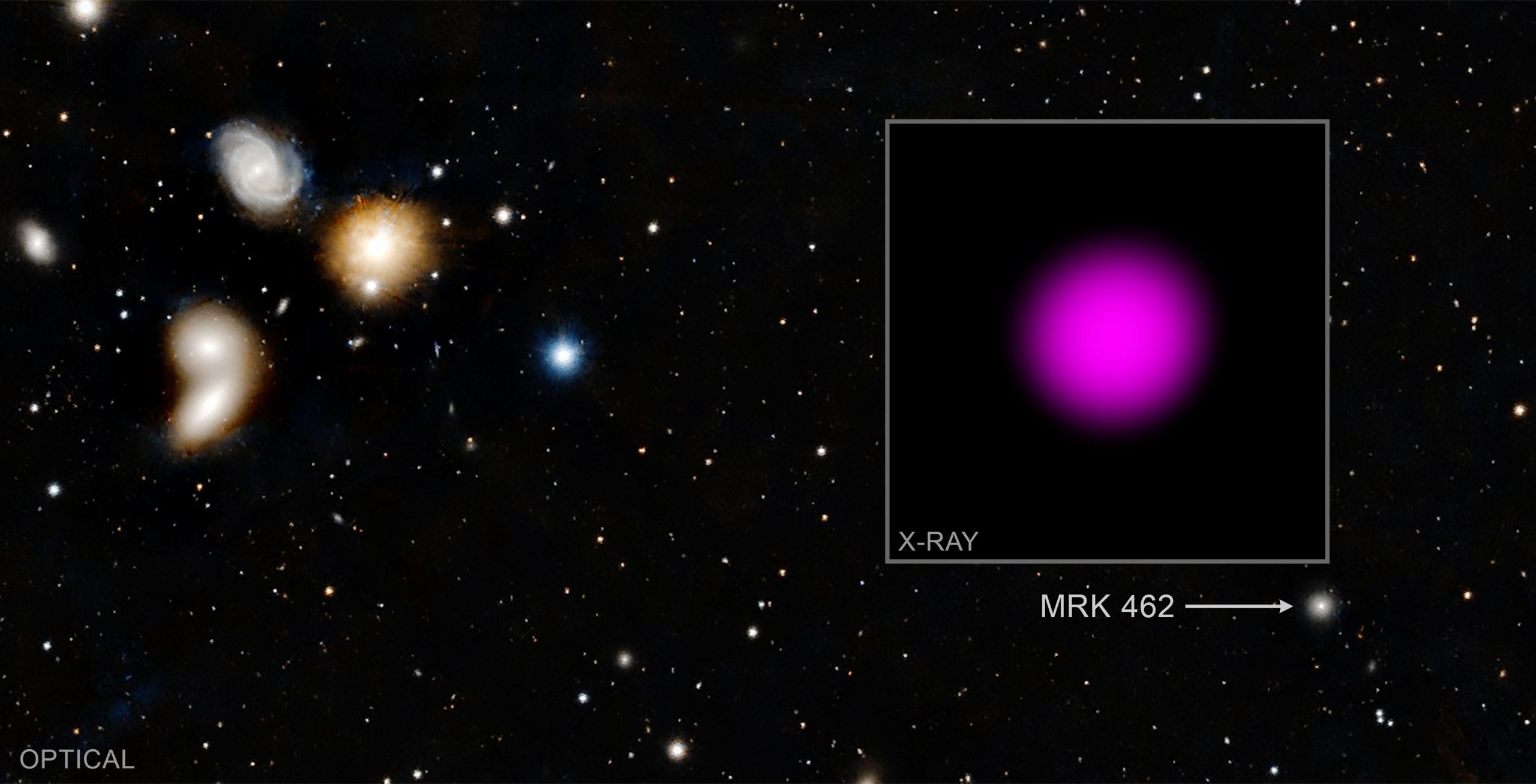
Chandra X-ray Observatory’s detection of a supermassive black hole in Mrk 462 sheds light on the evolution of early universe black holes.
- Astronomers have discovered a supermassive black hole in the dwarf galaxy Mrk 462 with NASA’s Chandra X-ray Observatory.
- The percentage of these galaxies that have such black holes could indicate how some of the earliest black holes in the Universe formed and grew.
- The black hole in Mrk 462 contains about 200,000 solar masses, placing it in the small side of the supermassive category.
- This is one of the first times that a heavily buried supermassive black hole has been found in a dwarf galaxy.
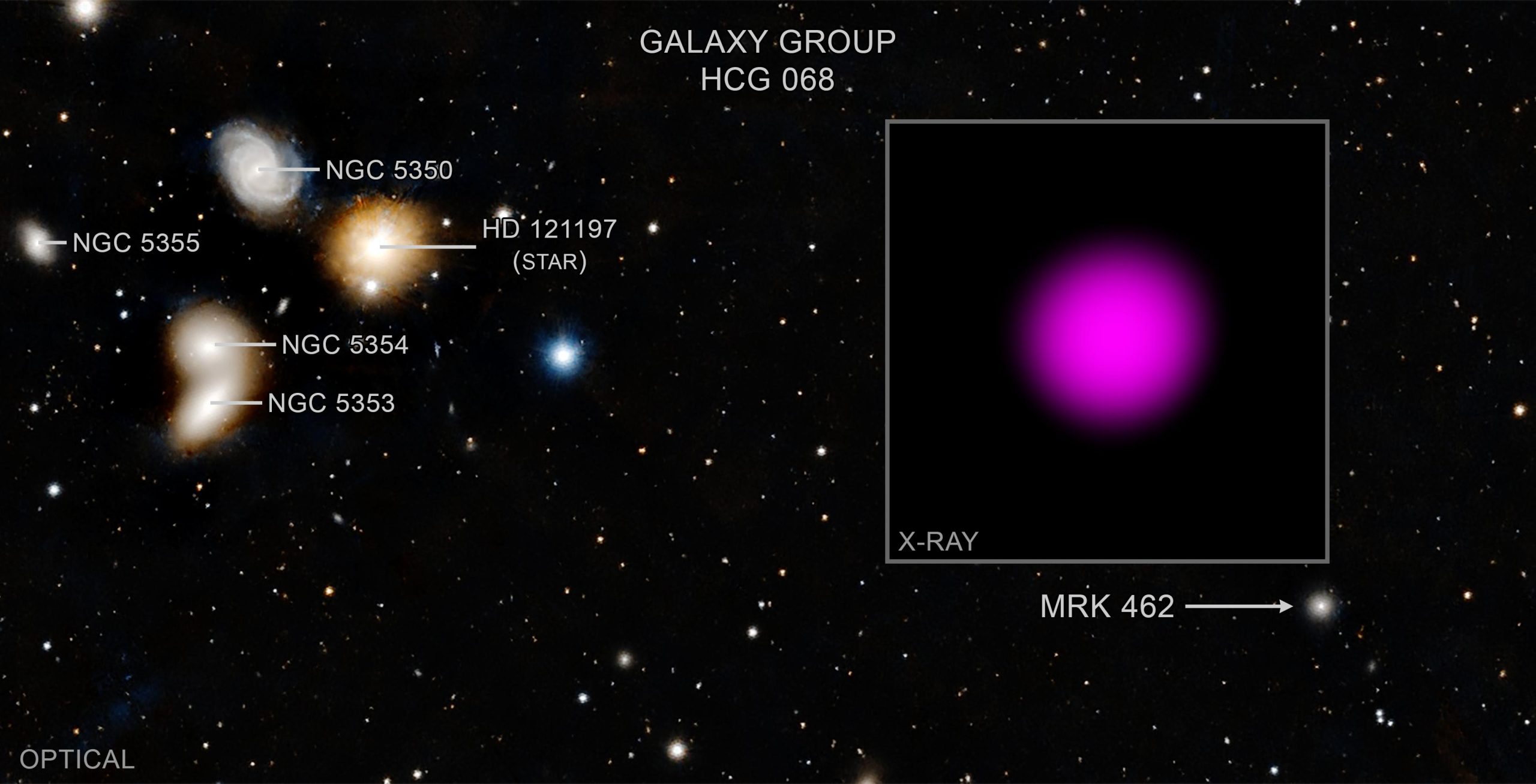
The graphic shows X-rays that NASA’s Chandra X-ray Observatory detected from the dwarf galaxy Mrk 462. This X-ray emission (inset) is important because it reveals the presence of a growing supermassive black hole within this relatively small galaxy. The mass contained in this black hole — about 200,000 times the mass of the Sun — provides information to astronomers about how some of the earliest black holes in the Universe may have formed and grown billions of years ago.
The background panel is an optical image from the Pan-STARRS telescope in Hawaii. There are several galaxies that are part of the HCG068 galaxy group on the left-hand side of the image. The galaxy that is emitting copious amounts of X-rays, however, is the much smaller galaxy located to the lower right of the image (marked by the arrow). Mrk 462 is a dwarf galaxy because it contains only a few hundred million stars, which means it holds about a hundred times fewer stars than a galaxy like the Milky Way. Black holes are notoriously hard to find in dwarf galaxies because they are usually too small and dim for optical light telescopes to track the rapid motions of stars in the centers.
To look for signs of black hole growth, researchers used Chandra to observe eight dwarf galaxies that had previously shown hints of black hole activity from optical data gathered by the Sloan Digital Sky Survey. Of those eight, only Mrk 462 showed the X-ray signature of a growing black hole. Moreover, the proportion of high-energy to low-energy X-rays from Mrk 462, along with comparisons to data at other wavelengths, indicates that the Mrk 462 black hole is heavily obscured by gas. This is one of the first times that a heavily buried, or “obscured,” supermassive black hole has been found in a dwarf galaxy.
Previous research has shown that black holes can grow to a billion solar masses by the time the Universe is less than a billion years old, a small fraction of its current age. One idea is that these huge objects were created when massive stars collapsed to form black holes that weighed only about 100 times the mass of the sun. Theoretical work, however, struggles to explain how they could pack on weight quickly enough to reach the sizes seen in the early universe. An alternative explanation is that the early Universe was seeded with black holes containing tens of thousands of solar masses when they were created — perhaps from the collapse of gigantic clouds of gas and dust.
If astronomers find that a large fraction of dwarf galaxies contain supermassive black holes like the one in Mrk 462, it favors the idea that small black hole seeds from the earliest generation of stars grew astonishingly quickly to form the billion solar mass objects in the early universe. A smaller fraction would tip the scales to favor the idea that black holes began life weighing tens of thousands of Suns. This is because the conditions necessary for the direct collapse from a giant cloud to a medium-sized black hole should be rare, so it is not expected that a large fraction of dwarf galaxies would contain supermassive black holes. Stellar-mass black holes, on the other hand, are expected in every galaxy.
These results were scheduled to be presented at the 239th meeting of the American Astronomical Society meeting in Salt Lake City, which was canceled due to COVID-19 concerns.
NASA’s Marshall Space Flight Center manages the Chandra program. The Smithsonian Astrophysical Observatory’s Chandra X-ray Center controls science operations from Cambridge, Massachusetts, and flight operations from Burlington, Massachusetts.
Never miss a breakthrough: Join the SciTechDaily newsletter.
Follow us on Google and Google News.
1 Comment
Mini monster. Is that like jumbo shrimp?