

An open-source Python-based code called BADASS revolutionizes how astronomers analyze spectra from active galactic nuclei (AGNs).
An astro-statistics course University of California, Riverside, graduate student Remington O. Sexton took three years ago taught him techniques that led him to develop free, open-source code benefiting astronomers everywhere.
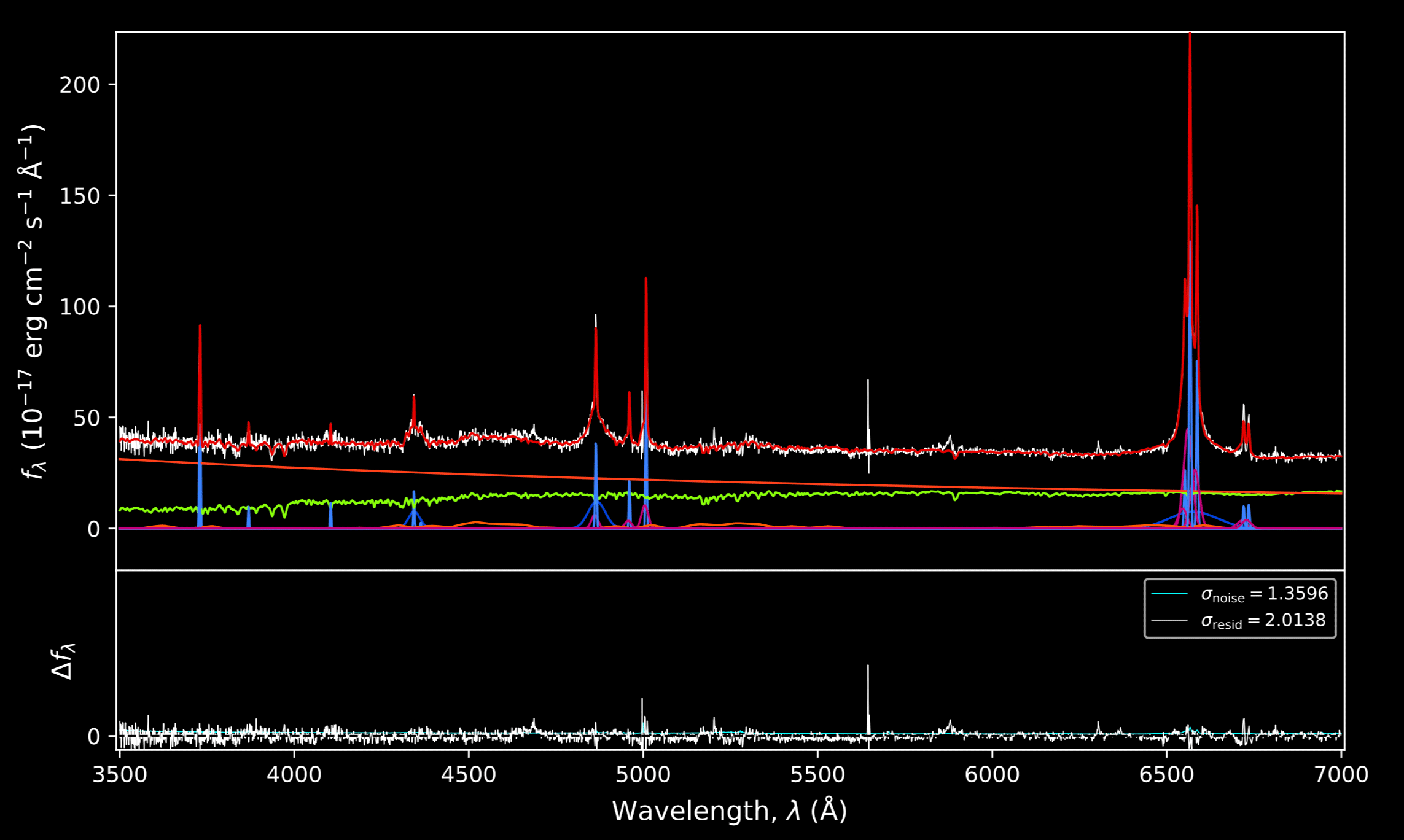
Called BADASS, which stands for Bayesian AGN Decomposition Analysis for SDSS Spectra, the code in its current form fits astronomical spectra of active galactic nuclei, or AGNs, from the Sloan Digital Sky Survey, or SDSS, using advanced statistical methods.
“The code is unique in that it finally provides a way for astronomers to fit the stellar motions of stars simultaneously with many other components, is written in the popular programming language Python, and is versatile enough to fit not just AGNs, but normal galaxies as well,” said Sexton, who earned his doctoral degree in physics and astronomy in September 2020.
Sexton’s breakthrough work is published in the January 2021 issue of the Monthly Notices of the Royal Astronomical Society.
AGN is the general term used to describe a supermassive black hole in the center of a galaxy that is actively accreting material, usually in the form of interstellar gas, using its strong gravitational influence. AGNs are common; but not all galaxies have them at their centers. Each galaxy’s center is believed, however, to have a supermassive black hole. Normal galaxies, such as the Milky Way, lack actively accreting black holes.
Different celestial objects produce different types of spectra. An object’s spectrum helps astronomers identify what type of object it is. Light from a celestial body with no intervening matter produces a spectrum that appears as a continuum. A challenge in astronomy has been separating the contribution of stellar light and the contribution of AGN light from each other in the galaxy’s main spectral continuum.
What Makes BADASS Different
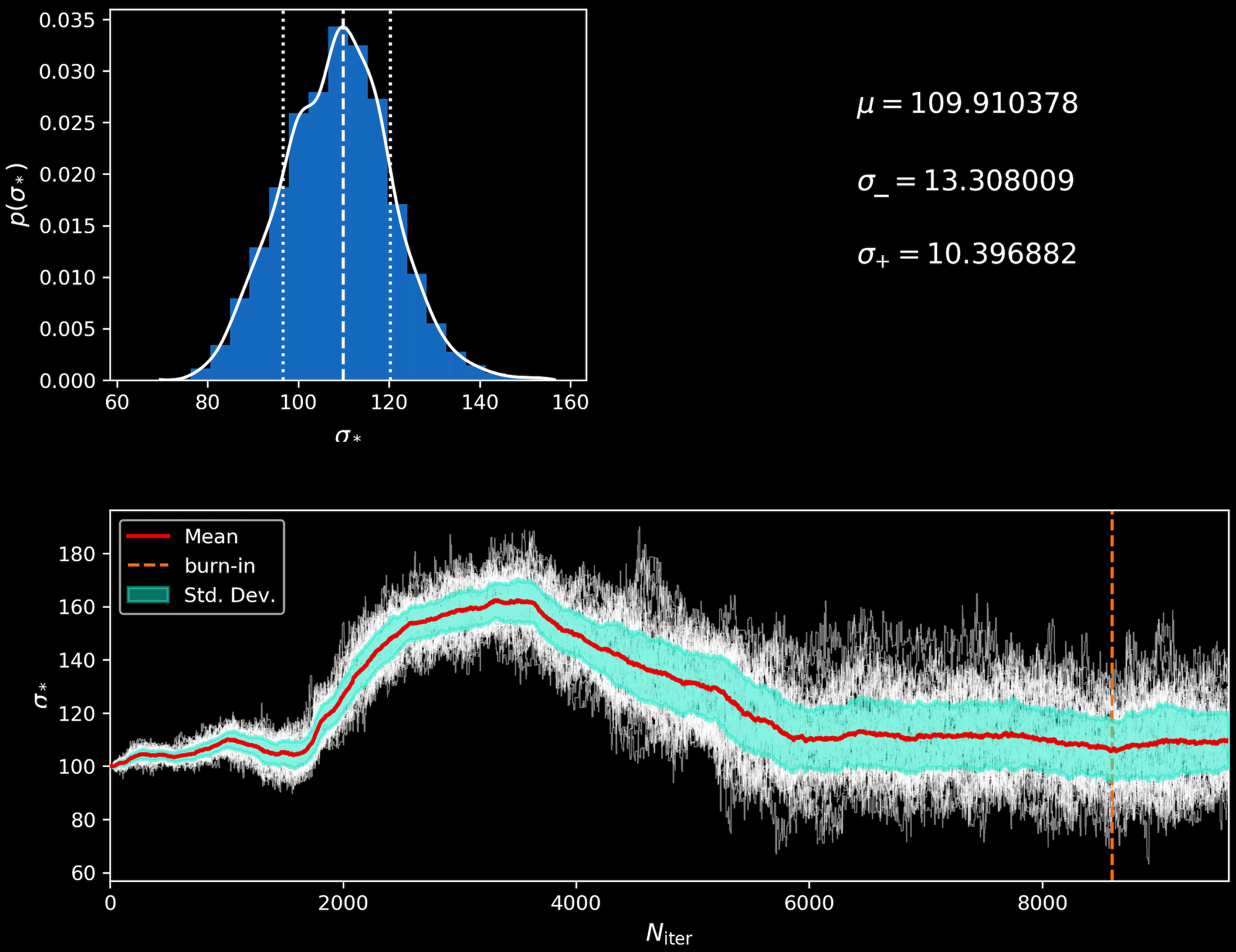
“The challenge is separating the two from each other, that is, isolating the stellar component from the AGN light contribution,” Sexton said. “Aside from being versatile enough to fit many kinds of astronomical objects, which many codes aren’t designed for, BADASS simultaneously fits stellar kinematics simultaneously with all other components in the spectra. Codes in the past used a two-step process of fitting stellar kinematics and other components independently. But this could introduce biases or uncertainties. The best way to perform spectral decomposition is to fit all components simultaneously. This is what BADASS does.”
Tracking Ionized Gas Outflows with Precision
Sexton designed BADASS also to detect and fit ionized gas outflows typically seen in optical emission line features and is the first to incorporate a set of specific criteria for their detection. Ionized gas outflow refers to the bulk motion of interstellar gas capable of escaping the gravitational influence of its host galaxy and the black hole.
“Ionized gas outflows have become a hot topic in the past decade and could explain how supermassive black holes and galaxies co-evolve with each other over cosmic time,” said coauthor Gabriela Canalizo, a professor of physics and astronomy at UC Riverside and Sexton’s doctoral advisor.
From Black Holes to Normal Galaxies and Stars
Currently, BADASS is only being used to fit AGN objects. Sexton emphasized, however, that the code is versatile, easy to use, and can fit other objects such as normal galaxies.
“BADASS can be used for fitting normal non-AGN host galaxies, and even individual stars,” he said. “Currently, its usage is strictly for astronomical spectra, but the statistical framework BADASS is built on can be generalized for any kind of spectroscopy. That makes it extraordinarily versatile and useful.”
One motivation Sexton had to develop BADASS was to phase out the need for proprietary software — IDL programming language — and replace it with a free open-source language such as Python.
“Now anyone can download BADASS for free and use it,” he said. “It is ready to be run as long as you can install Python and all the packages it requires. Because this code can also detect and fit ionized gas outflows in optical spectra, it could greatly assist in the heightened interest in astronomy now in studying ionized gas outflows by creating larger samples for analysis.”
Sexton and Canalizo were joined in the research by William Matzko of George Mason University in Virginia; Nicholas Darden of UCR; and Varoujan Gorjian of the Jet Propulsion Laboratory in California.
The research was supported partially by the National Science Foundation and the NASA MIRO program through the Fellowships and Internships for Extremely Large Data Sets (FIELDS) in the form of a graduate student fellowship.
Reference: “Bayesian AGN Decomposition Analysis for SDSS spectra: a correlation analysis of [O III] λ5007 outflow kinematics with AGN and host galaxy properties” by Remington O Sexton, William Matzko, Nicholas Darden, Gabriela Canalizo, Varoujan Gorjian, 27 October 2020, Monthly Notices of the Royal Astronomical Society.
DOI: 10.1093/mnras/staa3278
Never miss a breakthrough: Join the SciTechDaily newsletter.
Follow us on Google and Google News.
1 Comment
🙂 I suspected “burn in” meant that it is using a Markov chain Monte Carlo method – it is, says the abstract – same as standard bayesian methods for phylogenetic trees.