
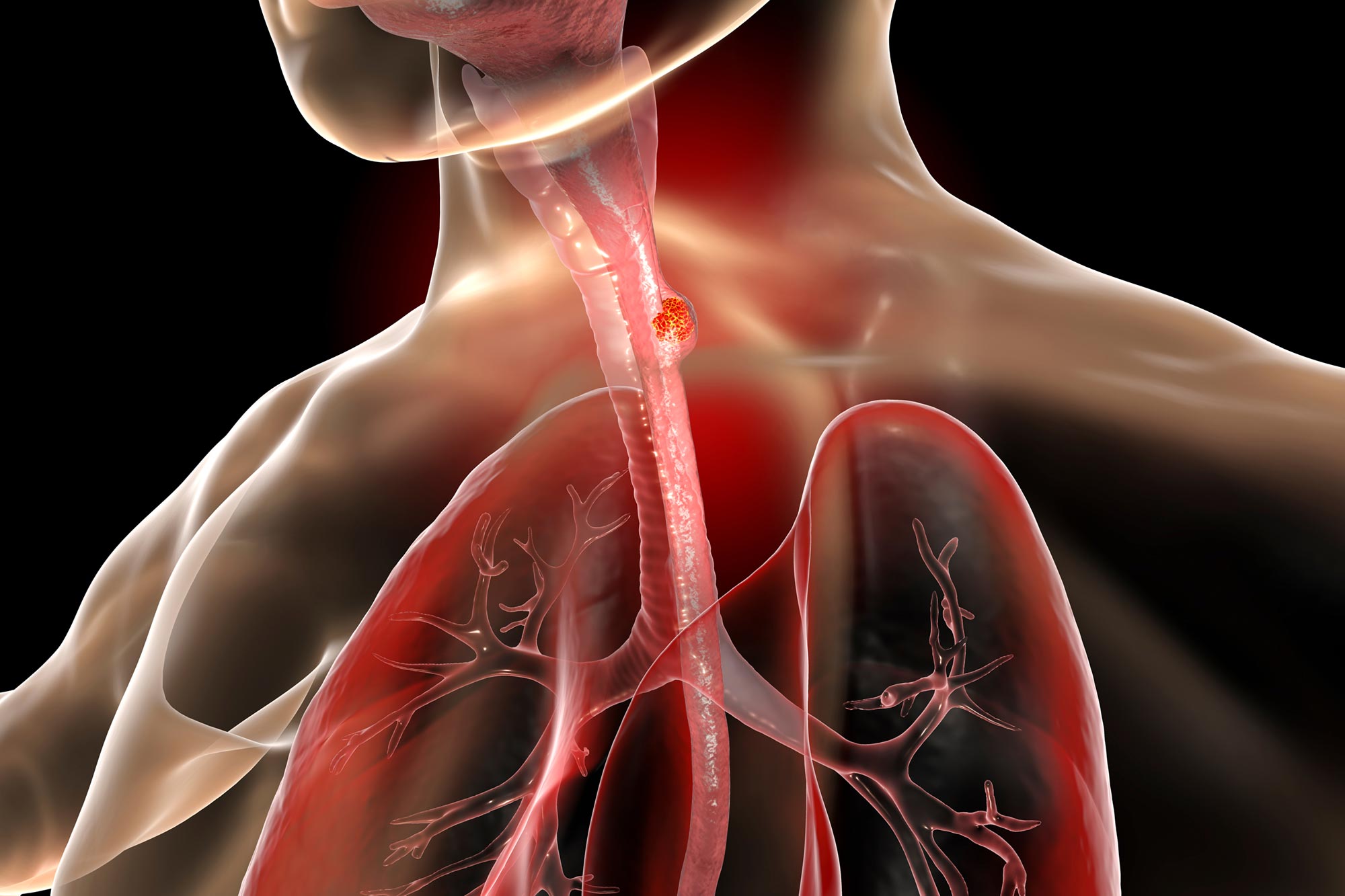
New research provides compelling evidence that Barrett’s esophagus underlies all cases of esophageal adenocarcinoma, even when it is no longer visible.
Scientists have uncovered the clearest evidence yet that Barrett’s esophagus is the origin of all cases of esophageal adenocarcinoma, the most common form of esophageal cancer in developed countries, even when visible signs of this precancerous condition have disappeared.
The study, published in Nature Medicine, could lead to better screening strategies and earlier detection of esophageal cancer, currently the sixth deadliest cancer worldwide, and improve patient outcomes.
Rates of esophageal cancer, including esophageal adenocarcinoma (OAC), are increasing across Western countries. Treatment remains challenging because the disease is often diagnosed at a late stage, when options are limited.
For years, researchers have linked OAC to Barrett’s esophagus, a condition identified during endoscopy as a pink patch on the lining of the esophagus. In the United Kingdom, it affects roughly 1 in every 100 to 200 people.
An estimated 3 to 13 out of every 100 individuals with Barrett’s esophagus will develop OAC during their lifetime. However, about half of patients diagnosed with OAC show no detectable signs of Barrett’s esophagus at the time of diagnosis, which has raised questions about whether it is always the starting point.
Investigating the Link to Barrett’s Esophagus
Professor Rebecca Fitzgerald from the Li Ka Shing Early Cancer Institute at the University of Cambridge said: “Cancer generally takes many years to evolve, giving us a window of opportunity to catch it before if develops into a life-threatening condition. Screening and preventative strategies can have a massive impact on the number of people who die from cancer, but if the link between precancers and cancer is unproven or unclear, screening programs risk doing more harm than good.”
To explore whether Barrett’s esophagus is required for OAC to develop, Fitzgerald and her team analyzed clinical and epidemiological data from 3,100 patients who underwent surgery to remove tumors or diseased tissue. These patients were recruited from 25 centers across the UK.
The researchers also examined whole-genome sequencing data from 710 patients, which captures an individual’s complete DNA profile. In addition, they performed whole-exome sequencing on multiple samples from 87 patients to track how tumors evolved and how genetic differences can exist within the same cancer.
Genomic Evidence Points to a Single Origin
The team proposed that if OAC could develop through multiple pathways, some independent of Barrett’s esophagus, then genetic patterns and risk factors would differ between groups. If not, strong similarities would point to a shared origin.
Just over one third of participants (35%) had a confirmed diagnosis of Barrett’s esophagus. Despite this, the cancers showed nearly identical DNA mutations, genomic features, and cellular ‘identity,’ regardless of whether Barrett’s esophagus was visible during endoscopy or identified in pathology samples.
The main distinction was tumor stage. Patients without visible Barrett’s esophagus tended to have more advanced disease. Researchers also identified biomarkers linked to Barrett’s esophagus, including the proteins TFF3 and REG4, in esophageal cells across all stages of disease, even before cancer formed.
These findings suggest that as tumors grow, they may destroy the original Barrett’s tissue. Importantly, markers such as TFF3 and REG4 could help identify people at higher risk of developing esophageal cancer in the future.
Implications for Detection and Prevention
Dr Shahriar Zamani, joint first author from the Li Ka Shing Early Cancer Institute at Cambridge and now based at the National Institutes of Health in Bethesda, US, said: “We found no evidence for an alternative pathway to esophageal adenocarcinoma other than Barrett’s esophagus. Because it seems to be the universal precursor, detecting Barrett’s esophagus earlier could offer a clearer route to preventing esophageal cancer.”
Dr Lianlian Wu, also a joint first author from the same institute, said: “What we need now are more sensitive, minimally invasive tests that identify people at risk based on molecular markers rather than relying solely on visible changes found during endoscopy.”
Future Directions in Screening
Dr Dani Skirrow, Research Information Manager at Cancer Research UK, said: “Detecting the earliest signs that cancer might develop gives us the opportunity to intervene and potentially prevent the disease.
“This research helps to clarify how the most common type of esophageal cancer begins and, crucially, shows that the earliest signs are detectable even when doctors can’t see them.
“This opens the door to future tests that look for molecular clues of hidden pre-cancerous changes, helping people understand their risk of esophageal cancer and get the necessary support to help keep the disease at bay.”
Professor Fitzgerald serves as Research Lead for Cambridge Cancer Research Hospital, a new facility focused on transforming cancer diagnosis and treatment. She has also led the development of a capsule sponge test for detecting Barrett’s esophagus, which can be administered in a GP setting to speed up diagnosis.
Reference: “Integrated epidemiological and molecular data inform the relationship between precancer and cancer states of esophageal adenocarcinoma” by Shahriar A. Zamani, Lianlian Wu, Emily L. Black, Alexander Bartram, Alvin W. T. Ng, Maria Secrier, Jacqueline D. Perelman, Ahsen Ustaoglu, Emma Ococks, Daniel Jacobson, Ginny Devonshire, Nicola Grehan, Barbara Nützinger, Adam Freeman, Ahmad Miremadi, Maria O’Donovan, Alexander M. Frankell, Sarah Killcoyne, Oesophageal Cancer Clinical and Molecular Stratification (OCCAMS) Consortium, Helen G. Coleman and Rebecca C. Fitzgerald, 16 April 2026, Nature Medicine.
DOI: 10.1038/s41591-026-04331-8
The research was supported by Cancer Research UK and the Medical Research Council, with additional support by the National Institute for Health and Care Research (NIHR) Cambridge Biomedical Research Centre.
Never miss a breakthrough: Join the SciTechDaily newsletter.
Follow us on Google and Google News.
8 Comments
You should consider adding an AI Summary button to your articles. chatGPT reduced this rather long and rambling 965 word article down to 124 words, as follows:
A new study from the University of Cambridge provides strong evidence that Barrett’s esophagus is the universal precursor to esophageal adenocarcinoma, even in cases where no visible signs of the condition remain at diagnosis. By analyzing thousands of patient samples and genomic data, researchers found nearly identical molecular patterns across cancers, suggesting a single origin rather than multiple pathways. They also identified biomarkers such as TFF3 and REG4 that persist even when Barrett’s tissue disappears, offering a potential way to detect risk earlier. Patients without visible Barrett’s esophagus tended to have more advanced disease, implying the precursor tissue may be destroyed as cancer progresses. These findings could improve screening and prevention by enabling minimally invasive tests that detect hidden molecular signs before cancer develops.
Constant hoccupping by my brother was the trigger for to investigations ..
Ignored by dr only when I pushed for investigation as I had heard this was a possible diagnoses by then inoperable and terminal drs should have taken investigations of iknew the should. Should have. !!!!
Every time you read these articles it’s a scare tactic to get you rush and open your wallet. To hell with big pharma.
That’s ridiculous to say.
My brother died from esophageal cancer. Now I have been diagnosed with Barrett’s esophagus. Keep your stupid statements to yourself.
My brother died from esophageal cancer. Now I have been diagnosed with Barrett’s esophagus. Keep your stupid statements to yourself.
Thanks to the researchers for this significant work. It is important to know that the Barrett’s esophagus is the precursor of esophageal adenocarcinoma and that two proteins (TFF3 and REG4) can be used as biomarkers to detect people at high risk of developing this disease or people who have this type of cancer in the early stages.
Hi, I have Barretts and have a scope every 2-3 years however I am interested in how I might be tested for the markers in Australia. My father died from osophageal cancer and keen to understand if I have the proteins. Any feedback would be appreciated.