
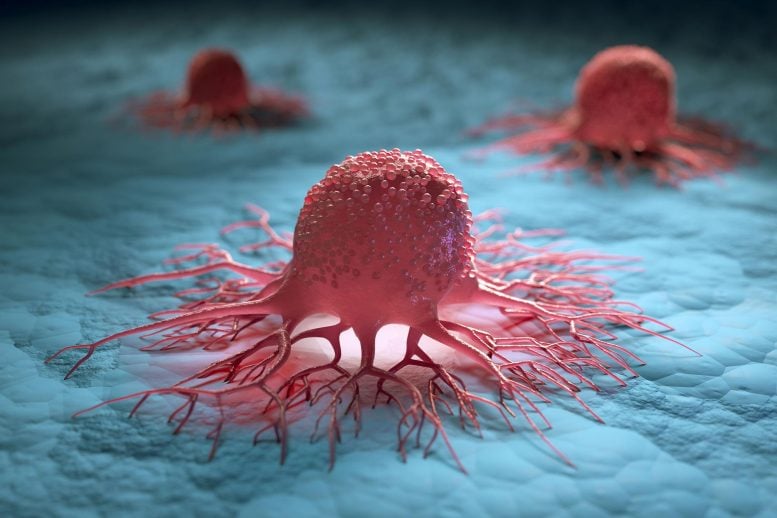
Blocking the CAIX enzyme weakens tumors’ defenses and, when paired with ferroptosis triggers, causes rapid cancer cell death—a potential breakthrough in cancer therapy.
Researchers at the University of British Columbia’s faculty of medicine and BC Cancer Research Institute have uncovered a weakness in a key enzyme that solid tumor cancer cells rely on to adapt and survive when oxygen levels are low.
The findings, published on August 27, 2021, in Science Advances, will help researchers develop new treatment strategies to limit the progression of solid cancer tumors, which represent the majority of tumor types that arise in the body.
Solid tumors rely on blood supply to deliver oxygen and nutrients to help them grow. As the tumors advance, these blood vessels are unable to provide oxygen and nutrients to every part of the tumor, which results in areas of low oxygen. Over time, this low-oxygen environment leads to a buildup of acid inside the tumor cells.
To overcome this stress, the cells adapt by unleashing enzymes that neutralize the acidic conditions of their environment, allowing the cells to not only survive, but ultimately become a more aggressive form of tumor capable of spreading to other organs. One of these enzymes is called Carbonic Anhydrase IX (CAIX).
CAIX: The Achilles Heel of Solid Tumor Cells
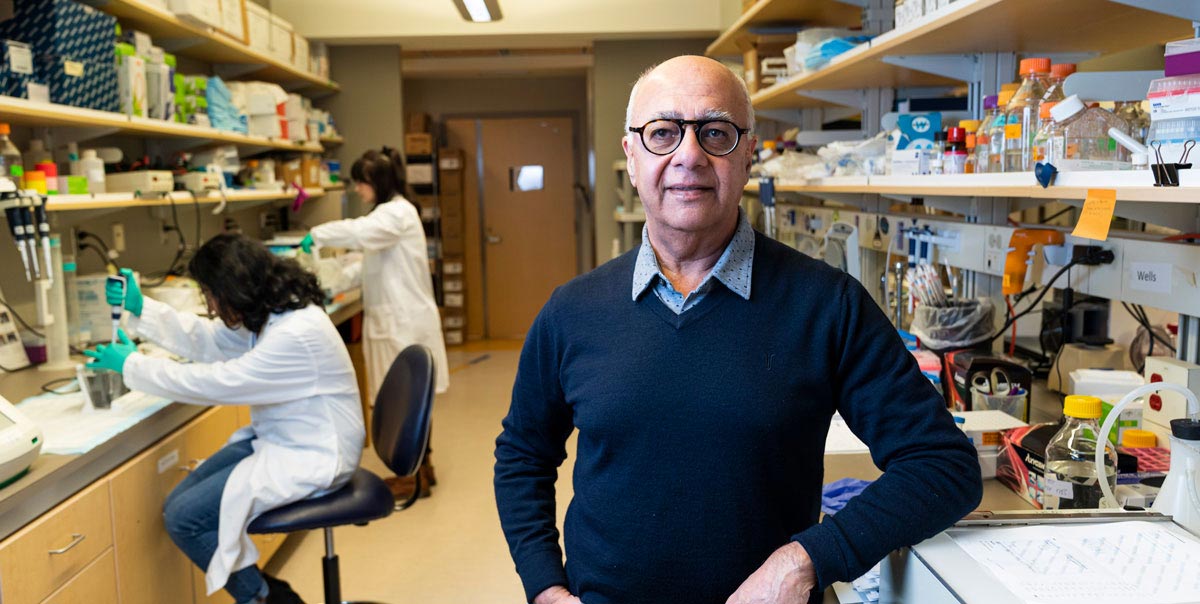
“Cancer cells depend on the CAIX enzyme to survive, which ultimately makes it their ‘Achilles heel.’ By inhibiting its activity, we can effectively stop the cells from growing,” explains the study’s senior author Dr. Shoukat Dedhar, professor in UBC faculty of medicine’s Department of Biochemistry and Molecular Biology and distinguished scientist at BC Cancer.
Dr. Dedhar and colleagues previously identified a unique compound, known as SLC-0111—currently being evaluated in Phase 1 clinical trials—as a powerful inhibitor of the CAIX enzyme. While pre-clinical models of breast, pancreatic, and brain cancers have demonstrated the effectiveness of this compound in suppressing tumor growth and spread, other cellular properties diminish its effectiveness.
In this study, the research team, which included Dr. Shawn Chafe, a research associate in Dr. Dedhar’s lab, together with Dr. Franco Vizeacoumar and colleagues from the University of Saskatchewan, set out to examine these cellular properties and identify other weaknesses of the CAIX enzyme using a powerful tool known as a genome-wide synthetic lethal screen. This tool looks at the genetics of a cancer cell and systematically deletes one gene at a time to determine if a cancer cell can be killed by eliminating the CAIX enzyme together with another specific gene.
According to Dr. Dedhar, the results of their examination were surprising and point to an unexpected role of proteins and processes that control a form of cell death called ferroptosis. This form of cell death happens when iron builds up and weakens the tumor’s metabolism and cell membranes.
Dual Approach to Trigger Catastrophic Tumor Death
“We now know that the CAIX enzyme blocks cancer cells from dying as a result of ferroptosis,” says Dr. Dedhar. “Combining inhibitors of CAIX, including SLC-0111, with compounds known to bring about ferroptosis results in catastrophic cell death and debilitates tumor growth.”
There is currently a large international effort underway to identify drugs that can induce ferroptosis. This study is a major step forward in this quest.
Reference: “Genome-wide synthetic lethal screen unveils novel CAIX-NFS1/xCT axis as a targetable vulnerability in hypoxic solid tumors” by Shawn C. Chafe, Frederick S. Vizeacoumar, Geetha Venkateswaran, Oksana Nemirovsky, Shannon Awrey, Wells S. Brown, Paul C. McDonald, Fabrizio Carta, Andrew Metcalfe, Joanna M. Karasinska, Ling Huang, Senthil K. Muthuswamy, David F. Schaeffer, Daniel J. Renouf, Claudiu T. Supuran, Franco J. Vizeacoumar and Shoukat Dedhar, 27 August 2021, Science Advances.
DOI: 10.1126/sciadv.abj0364
Never miss a breakthrough: Join the SciTechDaily newsletter.
Follow us on Google and Google News.