
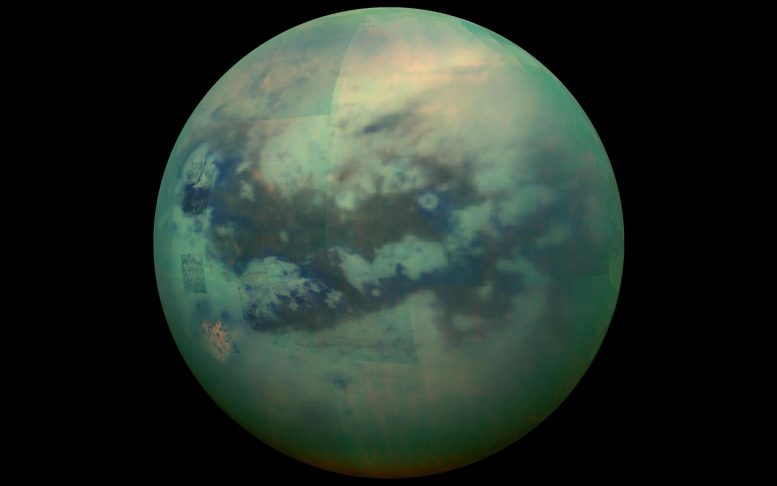
By replicating Titan’s harsh environment in the lab, scientists discovered how organic minerals form and behave on the moon’s surface.
Titan, Saturn’s largest moon, is a natural laboratory to study the origins of life. Like Earth, Titan has a dense atmosphere and seasonal weather cycles, but the chemical and mineralogical makeup are significantly different. Now, earthbound researchers have recreated the moon’s conditions in small glass cylinders, revealing fundamental properties of two organic molecules that are believed to exist as minerals on Titan.
The researchers will present their results today at the fall meeting of the American Chemical Society (ACS). ACS Fall 2021 is a hybrid meeting being held virtually and in-person August 22-26, and on-demand content will be available August 30-September 30. The meeting features more than 7,000 presentations on a wide range of science topics.
“Simple organic molecules that are liquid on Earth are typically solid icy mineral crystals on Titan because of its extremely low temperatures, down to -290 F (-180 C),” says Tomče Runčevski, Ph.D., the project’s principal investigator. “We found that two of the molecules likely to be abundant on Titan — acetonitrile (ACN) and propionitrile (PCN) — occur predominantly in one crystalline form that creates highly polar nano surfaces, which could serve as templates for the self-assembly of other molecules of prebiotic interest.”
ACN and PCN: Building Blocks in Titan’s Alien Chemistry
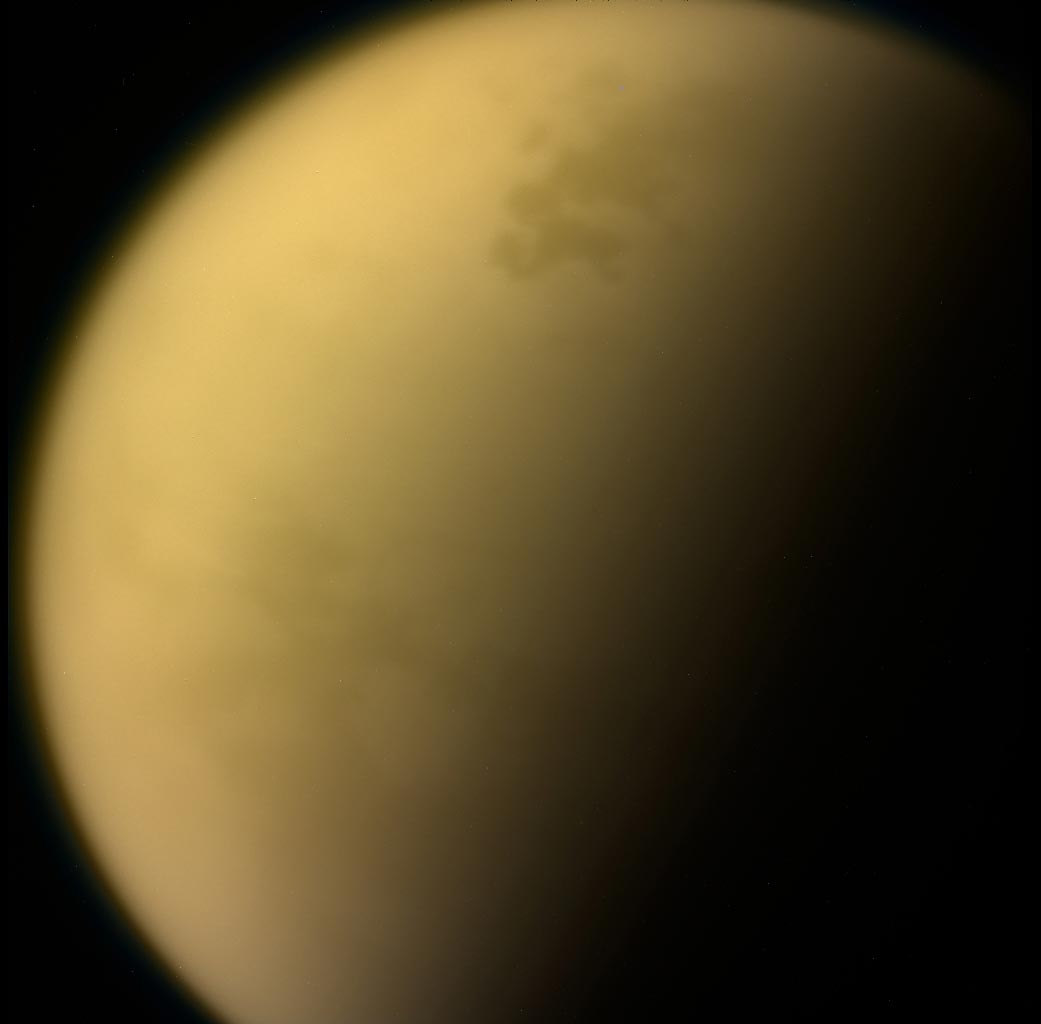
Most of what we know now about this icy world is thanks to the 1997-2017 Cassini-Huygens mission to Saturn and its moons. From that mission, scientists know that Titan is a compelling place to study how life came about. Like Earth, Titan has a dense atmosphere, but it is mostly made up of nitrogen, with a touch of methane. It is the only known body in space, other than Earth, where clear evidence of stable pools of surface liquid has been found. Fueled by the sun’s energy, Saturn’s magnetic field, and cosmic rays, both nitrogen and methane react on Titan to produce organic molecules of various sizes and complexities. ACN and PCN are believed to be present in the moon’s characteristic yellow haze as aerosols, and they rain down on the surface, settling as solid chunks of minerals.
The properties of these molecules on Earth are well known, but their characteristics under Titan-like conditions have not been studied until now. “In the lab, we recreated conditions on Titan in tiny glass cylinders,” Runčevski says. “Typically, we introduce water, which freezes into ice as we lower the temperature to simulate the Titan atmosphere. We top that with ethane, which becomes a liquid, mimicking the hydrocarbon lakes that Cassini-Huygens found.” Nitrogen is added to the cylinder, and ACN and PCN are introduced to simulate the atmospheric rainfall. The researchers then raise and lower the temperatures slightly to imitate the temperature swings on the surface of the moon.
The crystals that formed were analyzed using synchrotron and neutron diffraction instrumentation, spectroscopic experiments and calorimetric measurements. The work, supported by calculations and simulations, involved Runčevski’s team from Southern Methodist University, as well as scientists from Argonne National Laboratory, the National Institute of Standards and Technology, and New York University.
Planetary Ices and Surface Dynamics
“Our research revealed a lot about the structures of planetary ices that was previously unknown,” Runčevski says. “For example, we found that one crystalline form of PCN does not expand uniformly along its three dimensions. Titan goes through temperature swings, and if the thermal expansion of the crystals is not uniform in all directions, it may cause the moon’s surface to crack.” Such detailed knowledge of these minerals could help the team better understand what the surface of Titan is like.
Runčevski is now preparing crystals of ACN, PCN, and ACN and PCN mixtures to obtain detailed spectra. “Scientists will then be able to compare these known spectra to the spectral library collected by Cassini-Huygens and assign unidentified bands,” he says. The studies will help confirm the mineral makeup on Titan and will likely provide insights for researchers working on an upcoming NASA mission to Titan, launching in 2027.
The researchers acknowledge support and funding from the Welch Foundation and NASA.
Never miss a breakthrough: Join the SciTechDaily newsletter.
Follow us on Google and Google News.
1 Comment
If I don’t have access don’t show the article. If I need to send a bottomless lake of money for access at least have the courtesy of telling me.